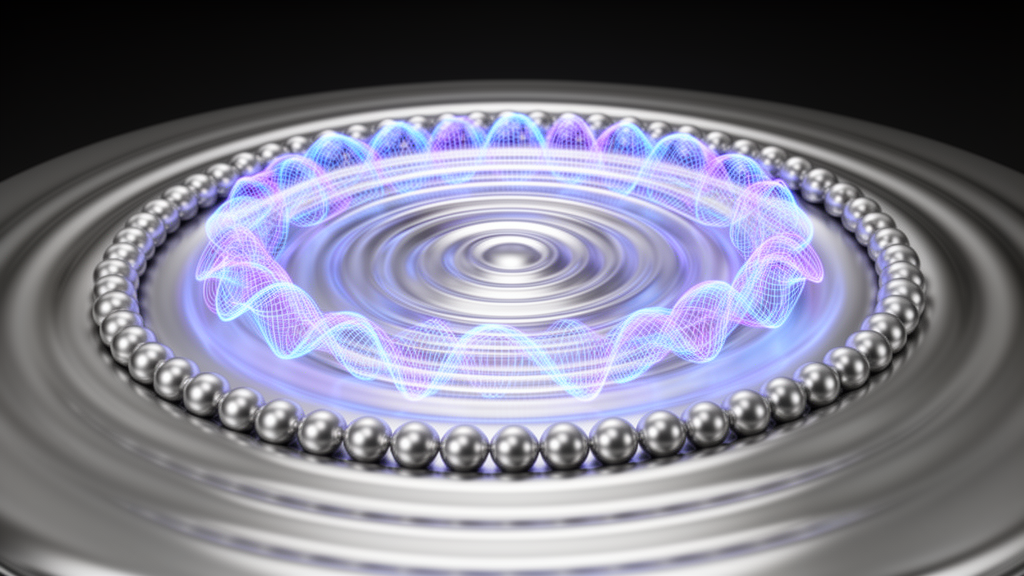
For roughly a century, quantum mechanics has told us that particles such as electrons behave not like tiny balls but like rippling waves, capable of spreading through a material and interfering with themselves. Yet one of the most striking predictions of that wave picture— that a wave can remain trapped in place even when infinitely many escape routes lie open— has never been caught in the act for electrons. A team of researchers at Columbia University now reports the first clear observation of exactly that phenomenon, known as a bound state in the continuum, inside a metal.
Writing in the journal Science, the team describes electron waves locked in place within a two-dimensional metal called Pd5AlI2, held there not by barriers or insulating gaps but purely by the quantum interference of the waves themselves. "Quantum mechanics predicts that an electron wave can, theoretically, remain trapped even when there are infinitely many paths for it to escape. This effect is known from light waves, but it has never been seen before for electrons," said Raquel Queiroz, a theoretical physicist at Columbia who developed the models explaining the team's observations.
The discovery was unexpected, and it opens new possibilities for manipulating quantum states in metals, a class of materials in which electrons are normally the freest movers in nature. To understand why the finding is so surprising, it helps to recall how metals work. Classically, metals conduct electricity because their electrons are free to spread throughout the material, hopping from atom to atom and carrying current along well-defined paths, like ping-pong balls shuttling from point A to point B. Quantum mechanics rewrites that picture entirely.
An electron's motion is described as a wave that, in principle, takes all possible paths at once. The consequence of that wave behavior is interference: waves arriving along different routes can reinforce one another constructively, increasing the chance of making it from point A to point B, or they can cancel one another destructively, suppressing movement altogether. If the destructive interference is strong enough, it can stop an electron wave from leaving point A completely, effectively binding it in place within the larger, continuous sea of conducting waves.
That locked-in configuration is what physicists call a bound state in the continuum, or BIC. Bound states of this kind are not entirely new to quantum physics— but until now they belonged to a different sea. Over the past decade, researchers working with light learned how to etch materials with tiny patterns that trap individual photons, creating optical BICs.
Those engineered light traps have helped advance lasing, sensing, and nonlinear optics. "Trapping a wave is an idea as old as quantum mechanics itself, but it took almost a century to figure out how to do it with light. We have now realized it with electrons in a material," said Xavier Roy, whose chemistry lab at Columbia created the metal at the heart of the new study.
"And if you trap a particle, you can manipulate it." The story of Pd5AlI2 began a few years ago in Roy's lab, where researchers synthesized a new metal with an unusual property: it can be peeled into two-dimensional layers while retaining its metallic character. But the material came with a puzzle.
Its electrons moved more slowly than the team expected— slower than the free-roaming behavior of a classic metal would suggest. That anomaly set the investigation in motion. Working with Queiroz and experimental physicists Cory Dean and Aravind Devarakonda, a former Columbia postdoc who is now an assistant professor of applied physics at Columbia, the researchers traced the sluggish electrons to a phenomenon they describe as frustration.
The way Pd5AlI2's atoms and their orbitals are arranged gives its electrons competing paths to hop from atom to atom. Those competing routes cancel each other out, holding many of the electrons back. The team published its results on this frustrated electron hopping in Nature Physics last year, laying the groundwork for what would come next.
The next step came through a collaboration with Columbia physicist Abhay Pasupathy, whose lab specializes in scanning and spectroscopy instruments capable of imaging materials with atom-scale accuracy. During initial scans of Pd5AlI2, the researchers noticed unexpected patterns in their data. On closer inspection, those patterns turned out to be electron waves bound in place near atomic defects in the material's crystal lattice.
"Bound electrons shouldn't occur in a metal, but they do in Pd5AlI2. What we have observed is the first clear evidence of quantum interference trapping a state in a metal," said Queiroz. The distinction between metals and other electronic materials is central to the significance of the result.
Electrons can be bound in place in insulating and semiconducting materials through several established methods. In semiconductors, these bound states are intimately connected to the process of doping, by which current is made to flow in a controlled manner— the basis of all chips used in computing devices today. In a metal, however, the only way to localize an electron is via a BIC, which can only occur in materials with frustrated crystal lattice structures like Pd5AlI2.
That constraint makes the Columbia observation a genuine first: a trapped electronic state arising inside a material whose electrons are, by every classical account, supposed to roam freely. There is, however, an important difference between the electronic BICs the team observed and the optical ones that preceded them. Optical BICs can be intentionally designed into materials, etched into place by researchers who know precisely where they want a photon trapped.
The electronic analogs in Pd5AlI2 are currently random, arising from defects that happen to form during the growth of the metal in the lab. To gain control over the effect, Roy and Pasupathy are now exploring ways to deliberately introduce defects into specific places in the metal, which would allow them to fine-tune the resulting interference patterns. The potential applications reach deep into quantum technology.
According to the researchers, electronic BICs could one day lead to new kinds of extremely sensitive quantum sensors, improve information transfer and processing in quantum computers, and help advance quantum chemistry. Just as optical BICs enabled new approaches to lasing, sensing, and nonlinear optics once photons could be trapped by design, the ability to trap electrons by interference alone could give engineers a new handle on quantum states in metallic environments, where such control has historically been out of reach. Perhaps the most far-reaching implication is a new recipe for materials discovery.
Because electronic BICs require frustrated lattice structures, there should be other classes of metals with similar architectures capable of hosting them. Now that Queiroz and her colleagues have confirmed that electron waves can be trapped in metals— and identified the quantum mechanical mechanism responsible— they possess a new set of design principles for finding bound states in the continuum in additional materials. A century after quantum mechanics first described particles as waves, the waves have finally been caught and held still, inside a metal that should never have let them stop moving.
Subject of Research: Observation of electronic bound states in the continuum trapped by quantum interference in a two-dimensional metal
Article Title: Quantum interference is key to catching electron waves
Article References: Quantum interference is key to catching electron waves. Original publication (Bibliographic details unavailable.)
Image Credits: AI Generated
DOI: Not provided
Keywords: Quantum, interference, catching, electron, waves, scientific research
News Source: Bethany Barker. (October 25, 2026). Electron waves trapped in a metal for the first time. Scienmag.