Credit: Photo: Thomas Kvalnes, NTNU
Why are house sparrows the exact size they are? Why aren't they hummingbird size or as large as geese?
It sounds like a strange question to ask, but it's actually an overarching question of evolution. It may be able to tell us something about how we adapt to changes in the environment. Our planet is changing and we need to change with it.
Why have we evolved as we have? Evolution theory says that we've adapted to our conditions. So sparrows are probably as big as they should be, according to their living conditions.
But can we prove that? Researchers have run experiments in laboratories, but never in nature. Could it be done?
Fiddled with evolution
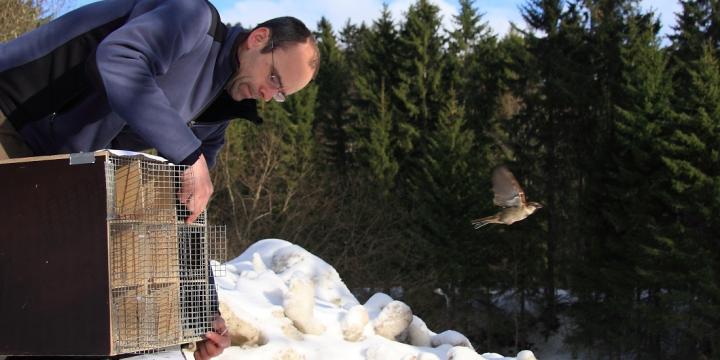
A group of researchers at the Norwegian University of Science and Technology (NTNU) wanted to attempt that experiment. First they would tamper with evolution to see if they could change the size of the sparrows. They would do that by capturing wild birds on islands and rejecting individuals with undesirable characteristics.
After releasing the selected birds back into the wild, the researchers wanted to see if their size would revert back to normal through evolution's natural selection process.
"It's the first time in the world that anyone has conducted artificial selection on birds from a wild population," says Thomas Kvalnes, a postdoctoral fellow at NTNU's Department of Biology.
Three Norwegian islands — Leka in Nord-Trøndelag county and Vega and Hestmannøy in Nordland county — have good house sparrow populations. The islands are far from isolated, but sufficiently measurable and limited in size that they are almost ideal locations to perform this type of experiment.
Researchers have been tracking these populations since 2001, so they have come to know the habitat conditions well.
Size is significant
On Vega, researchers wanted to make the birds smaller and on Leka they wanted to make them bigger. Hestmannøy was left alone as a control group to ensure that no other variables came into play. "In winter, before the breeding season, we caught all of the sparrows on Leka. We borrowed a barn where we closed in all the sparrows," says Kvalnes.
A few did escape, but the researchers caught about 90 per cent of the sparrows.
Then the researchers measured the birds' tarsus – the longest part of the foot on the sparrows – between the toes and the leg. The length of this bone reflects the birds' overall body size. From these measurements, the researchers arrived at an average length.
Blood tests were carried out at the same time, so that researchers could determine the genetic relatives of the birds. The birds were banded.
The researchers carried out the same procedure at Vega and Hestmannøy. About 100 to 300 birds were collected at each place.
Banished from home The largest birds collected on Leka stayed on their island, while the smallest birds collected on Vega were kept on that island. On Hestmannøy, researchers released all the sparrows back onto the island as soon as they had collected the data.
The rest of the birds from Leka and Vega were transported far away on the mainland, to Namsos and Overhalla, far enough so that they couldn't get back to the islands and breed with the remaining birds there. Between 55 and 65 per cent of the birds were removed from their islands.
In this way, the biggest birds on Leka ended up breeding with each other, as did the smallest birds on Vega.
The researchers repeated this process every year from 2002 to 2005.
Bird size changed
As the researchers had thought, the latest generation of birds became larger on average than the previous one. On Vega the birds became smaller, and on Hestmannøy the size remained stable.
"This change was reflected in the genetic breeding value of the birds," says Kvalnes.
Using blood tests, the researchers could see which birds were related to and had bred with which others. They could also discern which individuals were best at passing on their genes.
Sparrows that had flown in from other places and had bred on the three islands could also be detected and adjusted for by the researchers.
Many genes affect body size. We don't know exactly how many, but we do know that gene composition is a factor in the birds' phenotype – that is, the sparrows' observable characteristics.
The researchers had gone in and artificially changed the genetic composition of the bird populations, thus changing their size.
"The changes were much bigger than could be explained by coincidence," says Kvalnes.
The fact that the birds in nearby Hestmannøy did not change indicates that the changes cannot be explained by other conditions, such as temperature variations or altered access to food.
Complete release
But this has been the case for farmers and dog breeders for hundreds of years. They have chosen their animals based on external characteristics and ended up with cows that give more milk and dogs with useless noses and bad hips. Everyone figured these would be the results in this part of the experiment.
The next part of the experiment that was perhaps the most important. What would happen once the researchers stopped tampering with natural selection?
Between 2006 and 2012, the measurements continued, but the sparrows were then released and could breed as they pleased.
Back to original size
This phase also went as researchers predicted.
The average body size on Leka shifted downward toward the original. The size of the Vega birds went up.
Within a brief period of time and only a few generations, everything is returning to the way it was before scientists went in and artificially selected birds for breeding. This was reflected in the breeding value.
That's nice for the researchers. But what can the experiment tell the rest of us?
What does it really say?
Among other things, the experiment reveals that sparrows actually have an ideal size adapted to the conditions they live in. Why they are exactly that big, we don't know, but several things may play in.
"If they grow big enough, it may be easier to keep warm in the winter," says Kvalnes.
Large individuals stay warm more easily than small ones. This is due to the fact that the body surface area is smaller relative to the volume, so less heat escapes. Perhaps that's exactly what's needed to survive the winter?
But at the same time, it's no benefit to be too big, either. Maybe you then become a more vulnerable catch for birds of prey? So far these are mostly speculations. We don't actually know for sure.
What we do know is that the bird populations changed very quickly. This can tell us something about how adaptable the sparrows are.
Theory of evolution works
Climate changes, altered access to food and other conditions can change the selection pressure. This changes the basic assumptions along with which individuals have an advantage when it comes to breeding and passing on their genes to the next generation.
House sparrows are very adaptable. This probably applies to many other species as well – perhaps a reassuring thing on a planet that is undergoing so much change.
But the overall message is this: The researchers tested the theory of evolution, predicted the results and things went as expected.
The sparrows tell us that the theory of evolution actually works outside the laboratory as well.
Not bad for an experiment that set out to answer an apparently weird question.
###
Reference: Reversal of response to artificial selection on body size in a wild passerine. Thomas Kvalnes, Thor Harald Ringsby, Henrik Jensen, Ingerid Julie Hagen, Bernt Rønning, Henrik Pärn, Håkon Holand, Steinar Engen, Bernt-Erik Sæther. First published: 20 June 2017. DOI: 10.1111/evo.13277 http://onlinelibrary.wiley.com/doi/10.1111/evo.13277/full
Media Contact
Thomas Kvalnes
[email protected]
47-735-96058
@NTNU
http://www.ntnu.edu
Related Journal Article
http://dx.doi.org/10.1111/evo.13277