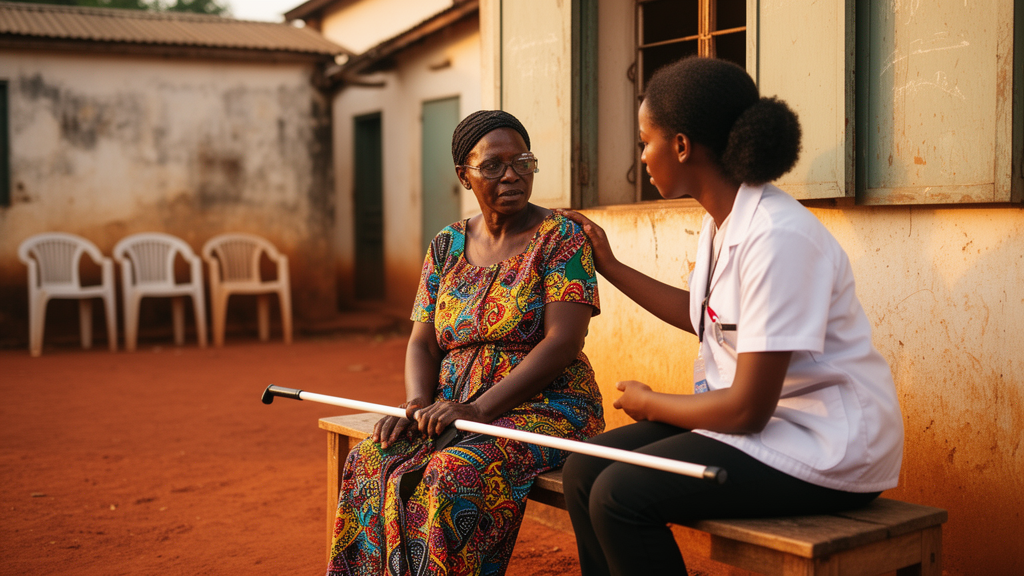
Roughly 90 percent of people with unaddressed vision impairment or blindness live in low- and middle-income countries, and Ghana is among them. A new descriptive qualitative study published in BMC Public Health by Deborah Annan and colleagues explores how vision rehabilitation and related supports actually work for people with visual impairment in Ghana, drawing on the perspectives of those who live with the condition and the professionals who serve them. Rather than measuring service coverage or clinical outcomes, the research documents how participants perceive and navigate the education, assistive devices, eye care services, and government programs that are intended to promote independence and social inclusion.
The team conducted semi-structured interviews with ten participants purposively sampled across three stakeholder groups: four people with visual impairment, three rehabilitation practitioners and educators, and three optometrists. People with visual impairment were recruited through study invitations circulated by the Ghana Blind Union and through participant referrals, optometrists through the first author’s professional network, and rehabilitation practitioners and educators through snowball sampling. Interviews took place via Zoom between November 2024 and March 2025, followed a guide adapted from prior research, were transcribed verbatim, and were analyzed thematically using MAXQDA software.
From the inductive analysis, seven themes emerged: resources as a pathway to independence, living with fragmented support, knowledge barriers in accessing support, compromised safety, the financial and structural burden of visual disability, stigma and social exclusion, and a call for reform. Participants described vocational training, peer networks, inclusive education, and free assistive devices as beneficial supports. At the same time, they reported barriers including inconsistent service provision, environmental inaccessibility, poor public awareness, and perceived gaps in the implementation of disability policies.
The theme of resources as a pathway to independence suggests that when supports are available and reachable, participants see them as enabling greater autonomy, with vocational training and peer networks highlighted as particularly valuable. The counterweight is fragmentation: participants perceived that services were inconsistent, so whether a person benefited could depend on where they lived, which organizations they encountered, and how much they happened to know about what existed. Knowledge barriers compounded the problem, since low public awareness meant that both people with visual impairment and the wider community were often unfamiliar with the supports that were nominally available.
Safety, finances, and stigma formed a further cluster of perceived challenges. Participants described compromised safety in daily navigation of inaccessible environments, alongside the financial and structural burden that visual disability can impose on individuals and families. Stigma and social exclusion were reported as shaping how people with visual impairment are treated and how included they feel in community life. These perceptions align with the study’s broader conclusion that a gap separates the resources designed to support people with visual impairment from the barriers that may limit their access to them.
The authors frame their findings as pointing toward possible reform rather than as prescriptions. When considered alongside previous research, they suggest that closing the gap may involve the Government of Ghana prioritising the integration of vision rehabilitation into the eye care system, increasing public awareness, expanding support systems, and reinforcing the implementation of disability policies. Crucially, they emphasize that such steps should be taken in close collaboration with people with visual impairment and the professionals who support them, so that the well-being of this population guides the design of the systems meant to serve it.
As with any descriptive qualitative study, the findings reflect the perspectives of a small, purposively sampled group rather than a statistically representative survey of Ghana’s visually impaired population, and the reported themes are participants’ perceptions rather than measured service outcomes. Even so, the study adds documented detail to an area the authors note is seldom researched: how people with visual impairment in a low- and middle-income country navigate rehabilitation, education, assistive devices, and government-supported programs in real life. By capturing the viewpoints of people with lived experience, optometrists, and rehabilitation practitioners and educators in a single analysis, the research offers a grounded picture of where supports are perceived to work and where they are perceived to fall short, providing evidence that may inform future efforts to strengthen vision rehabilitation in Ghana.
Subject of Research: Vision rehabilitation and support structures for people with visual impairment in Ghana
Article Title: Perspectives of those with lived and professional experience on vision rehabilitation and related supports in Ghana: a descriptive qualitative study
Article References: Annan, D., Kaboré, S. S., Puri, P. R., & Nemargut, J. P. (2026). Perspectives of those with lived and professional experience on vision rehabilitation and related supports in Ghana: a descriptive qualitative study. BMC Public Health. https://doi.org/10.1186/s12889-026-29924-3
Image Credits: AI Generated
DOI: 10.1186/s12889-026-29924-3
Keywords: Perspectives, those, lived, professional, experience, vision, rehabilitation, related, supports, Ghana, descriptive, qualitative
News Source: Ophelia Keating. (October 24, 2026). Voices from Ghana reveal gaps between vision rehabilitation resources and access barriers. Scienmag.