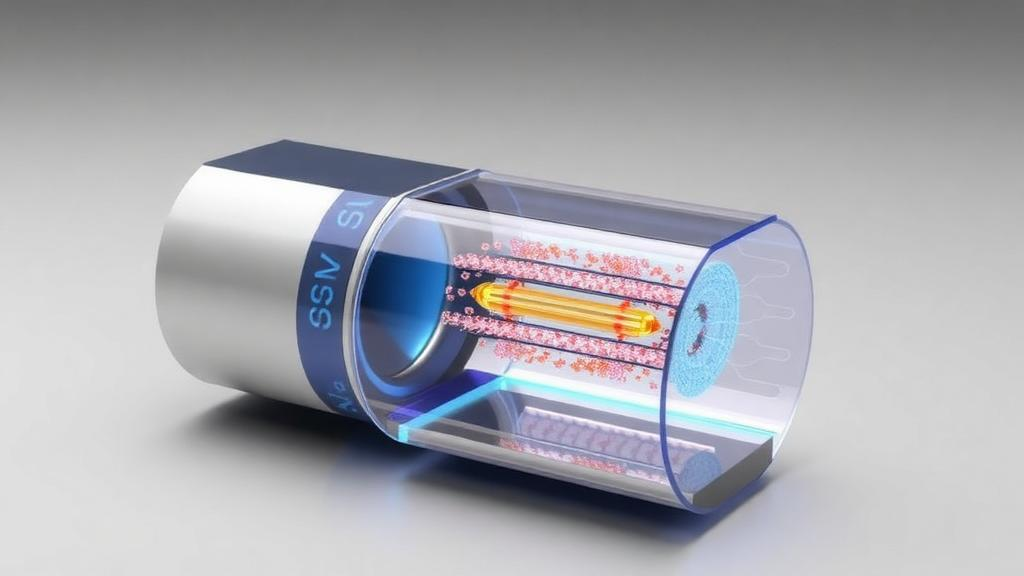
A solid-state fuel cell that converts carbon dioxide into carbon monoxide while generating electricity has been reported by Yijian Lv, Xuanyu Lin and Xin Tang, whose study appears in the Journal of Materials Science. Under optimized conditions, the cell reached a maximum power density of 126.6 watts per square meter and a peak carbon monoxide yield of 859.2 micromoles per gram of catalyst per hour, figures the authors describe as significantly improved and competitive relative to previously reported CO2/H2 fuel cells.
The device is a CO2-air/H2 solid oxide fuel cell. At the cathode, carbon dioxide is co-fed with a controlled amount of air, while hydrogen serves as the fuel at the anode. The cathode catalyst, designated CuNi-SDC, consists of copper oxide and nickel oxide incorporated into Sm0.5Ce1.5O3.75, a samarium-doped ceria composition. In this arrangement, the cathode drives the reduction of CO2 to carbon monoxide, a high-value C1 product, as the cell delivers power.
A central result of the study is that the introduction of air was found to be critical to the cell’s performance. The authors report that, compared with previously reported CO2/H2 fuel cells, their system achieves a significantly improved CO yield and a competitive power density, which they attribute to the CO2-air/H2 configuration and the CuNi-SDC catalyst.
The work sits within the broader field of energy materials, where rising atmospheric CO2 concentrations have created an urgent need for efficient carbon capture and utilization technologies. Solid oxide fuel cells are considered a promising platform for simultaneous power generation and CO2 conversion because of their high energy efficiency, fuel flexibility and all-solid-state structure, according to the authors.
Existing CO2/H2 fuel cells, however, often suffer from low product yield, moderate power output and reliance on high operating temperatures, limitations the authors identify as motivation for their design. The reported cell addresses the yield and power output dimensions of that problem within the conditions tested, achieving its maximum power density and peak CO yield under optimized operating conditions.
The performance envelope of the reported system is defined by two headline measurements. The maximum power density of 126.6 watts per square meter characterizes the electrical output, while the peak CO yield of 859.2 micromoles per gram of catalyst per hour characterizes the conversion performance. Both were obtained under optimized conditions in the reported configuration, and the authors state that these results compare favorably with previously reported CO2/H2 fuel cells in CO yield while remaining competitive on power density.
The authors frame their findings as a demonstration of the potential of the CuNi-SDC catalyst and the CO2-air/H2 fuel cell configuration for efficient CO2 reduction to a high-value C1 product. In their view, the approach offers a viable pathway for integrating carbon utilization with clean power generation in a single solid-state device.
As with any single study, the reported results describe one cell design evaluated under the conditions chosen by the authors, and the full experimental detail sits behind subscription access. The published abstract documents the catalyst composition, the co-feed design and the two performance measurements; further characterization of durability, operating temperature and scale-up potential would require the complete article. Within that scope, the study reports a CO2-air/H2 solid oxide fuel cell built around a CuNi-SDC cathode catalyst that converts CO2 to carbon monoxide with a peak yield of 859.2 micromoles per gram of catalyst per hour and a maximum power density of 126.6 watts per square meter under optimized conditions.
Subject of Research: CuNi-SDC catalyst for CO2 reduction in CO2-air/H2 solid oxide fuel cells
Article Title: CuNi-SDC catalyst for CO2 reduction in CO2-air/H2 solid oxide fuel cells
Article References: Lv, Y., Lin, X., & Tang, X. (2026). CuNi-SDC catalyst for CO2 reduction in CO2-air/H2 solid oxide fuel cells. Journal of Materials Science. https://doi.org/10.1007/s10853-026-13983-3
Image Credits: AI Generated
DOI: 10.1007/s10853-026-13983-3
Keywords: solid oxide fuel cell, CO2 reduction, CuNi-SDC, carbon monoxide, energy materials, catalysis, carbon capture and utilization, Journal of Materials Science, catalyst, reduction, CO2-air, solid
News Source: Bethany Barker. (October 24, 2026). CuNi-SDC Catalyst Boosts CO2 Reduction in CO2-Air/H2 Fuel Cell. Scienmag.