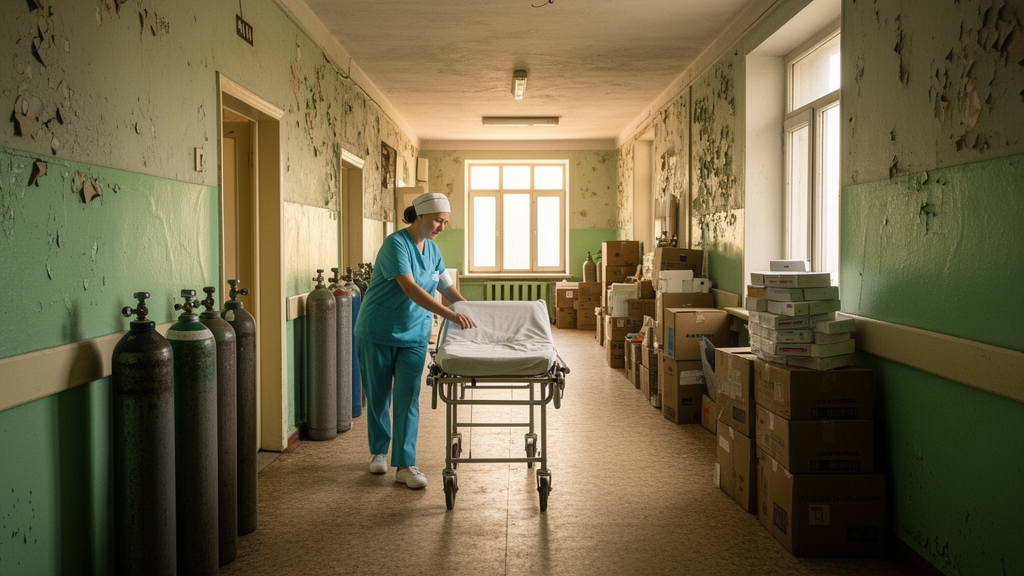
When the World Health Organization declared the novel coronavirus outbreak a Public Health Emergency of International Concern on January 30, 2020, few regions felt the shock as sharply as the post-Soviet countries. A new editorial published in Frontiers in Public Health, presenting the second volume of a research collection on public health challenges in post-Soviet countries during and beyond COVID-19, argues that the pandemic was the first crisis of such magnitude faced by the region’s health ministries since the fall of the Soviet Union in 1991. The assessment, compiled by researchers based in Kazakhstan and Lithuania, paints a picture of health systems caught between two eras: institutions shaped by a centralized Soviet model that were undergoing reforms of varying depth, yet carrying emergency response structures that had not been meaningfully updated since Soviet times.
The editorial frames this legacy as a decisive factor in pandemic performance. Unlike many developing countries whose public health systems were simply under-resourced, the post-Soviet states inherited systems built on the Semashko model that were undergoing reforms to varying degrees. Decades of reform transformed these systems unevenly, and the public health emergency response apparatus lagged behind. The authors point to the lack of progress in incorporating up-to-date methodologies of disease surveillance and laboratory testing as a particularly visible weakness. As a result, COVID-19 functioned as a system shock that exposed how unprepared the emergency response capacities were. The editorial notes that these countries were not ready, a shortfall shared with many developed nations, but raises an open question: whether the ministries of health have absorbed the lessons and strengthened their capacity for the next pandemic remains unclear.
The immediate impacts were severe. The pandemic left many people unable to access needed health services, drove households toward catastrophic healthcare expenditures, and caused premature deaths. Hospitals faced shortages of facilities and medical professionals, a gap made more pronounced by earlier reductions in hospital beds. During peak periods, essential supplies ran short, including medicines, diagnostic tests, and personal protective equipment. These resource constraints placed intense pressure on hospitals, staff, and supply chains at the very moment demand surged.
One of the most striking structural stories comes from Kazakhstan, where researchers examined the shift toward private healthcare. The country’s healthcare system was based on the Soviet-era system, and the private healthcare sector was almost non-existent, but in the decade preceding the pandemic the country’s healthcare landscape shifted toward a growing number of private facilities. When patient numbers surged, the government had to mobilize both public and private providers simultaneously. Private hospitals, which had not originally been adapted to manage large-scale infectious disease outbreaks, responded by setting up dedicated COVID-19 units. That mobilization came at a cost: many private facilities experienced considerable business disruption as routine patient flows dropped and financial constraints mounted, illustrating how emergency reliance on mixed public-private capacity can strain the very institutions it depends on.
The pandemic also intensified a pre-existing and often overlooked problem: violence against healthcare workers. The editorial reports that up to 38 percent of healthcare professionals experience some form of workplace violence, a figure that predates the pandemic. COVID-19 brought higher workloads and burnout, and alongside them a heightened threat of violence from patients and their family members. The authors argue that the pandemic eroded the societal respect traditionally accorded to healthcare workers in the region. Evidence from Moldova included in the collection shows that almost half of the violence directed at healthcare workers involved primarily verbal threats, and that concerns about workplace violence increased during the pandemic. For health systems already short of staff, an environment in which clinicians face abuse on top of exhaustion adds a further burden on the workforce.
The collection also connects the infectious disease crisis to the region’s chronic disease burden. Cardiovascular disease and type 2 diabetes have traditionally affected older populations, but their prevalence among younger people is rising. Forecasting work by Moiynbayeva and colleagues projects a rise in cardiovascular disease and stroke prevalence across Kazakhstan, Kyrgyzstan, Uzbekistan, Tajikistan, and Turkmenistan. The editorial flags this as especially concerning because patients with chronic diseases faced a higher risk of severe complications and death from COVID-19, meaning the pandemic’s damage was concentrated among populations whose chronic conditions were already expanding. The intersection of chronic and infectious disease emerges as a central theme of the collection.
Demographic effects varied across the region. The editorial reports that, according to work by Karibayeva and colleagues, Kazakhstan saw no long-term effect of the pandemic on birth rates, which the authors suggest may indicate a limited effect of the pandemic on daily life. They caution, however, that long-term studies of birth rates and reproductive health are still needed, since some research suggests COVID-19 infection might have lasting effects on the reproductive system, including hormonal disturbances that can affect the regularity of the menstrual cycle, ovulatory function, and the receptivity of the endometrium. The finding is presented as a signal that warrants follow-up rather than a settled conclusion about the pandemic’s demographic legacy.
Inequalities in access to care ran through much of the evidence. The editorial cites data from the United States, reported by the Centers for Disease Control and Prevention, showing that segregated ethnic groups experienced higher rates of infection, hospitalization, and death than other populations, and European studies that found people living in segregated, low-income neighborhoods suffered disproportionately higher COVID-19 infection rates. Within the post-Soviet region itself, older adults emerged as a particularly vulnerable group, with those aged 65 and over at higher risk of severe complications and death and therefore requiring improved access to services for both acute and chronic conditions. A survey of 1,503 Lithuanians aged 65 and over by Kalibatas and colleagues found that fear of COVID-19 infection was the primary reason for not using healthcare services for one in six respondents. The authors read these findings as further support for the conclusion that the pandemic limited access to routine healthcare and widened inequalities in who could reach it.
Behavior change among older adults extended beyond missed appointments. In Lithuania, researchers documented a decrease in physical activity and face-to-face communication, alongside an increase in remote communication, among older adults during and after the pandemic. The analysis by Sauliune and colleagues found that these outcomes were shaped by education, income, age, place of residence, and health status, implying that a differential approach, tailored to these social characteristics, is needed to mitigate negative outcomes. Hygiene research pointed in a more instructive direction for children: a study from the Karaganda region of Kazakhstan by Bolatova and colleagues found that the majority of schoolchildren showed appropriate hand hygiene practices, yet only one-fourth of students washed their hands after contact with a sick friend. The authors conclude that interventions to reduce infectious disease spread in schools should combine education with behavioral reinforcement, including habit formation techniques and peer modeling.
Behind these individual findings sits a larger measurement problem. The editorial notes that undiagnosed infection was a significant challenge during the pandemic, with the potential undercount of overall cases estimated at 55 to 60 percent relative to official statistics. It also observes that the effort to manage COVID-19 may have decreased health systems’ ability to surveil and report other infectious diseases, a subtle but consequential form of collateral damage. Although the WHO declared the end of the pandemic in 2023, the authors stress that research attention has focused overwhelmingly on the virus itself, with far less devoted to lessons learned or to the state of readiness for another worldwide outbreak. They also acknowledge the limits of the evidence base: the collected studies were predominantly cross-sectional in design, and data on long-term public health impacts, the persistent effects of the pandemic, or comparisons of health systems before and after it are lacking. The editorial’s closing argument is that the pandemic’s lessons point toward comprehensive health policies that strengthen national systems on the foundations of public health and universal health coverage, managing and preventing chronic and infectious diseases together while maintaining emphasis on population health behavior, especially among vulnerable groups, and that countries should determine and expand national pandemic preparedness plans to prevent and respond to newly emerging infectious diseases.
Subject of Research: Public health system challenges and pandemic preparedness in post-Soviet countries during and beyond COVID-19
Article Title: Editorial: Public health challenges in post-Soviet countries during and beyond COVID-19, volume II
Article References: Sarria-Santamera, A., Liseckiene, I., Glushkova, N., & Semenova, Y. (2026). Editorial: Public health challenges in post-Soviet countries during and beyond COVID-19, volume II. Frontiers in Public Health, 14, Article 1975308. https://doi.org/10.3389/fpubh.2026.1975308
Image Credits: AI Generated
DOI: 10.3389/fpubh.2026.1975308
Keywords: post-Soviet countries, COVID-19, pandemic preparedness, health systems, Semashko model, universal health coverage, health inequalities, workplace violence, Kazakhstan, Lithuania, chronic disease, public health policy
News Source: Kristina Jarvis. (October 24, 2026). Post-Soviet Health Systems Faced a Pandemic Stress Test They Were Never Ready For. Scienmag.