A bacterium isolated from the crew quarters of the International Space Station can break down dopamine, the neurotransmitter that governs motivation, memory, and reward, and the ammonium it produces as a catabolite measurably changes how a model organism navigates its environment. The study, published in Frontiers in Microbiology, was led by researchers at Yenepoya Research Centre in Mangalore, India, working with collaborators at NASA’s Jet Propulsion Laboratory and institutions in Ireland, Canada, and Saudi Arabia. Their analysis of Leifsonia virtsii, an actinomycete recovered from the space station in 2018, provides direct experimental evidence that a dopamine-metabolizing phenotype exists in an ISS-associated microbe, and it traces the genetic signature of such microbes across seven years of station metagenomic data. Rather than simply cataloguing which organisms persist aboard the station, the work asks what those organisms are biochemically capable of doing, with results spanning microbial ecology, neurochemistry, and the long-term biology of spaceflight.
Dopamine is a catecholamine neurotransmitter, belonging to the same family as norepinephrine and epinephrine, and its deficiency is linked to cognitive impairment and neurodegenerative disease. Prior studies of microbial interactions with host dopamine pathways have been largely confined to terrestrial gut and clinical microbiomes. Enterococcus faecalis can metabolize levodopa, a dopamine precursor, reducing the bioavailability of the drug in the gut and potentially affecting Parkinson’s disease treatment outcomes. Bacteroides uniformis and Prevotella copri have been shown to modulate dopamine transport activity in host systems. Catecholamines including dopamine are also known to stimulate growth, iron acquisition, virulence, and biofilm formation in pathogens such as Salmonella enterica, Pseudomonas aeruginosa, and Escherichia coli. What remained unexplored was whether microbes equipped with the ability to actually degrade dopamine occur aboard the ISS, and what their catabolites might do to eukaryotic systems.
The two Leifsonia species at the center of the study, L. virtsii F6_8S_P_1AT and L. williamsii F6_8S_P_1BT, were isolated from the station’s crew quarters in 2018 and described as distinct species through polyphasic taxonomy. Preliminary genome mining revealed a crucial asymmetry: L. virtsii carries a gene encoding monoamine oxidase, or MAO, the enzyme that catalyzes the first step of dopamine catabolism, while its co-isolate L. williamsii, sharing the same niche, does not. MAO converts dopamine into 3,4-dihydroxyphenylacetaldehyde, ammonia, and hydrogen peroxide, and it can likewise transform 3-methoxytyramine into homovanillin with the same nitrogenous byproducts. Ammonia is a membrane-permeable gas and a potent neurotoxin, whereas ammonium, the ionic species formed when ammonia reacts spontaneously with water, exerts fundamentally different biological effects. L. virtsii harbored a complete set of genes encoding MAO, catechol-O-methyltransferase, and aldehyde dehydrogenase dedicated to dopamine degradation.
Comparative genomics showed that this metabolic equipment is heterogeneously distributed across the genus. The researchers screened the genomes of 13 validly established, genome-sequenced Leifsonia species and found MAO in 61.5 percent of them, including L. virtsii but not L. williamsii or L. xyli ssp. cynodontis, while the aldehyde dehydrogenase and methyltransferase genes were absolute in occurrence. MAO was also present in 62.5 percent of reclassified Leifsonia species now placed in seven distinct genera within the phylum Actinomycetota. A maximum likelihood phylogeny built from 60 MAO amino acid sequences placed the L. virtsii enzyme in a distinct lineage within a clade containing type strains of L. soli, L. lichenia, and L. poae, isolated from teak rhizosphere soil, lichen, and annual meadow grass respectively. The genetic relatedness between the ISS isolate and Earth-bound species suggested that the dopamine pathway is not a space-station-specific adaptation but rather an ancestral phenotype retrieved from terrestrial habitats.
To trace MAO-bearing taxa through time aboard the station, the team screened 355 ISS shotgun metagenomes from NASA’s Microbial Tracking missions, spanning 2015 to 2022, for homologs of the 667-amino-acid MAO protein encoded by the L. virtsii lineage. Raw MAO-like hits appeared in 323 of 355 metagenomes, indicating that distant homologs are common, but after applying stringent read identity and coverage thresholds, 85 metagenomes retained evidence of MAO homologs related to the query. The proportion of MAO-positive runs rose significantly across missions: 4.8 percent in MT1, 12.5 percent in MT2, and 30.1 percent in MT3, with pairwise Fisher’s exact tests confirming that the MT3 frequency significantly exceeded both earlier missions. Kraken2 profiling of extracted MAO-hit reads showed the signal was taxonomically structured, predominantly associated with Actinomycetota, with Micrococcus and Leifsonia together accounting for 47.6 percent of classified candidate-only runs. The authors interpret this temporal enrichment as evidence for the succession and persistence of MAO-bearing actinomycetes aboard the ISS.
Only two metagenomes met the strictest criteria for a strong L. virtsii-like MAO signal, and both proved to be matched non-PMA and PMA-treated libraries from the Node 2 Port crew quarters exterior aft wall sampled on 6 February 2018, the same location and sampling context as the original isolate. Their combined reads reached 100 percent amino acid identity to the MAO query, with one library showing 97.45 percent candidate coverage and 90.25 percent close-hit coverage of the protein, and read recruitment placed the strong-positive reads at the expected MAO-containing genomic locus. This metagenomic evidence authenticated the strain’s ISS origin. The MAO-targeted screen also identified genetic signatures of Microbacterium associated with later missions, a genus whose ISS isolates have previously been characterized with unique antimicrobial-resistant and virulent phenotypes, underscoring that actinomycetes aboard the station warrant detailed investigation.
In laboratory assays, dopamine input clearly stimulated L. virtsii. Grown in citrate buffer at pH 5.6, chosen because the ammonia-ammonium equilibrium at that pH favors ammonium by more than 99.99 percent, the bacterium showed increased growth, higher viable cell counts, and significantly enhanced biofilm formation when dopamine was supplemented, while L. williamsii grew slowly with no significant difference between dopamine-treated and untreated cultures. UV-visible spectrophotometry confirmed the biochemical distinction: the primary dopamine absorption peak at 280 nanometers declined in L. virtsii cultures, indicating degradation, whereas in L. williamsii the primary peak fell while the secondary peak rose, suggesting transformation rather than breakdown. Colorimetric assays showed that L. virtsii in dopamine-supplemented medium exhibited significantly increased alamar blue reduction, media alkalization, and extracellular ammonium-nitrogen, consistent with active dopamine metabolism, while L. williamsii showed alkalization and ammonium formation without a corresponding increase in metabolic activity, pointing to an alternative pathway.
Gene expression analysis revealed a striking regulatory dynamic. Quantitative reverse transcription PCR showed that MAO expression was activated rapidly within four hours of dopamine exposure but declined significantly within 20 hours, reaching complete inhibition by 48 hours of incubation, even as ammonium accumulated in an exponential trajectory. To distinguish dopamine-specific regulation from general growth-phase effects, the team tracked MAO alongside gyrB, representing DNA replication and transcription, tuf, representing translation, and cslA, representing biofilm formation, using the RNA polymerase sigma factor gene rpoD as a reference. Under dopamine input, gyrB showed an increasing trend peaking at 48 hours, and tuf and cslA were significantly upregulated at 48 hours, explaining the enhanced growth, metabolism, and biofilm formation observed earlier. The rapid activation of MAO followed by its eventual decline suggests a combination of growth-phase-dependent transcriptional control and negative feedback by accumulating ammonium, though the authors note that recombinant enzyme kinetics studies are needed to establish the enzyme’s specific activity.
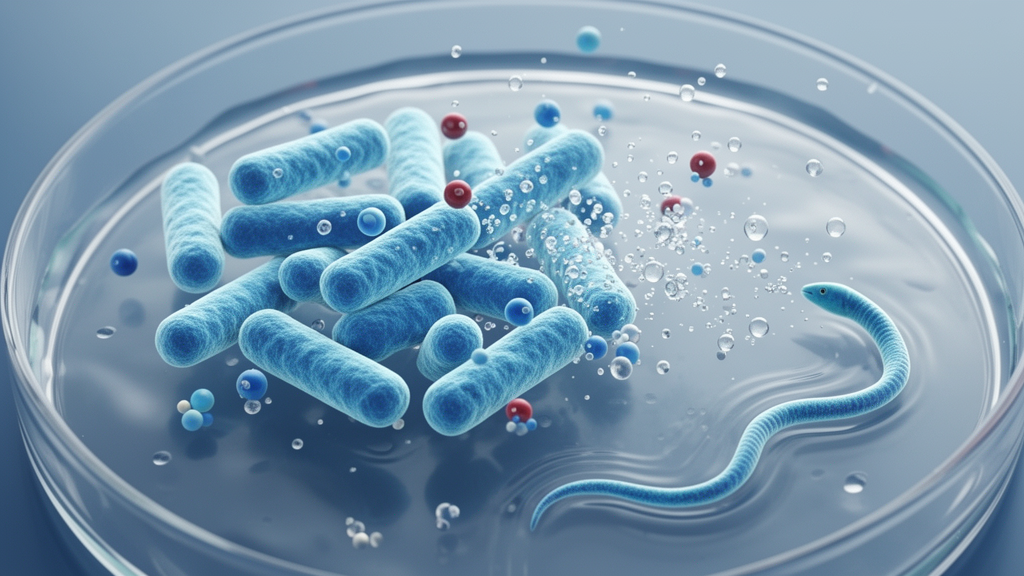
The in vivo experiments extended the findings to a eukaryotic model. On nematode growth medium buffered at pH 6.3, starved Caenorhabditis elegans showed significant positive chemotaxis toward E. coli OP50, their standard food, and preconditioning assays revealed associative learning: worms pretreated with the culture supernatant of L. virtsii grown in dopamine-supplemented medium subsequently migrated significantly toward that supernatant, treating the bacterial metabolites as a food cue. When ammonium itself was tested at 0 to 50 micromolar doses, which raised medium pH by 0 to 0.18 units, worms showed positive chemotaxis toward 2.5 to 25 micromolar ammonium against both buffer and supernatant counter-cues, but responses were low at 50 and 0 micromolar, suggesting a sensory threshold. The authors caution that osmolarity-matched controls may be needed to exclude confounding osmotic effects at higher doses, and that whether the observed dopamine metabolism is MAO-specific or reflects broader amine oxidase activity remains to be explored. The study demonstrates that a dopamine catabolite can modulate chemosensory interactions in a eukaryotic model, and it highlights the spatiotemporal flexibility of dopamine-metabolizing capacity among actinomycetes, from soil and lichen on Earth to the confined environment of humanity’s orbital outpost.
Subject of Research: Dopamine metabolism by the ISS bacterium Leifsonia virtsii and behavioral effects of its ammonium catabolite on Caenorhabditis elegans
Article Title: Temporal enrichment of bacterial monoamine oxidase gene aboard the international space station and neuromodulator impacts of dopamine-driven ammonium formed by space isolate Leifsonia virtsii on Caenorhabditis elegans
Article References: Mayuri, N., Dhanyashree, H. R., Shastry, R. P., Venkateswaran, K., Miliotis, G., Singh, N. K., Stothard, P., Arun, A. B., & Hameed, A. (2026). Temporal enrichment of bacterial monoamine oxidase gene aboard the international space station and neuromodulator impacts of dopamine-driven ammonium formed by space isolate Leifsonia virtsii on Caenorhabditis elegans. Frontiers in Microbiology, 17, Article 1943403. https://doi.org/10.3389/fmicb.2026.1943403
Image Credits: AI Generated
DOI: 10.3389/fmicb.2026.1943403
Keywords: microbiology, International Space Station, dopamine, monoamine oxidase, actinomycetes, Caenorhabditis elegans, metagenomics, spaceflight, Temporal, enrichment, bacterial, monoamine
News Source: Morgan Morrow. (October 24, 2026). ISS Bacterium Degrades Dopamine, and Its Ammonium Byproduct Alters Worm Chemotaxis. Scienmag.