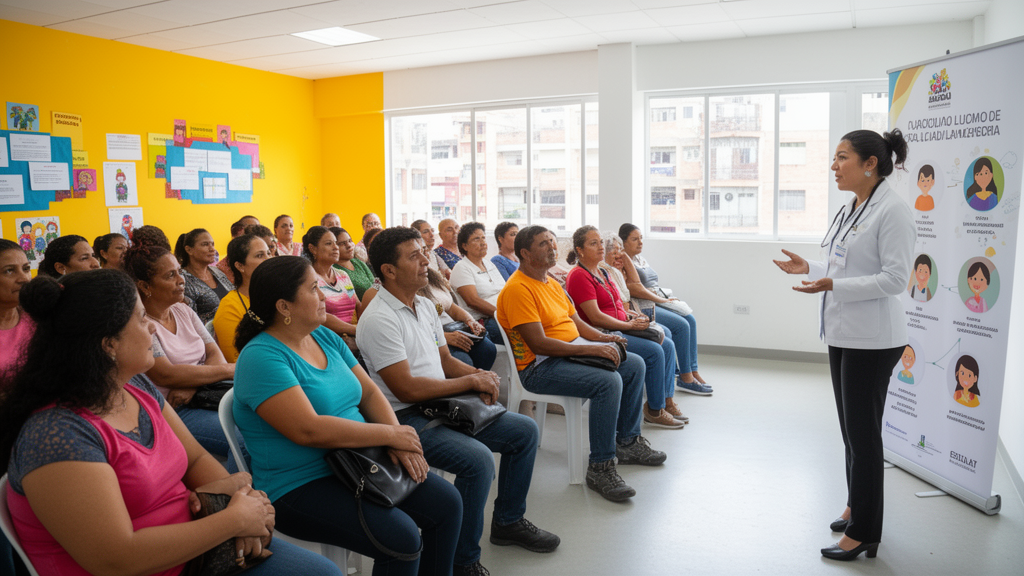
Vaccine hesitancy remains one of public health’s most stubborn challenges, and a team of Colombian researchers has now reported results from a large-scale attempt to address it. Writing in BMC Public Health, the authors describe VACtívate, a psychoeducational intervention delivered as a 12-hour in-person course in 20 cities across Colombia, designed to strengthen informed decision-making about vaccination rather than simply promote uptake.
The programme drew on findings from the earlier AderVax project and targeted the people who shape vaccine conversations in their communities: health personnel, community leaders, health authorities and social communicators. In total, 716 participants took part. The choice of audience reflects a core premise of the intervention, namely that vaccination decisions are made within social networks, and that trusted local figures can either amplify confidence or feed doubt.
VACtívate was structured into four modules. The first covered vaccine education. The second examined decision-making in vaccination. The third focused on the role of influential agents, the communicators and leaders whose messages travel furthest within communities. The fourth integrated public health proposals, encouraging participants to connect what they had learned to their local context.
To assess the course, the researchers administered questionnaires before and after the intervention and collected open-ended responses on participants’ perceptions. Quantitative data were analysed in SPSS, while the qualitative material was examined in ATLAS.ti, allowing the team to pair statistical comparisons with a richer picture of how participants reasoned about vaccination.
The pre–post comparison showed a significant increase in global learning scores. A Wilcoxon signed-rank test yielded W = 2,099, Z = −6.31 and p < 0.001, with an effect size of r_rb = 0.60, indicating a substantial shift in measured learning between the two assessments. The Wilcoxon test is a non-parametric method suited to paired data such as repeated measures on the same individuals, making it appropriate for before-and-after course evaluations.
Beyond the numbers, participants’ open-ended answers revealed how they understood their own vaccination choices. They identified personal, family, emotional, work-related and social factors as determinants of the decision to be vaccinated, underscoring that hesitancy is rarely a purely intellectual position. Participants also highlighted the relevance of community leadership, intersectoral work and the co-creation of strategies to counter disinformation and strengthen confidence in vaccines.
The authors are careful about what these results can and cannot show. Because the study relied on pre- and post-intervention assessments without a control condition, the observed increase in knowledge scores cannot be attributed solely to the intervention; other experiences between the two measurements could have contributed. This limitation is common in community-based educational research, where randomisation and blinding are often impractical, and it means the findings should be read as promising rather than definitive evidence of causal impact.
Even with that caveat, the team argues that the results highlight the relevance of culturally appropriate public health proposals adapted to territorial needs and developed with the participation of diverse social and institutional actors. In a country as regionally varied as Colombia, a single top-down message is unlikely to resonate everywhere, and VACtívate’s city-by-city delivery model was built around that insight. As vaccine confidence continues to be tested by disinformation, interventions that equip local leaders with both knowledge and communication tools may prove an increasingly important line of defence, and this 716-person, 20-city experience offers a template worth watching as further evaluations accumulate.
Subject of Research: A psychoeducational vaccination decision-making course evaluated across 20 cities in Colombia
Article Title: VACtívate: a proposal targeting conscious decision-making regarding vaccination in 20 cities in Colombia
Article References: Valderrama-Orbegozo, L. J., Ramíerz-Lasprilla, L. J., Arce-Leonel, D. E., Tesfamariam-Ortega, M. R., Herrán-Murillo, Y. F., & Victoria-Mojica, S. (2026). VACtívate: a proposal targeting conscious decision-making regarding vaccination in 20 cities in Colombia. BMC Public Health. https://doi.org/10.1186/s12889-026-29506-3
Image Credits: AI Generated
DOI: 10.1186/s12889-026-29506-3
Keywords: vaccination, vaccine hesitancy, Colombia, public health, health education, psychoeducational intervention, community health, informed decision-making, disinformation, BMC Public Health, VACt, vate
News Source: Phoebe Ingram. (October 24, 2026). VACtívate course boosts vaccination knowledge across 20 Colombian cities. Scienmag.