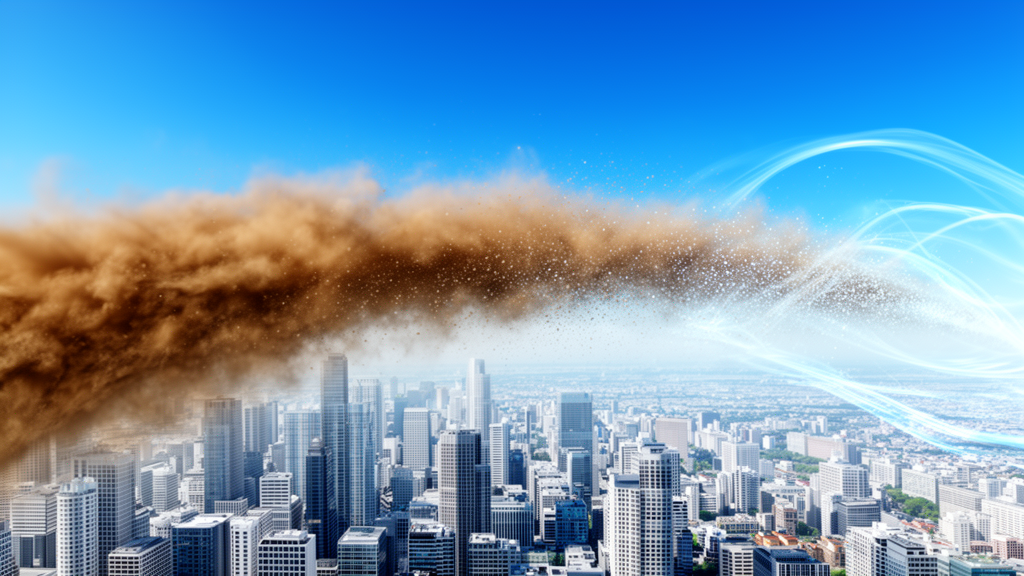
Brown carbon is the atmosphere’s stealth absorber. Unlike its famous dark cousin black carbon, it does not look black at all; it is the tannish, tea-colored fraction of organic aerosol particles that soaks up sunlight most strongly in the near-ultraviolet and blue end of the spectrum, then fades to near-transparency at longer visible wavelengths. That wavelength-dependent absorption makes it one of the largest remaining uncertainties in global climate models, and a new 16-year study of China now offers the first long-term accounting of how this pollutant has actually changed in a region where human activity, not wildfire, dominates its emissions.
The research, published in Atmospheric Chemistry and Physics by Guochao Chen of Fudan University and colleagues, used a two-way coupled Weather Research and Forecasting and Community Multiscale Air Quality modeling system, WRF-CMAQ, to simulate primary brown carbon, or PBrC, across China every year from 2005 to 2020. Unlike conventional model setups that drive chemistry with archived meteorology, the coupled framework feeds aerosol optical properties back into the WRF shortwave radiation scheme, so the particles’ absorption of sunlight genuinely alters the energy reaching the surface. The team tracked PBrC with a tracer-tagging method, scaling its mass by a factor of 10^-5 so the tagged species could follow source-specific dynamics without disturbing other aerosol processes, then restoring its optical magnitude by scaling the imaginary part of its complex refractive index by 10^5. Absorption calculations relied on a core-shell internal mixing treatment, with black carbon as the core and other components, including PBrC, forming the shell, solved through Mie theory.
The headline number is a national mean surface PBrC concentration of 0.81 micrograms of carbon per cubic meter over the study period. What makes China unusual is where that brown carbon comes from. Globally, biomass burning is recognized as the dominant PBrC source, and natural sources account for roughly 57 percent of global PBrC emissions. In East Asia, natural sources contribute only about 4 percent. The simulation shows that residential combustion, the small-scale, non-industrial stationary burning of coal and biomass in homes, contributed 57 percent of multi-year mean surface PBrC, followed by industrial combustion at 22 percent and agriculture at 18 percent. Together, anthropogenic sectors supplied 97.7 percent of surface PBrC and 91 percent of column concentrations in 2010. Wildfires, the star of most brown carbon studies worldwide, contributed a mere 0.8 percent of surface concentrations in China.
The temporal story is just as striking. Between 2005 and 2020, national mean surface PBrC fell from 0.83 to 0.66 micrograms of carbon per cubic meter, a decline of 20.8 percent. Over the same window, PM2.5 declined by only 8.1 percent. The divergence reflects different source mixes. Before 2013, PM2.5 rose because industrial expansion outweighed residential reductions, while PBrC stayed stable because industry contributes less to it. After the Air Pollution Prevention and Control Action Plan of 2013 to 2017 and the Three-Year Action Plan for Winning the Blue Sky Defense Battle of 2018 to 2020 took effect, both pollutants dropped sharply, but PBrC fell faster because its dominant source, inefficient residential burning, was targeted directly through coal-to-gas and coal-to-electricity conversions for household heating and bans on open crop-residue burning. Residential PBrC concentrations dropped from 0.56 micrograms of carbon per cubic meter in 2005 to 2007 to 0.35 in 2017 to 2020.
One sector moved against the trend. Agricultural PBrC, generated by inefficient biomass combustion and spatially localized with peaks in spring and autumn, saw its share of the national total rise from 13.8 percent in 2005 to 2007 to 23.3 percent in 2017 to 2020. Its absolute concentrations remain low, but as other anthropogenic sources declined steeply, agriculture became an increasingly prominent slice of China’s remaining brown carbon burden. The highest PBrC levels nationwide appeared over the North China Plain and the Yangtze River Delta, with residential heating demand driving pronounced winter maxima over the North China Plain, where the residential sector’s low combustion efficiency also produces higher PBrC to organic carbon ratios than the more efficient industrial facilities that burn large amounts of coal yet suppress PBrC formation.
Vertically, the picture inverts. Because anthropogenic emissions are confined mostly to near-surface layers, PBrC accumulates in the lower troposphere. Wildfire plumes, by contrast, can reach higher altitudes and ride southwesterly winds in the free troposphere. Although wildfires contributed little to surface concentrations, their influence becomes dominant at altitudes of 2 to 3 kilometers, and in regions affected by wildfire plumes from the Indochinese Peninsula, such as the Pearl River Delta, wildfire contributions to column PBrC can reach up to 71 percent.
Brown carbon does not just warm the planet; it also tinkers with atmospheric photochemistry. By absorbing ultraviolet light, PBrC suppresses the photolysis rate of nitrogen dioxide, J(NO2), which feeds into ozone formation. China’s surface ozone has actually increased despite falling emissions, with maximum daily 8-hour average ozone rising from 40.0 to 42.6 parts per billion, a 6.57 percent increase, driven by nonlinear precursor responses, particularly over the densely populated North China Plain. Against that backdrop, PBrC exerts a modest braking effect: it reduces annual mean J(NO2) by roughly 2 percent and lowers maximum daily 8-hour average ozone by 1 to 2 percent in eastern and central China. The suppression is stronger in winter, when PBrC concentrations peak, and weakened over time as PBrC declined. During 2013 to 2016, a mean J(NO2) reduction of 1.9 percent coincided with a mean ozone decrease of 1.0 percent over the North China Plain.
The climate effect, quantified as the direct radiative effect at the top of the atmosphere, declined in step with concentrations. China’s mean PBrC direct radiative effect fell from +0.032 ± 0.006 watts per square meter in 2005 to +0.023 ± 0.008 watts per square meter in 2020, a reduction of 25.7 percent, corresponding to a trend of −0.004 watts per square meter per decade. Anthropogenic sources accounted for 84.2 percent of the total, though their relative share slipped from 90.9 percent in 2005 to 87.8 percent in 2020. The relationship between concentrations and radiative effect is not strictly linear, hinting at complex interactions within the climate system. Seasonally, anthropogenic emissions dominate, but in spring the strongest signals appear over southern China near Indochina, where intense wildfires burn; lensing effects, in which co-emitted black carbon’s absorption is amplified inside mixed particles, further boost the wildfire contribution.
The team stress-tested their assumptions. Incorporating hydroxyl-radical-induced bleaching, the aging process that gradually strips brown carbon of its chromophores, produced only minor changes: nationwide PBrC concentrations fell by about 3.9 percent and ozone by less than 0.1 percent in 2010, consistent with earlier findings that OH aging matters little in East Asia’s anthropogenically dominated, wildfire-sparse environment. Sensitivity experiments varying the imaginary refractive index by a factor of five, based on reported source-dependent differences, shifted the 2010 direct radiative effect across a range from +0.012 to +0.085 watts per square meter around a baseline of +0.029. The authors also note their baseline absorption prescription likely underestimates the true effect: an alternative parameterization raised simulated March radiative effect in southern China from roughly 0.24 to about 0.62 watts per square meter, approaching the approximately 0.89 watts per square meter reported in previous work. Secondary brown carbon, formed by oxidation of volatile organic compounds and aqueous-phase reactions, was excluded, though prior research suggests it may contribute radiative effect equivalent to roughly 15 percent of PBrC’s in China.
Model evaluation supports the framework: simulated PM2.5 met US Environmental Protection Agency performance criteria for bias and error from 2015 to 2020, modeled organic carbon correlated with observations at R = 0.61, adding PBrC improved agreement with AERONET absorption aerosol optical depth at 440 nanometers, and simulated PBrC absorption matched field Aethalometer measurements at R = 0.54. The broader implication is a rare piece of good climate news: emission controls designed to clear the air also dimmed a light-absorbing, climate-warming aerosol, delivering environment and climate co-benefits simultaneously. With global brown carbon contributing an estimated 10 to 40 percent of total absorption by carbonaceous aerosols and a direct radiative effect ranging from +0.03 to +0.57 watts per square meter worldwide, the authors argue that climate governance across East, South, and Southeast Asia should target anthropogenic emissions alongside wildfire management, especially as rising wildfire activity increasingly offsets declining anthropogenic brown carbon.
Subject of Research: Atmospheric chemistry and climate effects of primary brown carbon aerosol in China
Article Title: Long-term evolution and effects of primary brown carbon aerosol in China
Article References: Chen, G., Wang, Y., Ying, Q., Wang, X., & Zhang, H. (2026). Long-term evolution and effects of primary brown carbon aerosol in China. Atmospheric Chemistry and Physics, 26(20), 14867-14880. https://doi.org/10.5194/acp-26-14867-2026
Image Credits: AI Generated
DOI: 10.5194/acp-26-14867-2026
Keywords: brown carbon, aerosols, air quality, climate, China, radiative forcing, ozone, emission controls, Long-term, evolution, effects, primary
News Source: Russell Cooper. (October 24, 2026). China’s clean air drive quietly dimmed a hidden climate-warming aerosol. Scienmag.