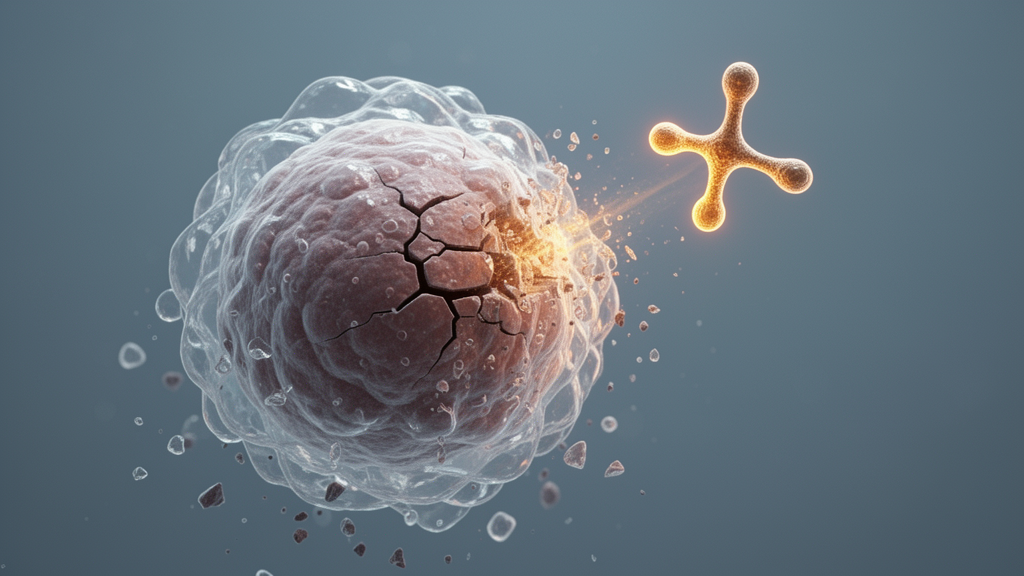
Researchers mining the porcine gut virome have identified Lys33795, a bacteriophage-derived protein that attacks Streptococcus suis with two distinct activities in a single gene product: it lyses bacterial cells by degrading peptidoglycan and simultaneously breaks down the capsule that shields the pathogen from immune and chemical attack. According to the study, no protein combining both lytic and capsule-degrading functions had previously been described for this encapsulated zoonotic pathogen, which is notorious for forming recalcitrant biofilms.
Structurally, Lys33795 consists of an N-terminal GH25 muramidase domain and a C-terminal cell wall binding domain (CBD). The authors found that translational reinitiation at an internal start codon, methionine 217, generates an additional CBD fragment that may assemble with the full-length protein into an oligomeric complex. This unusual translation behavior adds a layer of molecular complexity to how the protein is organized in the bacterial target.
The most striking mechanistic finding concerns the GH25 muramidase domain itself. In truncation experiments, this fragment not only retained its classical role as a peptidoglycan hydrolase that degrades the bacterial cell wall but also showed degradation activity against the S. suis capsule. The researchers note that this discovery contrasts sharply with the traditional functional understanding of the GH25 family, which has not previously been associated with capsule breakdown.
The CBD, meanwhile, behaves as what the authors call a nonstandard depolymerase. It forms a stable dimer and, despite lacking any classical polysaccharide-degrading catalytic domains, retains its degradation activity against the S. suis capsule. By combining mutagenesis with lysis and capsule degradation assays, the team elucidated the molecular mechanism underlying the protein’s dual activity.
Functional testing supported the antibiofilm promise of the dual design. In both in vitro and in vivo experiments, Lys33795 effectively prevented and cleared S. suis biofilms. The full-length protein outperformed single-activity mutants, indicating that the combined lytic and capsule-degrading functions contribute more than either activity alone. When used in combination with antibiotics, Lys33795 showed an enhanced effect, suggesting a potential role as a complement to conventional therapy rather than a standalone replacement.
The study is presented as the first description of a multimeric bacteriophage protein with dual lysis and capsule degradation activities against S. suis, all encoded by a single gene. The authors argue that these findings provide valuable insights for designing potent antibacterial proteins aimed at encapsulated pathogens, a class of bacteria whose protective sugar coats have long limited the effectiveness of enzyme-based antimicrobials. As with all preclinical work, the in vivo results reported here form the basis for further evaluation before any therapeutic application.
Subject of Research: Dual-activity bacteriophage protein Lys33795 disrupting Streptococcus suis biofilms through lysis and capsule degradation
Article Title: Dual activities of lysis and capsule degradation enable the bacteriophage protein Lys33795 to effectively disrupt Streptococcus suis biofilms
Article References: Ji, Y., Zhang, M., Song, L., Ning, H., Wang, L., Qiu, C., & Gu, J. (2026). Dual activities of lysis and capsule degradation enable the bacteriophage protein Lys33795 to effectively disrupt Streptococcus suis biofilms. PLOS Pathogens, 22(10), e1014741. https://doi.org/10.1371/journal.ppat.1014741
Image Credits: AI Generated
DOI: 10.1371/journal.ppat.1014741
Keywords: Streptococcus suis, bacteriophage, endolysin, depolymerase, biofilm, GH25 muramidase, capsule degradation, antibacterial proteins, Dual, activities, lysis, capsule
News Source: Drew Townsend. (October 23, 2026). Phage Protein Lys33795 Combines Cell-Wall Lysis and Capsule Degradation Against Streptococcus suis Biofilms. Scienmag.