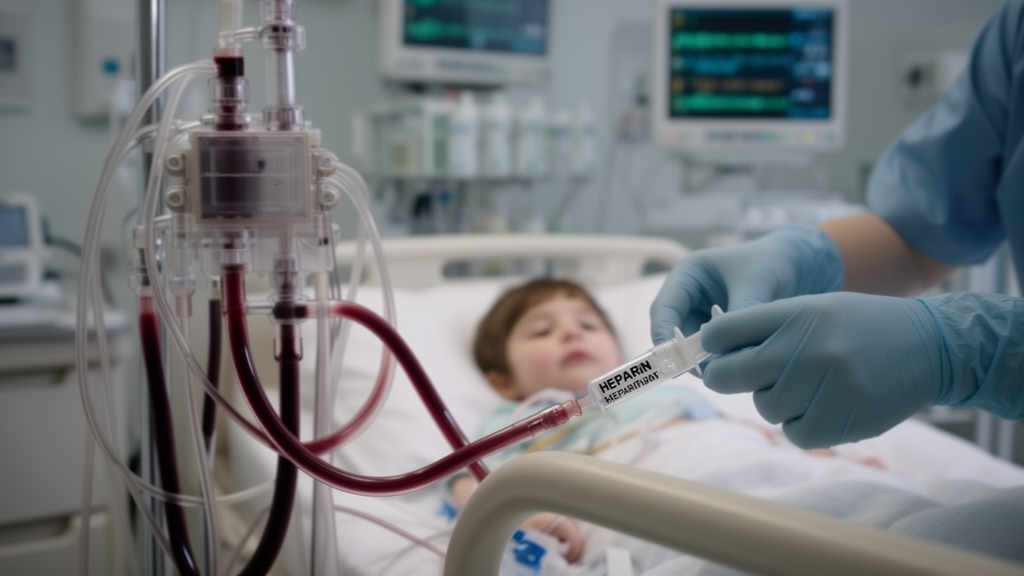
A ten-year-old girl in China with a hereditary clotting disorder survived a massive pulmonary embolism after clinicians placed her on extracorporeal membrane oxygenation (ECMO) and managed her with an unusually conservative, low-dose heparin protocol, according to a case report published in Frontiers in Pediatrics. The child, who had protein S deficiency and a prior history of cerebral venous sinus thrombosis complicated by intracerebral hemorrhage, was weaned from ECMO after 98 hours of support, extubated on day 10 of admission, and discharged in stable condition after 34 days in hospital. At follow-up, her medical team reported no thrombus recurrence and a full return to normal life and school activities.
The case, described by Chen Geng and Miao Zhang of the Department of Intensive Care Medicine at Qilu Hospital (Qingdao), Cheeloo College of Medicine, Shandong University, is presented as the first reported pediatric case combining protein S deficiency, prior intracerebral hemorrhage, massive pulmonary embolism, systemic thrombolysis, and venoarterial ECMO support managed with an individualized anticoagulation and nursing protocol. The authors emphasize that as a single case report, the findings cannot be generalized to all pediatric ECMO patients with thrombophilia, but they argue the experience offers a practical framework for similar rare presentations.
The rarity of this scenario is difficult to overstate. Pediatric venous thromboembolism occurs in only 0.2 to 0.6 percent of children, and pulmonary embolism accounts for roughly 15 percent of those cases. Hereditary thrombophilia also varies by ancestry: abnormalities of coagulation factors are more prevalent in Western populations, whereas deficiencies of anticoagulant proteins, including protein C and protein S, predominate in Chinese populations. Cases of acute massive pulmonary embolism requiring ECMO-supported intervention in children with thrombophilia are exceptionally rare, with few reports in the literature and no standardized nursing protocols available.
The clinical story began with a one-day history of sudden swelling and pain in the girl’s left leg. Ultrasound revealed thrombosis involving the bilateral iliac veins, the left common femoral vein, and the orifice of the left great saphenous vein. Eleven months earlier, she had been diagnosed at another hospital with cerebral venous sinus thrombosis complicated by cerebral infarction and intracerebral hemorrhage. Laboratory testing at that time showed protein S at 55.2 percent against a reference range of 60 to 130 percent, alongside elevated lupus anticoagulant, antithrombin III of 68.5 percent, and protein C of 116.9 percent. Genetic testing for F5 and F2 gene variants associated with venous thrombosis risk was negative, and a diagnosis of protein S deficiency-associated thrombophilia was established. She had been prescribed rivaroxaban 10 mg once daily but discontinued the medication voluntarily in March 2024.
On day 4 of admission, the girl developed sudden chest pain, severe dyspnea, and rapidly deteriorating hemodynamics: her heart rate rose to 142 beats per minute, blood pressure fell to 85/50 mmHg, and oxygen saturation dropped to 82 percent on room air. Given her known deep vein thrombosis and thrombophilia, the team suspected acute massive pulmonary embolism. She was intubated and placed on mechanical ventilation, received intravenous alteplase thrombolysis, and was transferred to the pediatric intensive care unit. There, her oxygenation index was 41.0 on 100 percent inspired oxygen. Echocardiography showed right ventricular enlargement, reduced right ventricular systolic function, and pulmonary hypertension, while a chest x-ray revealed bilateral patchy opacities and an enlarged cardiac silhouette consistent with acute pulmonary edema and right heart strain. Inhaled nitric oxide was given to reduce pulmonary artery pressure, and venoarterial ECMO was established emergently that afternoon.
Seven hours after the systemic alteplase dose, still under ECMO support, the patient underwent pulmonary artery thrombus fragmentation, thrombolysis, and aspiration in the interventional suite. Angiography showed occlusion of the main right pulmonary artery and partial embolism of the left lower pulmonary artery. Because systemic thrombolysis alone had not achieved sufficient recanalization, the team combined mechanical thrombus fragmentation and aspiration with local low-dose thrombolysis to improve clot removal while limiting the total thrombolytic dose and reducing systemic bleeding risk. Residual organized thrombus prompted placement of a multi-side-hole catheter for continuous local alteplase infusion at 0.5 mg/kg/h for 12 hours. The next day, her left ventricular ejection fraction fell to 35 percent with wall-motion abnormalities, reflecting secondary left ventricular dysfunction from severe hypoperfusion and myocardial stunning, so an intra-aortic balloon pump was added. After 24 hours of that support and optimized drug therapy, ejection fraction recovered to 65 percent and the balloon pump was removed.
The central therapeutic dilemma, the authors write, was the contradiction between the girl’s hypercoagulable state and her extreme bleeding risk. Protein S is a vitamin K-dependent anticoagulant protein that acts as a cofactor for activated protein C in degrading factors Va and VIIIa; its deficiency produces a prothrombotic tendency and predisposes patients to recurrent venous thromboembolism. Meanwhile, the recent alteplase had induced systemic fibrinolysis and coagulopathy, and her prior intracerebral hemorrhage raised the specter of catastrophic recurrent brain bleeding. ECMO added a further constraint, because the circuit itself requires continuous anticoagulation to prevent clotting. The authors note that up to 70.2 percent of pediatric ECMO patients experience bleeding complications and 16 percent develop intracranial hemorrhage, making bleeding an independent risk factor for mortality in this population.
Guided by the 2025 Pediatric ECMO Anticoagulation CollaborativE (PEACE) consensus, which recommends low-dose unfractionated heparin targeting an activated clotting time of 140 to 180 seconds for high-bleeding-risk pediatric patients, the team built a more conservative protocol on three principles: low starting dose, slow titration, and intensive monitoring. Unfractionated heparin was started at 4 units per kilogram per hour through a dedicated central venous line, substantially below the conventional ECMO range of 10 to 50 units per kilogram per hour. Anticoagulation targets were deliberately set lower than usual, at an activated clotting time of 140 to 160 seconds and activated partial thromboplastin time of 50 to 60 seconds, compared with conventional ECMO targets of 160 to 200 seconds and 60 to 80 seconds respectively.
A closed-loop monitor-assess-adjust cycle followed. Activated clotting time, partial thromboplastin time, platelet count, and fibrinogen were checked every 4 hours, with hemoglobin also tracked daily. If the activated clotting time fell below 140 seconds without active bleeding, the heparin infusion was increased by 0.5 to 1 unit per kilogram per hour; if partial thromboplastin time exceeded 60 seconds or bleeding signs increased, the infusion was paused for 30 minutes and resumed at a reduced rate. Over the entire 98-hour ECMO run, the dose was adjusted only once, rising from 4 to 5 units per kilogram per hour on the first day after the activated clotting time dipped to 135 seconds without bleeding, then held at 4.5 to 5 units per kilogram per hour. Platelets dipped from 225 to a low of 122 × 10⁹/L without significant thrombocytopenia, and fibrinogen stayed between 2.0 and 3.46 g/L. The team transfused 9.5 units of packed red blood cells, 3,370 mL of fresh frozen plasma, and 40 units of cryoprecipitate as hemoglobin fell as low as 56 g/L. The authors chose unfractionated heparin over bivalirudin because their center has extensive experience with its monitoring and because protamine sulfate offers a well-characterized reversal agent, a decisive safety consideration in a patient with prior intracranial hemorrhage, even though bivalirudin offers predictable pharmacokinetics and lower heparin-induced thrombocytopenia risk.
Beyond the heparin infusion, the team layered a multidimensional bleeding-prevention strategy alongside supportive and psychological care. Cannulation sites in the internal jugular vein and femoral artery received 30 minutes of manual compression after any manipulation, followed by continuous compression with a 1-kg saline bag for 24 hours. Structured surveillance included daily gastric occult blood testing, daily inspection of urine, stool, oral mucosa, and skin, and hourly neurological checks of pupils and consciousness to catch intracranial hemorrhage early. A predefined protocol triggered immediate transfusion of red cells and plasma for any hemoglobin drop greater than 15 g/L within 4 hours. When gastric occult blood turned positive, the team adjusted enteral nutrition, gave acid suppression, gastric protection, and hemostatic medications including iced saline and thrombin, and temporarily adjusted systemic anticoagulation, successfully controlling the gastrointestinal bleeding. A checklist-based infection prevention bundle kept the patient free of catheter-related infections, and her nutritional status was maintained without feeding intolerance or rebleeding. After she regained consciousness, narrative therapy techniques helped her process fears about the endotracheal tube and ECMO machine, her mother accompanied her during designated visiting hours under infection precautions, and an illustrated home care manual plus a WeChat follow-up group supported medication adherence after discharge.
The authors caution that the protocol was tailored to this specific patient’s age, weight, bleeding risk, and prior intracranial hemorrhage, and may require modification for others; long-term neurodevelopmental outcomes beyond 6 months were not assessed; and multicenter studies with larger pediatric cohorts are needed to validate the approach. They also note that most published pediatric ECMO case reports focus on respiratory failure from pneumonia or sepsis, and that this case provides one of the first published descriptions of the PEACE consensus applied to a patient with concurrent thrombophilia and recent thrombolysis. At 1-year follow-up, the girl had no recurrent thrombotic events or bleeding complications on rivaroxaban 20 mg once daily, had fully resumed normal activities, and had returned to school without evidence of psychological maladjustment.
Subject of Research: Anticoagulation management in a pediatric ECMO patient with protein S deficiency and acute pulmonary embolism
Article Title: Anticoagulation management in a pediatric patient with protein S deficiency and acute pulmonary embolism undergoing ECMO-supported intervention: a case report
Article References: Geng, C., & Zhang, M. (2026). Anticoagulation management in a pediatric patient with protein S deficiency and acute pulmonary embolism undergoing ECMO-supported intervention: a case report. Frontiers in Pediatrics, 14, Article 1956558. https://doi.org/10.3389/fped.2026.1956558
Image Credits: AI Generated
DOI: 10.3389/fped.2026.1956558
Keywords: protein S deficiency, pulmonary embolism, ECMO, pediatric critical care, anticoagulation, heparin, thrombophilia, PEACE consensus, case report, bleeding risk, thrombolysis, nursing management
News Source: Ophelia Keating. (October 23, 2026). Rare Child Case Shows How Low-Dose Heparin Steered ECMO Through a Deadly Clot-Bleeding Dilemma. Scienmag.