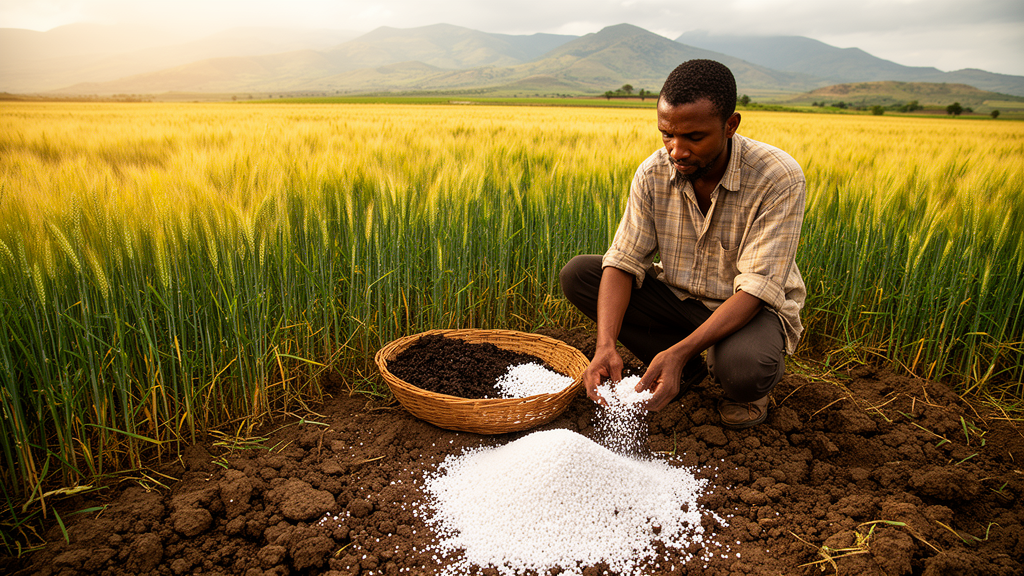
Bread wheat yields in the Guagusashekudad District of northwestern Ethiopia are below the crop's potential, a situation the researchers attribute to low soil fertility and suboptimal use of nitrogen-phosphorus-sulfur-boron (NPSB)-Urea and farmyard manure fertilizers. A field trial conducted during the 2024 main cropping season, published in BMC Plant Biology, tested different combinations of these two nutrient sources to identify an optimum for wheat production in the area. The experiment used a factorial design with four levels of NPSB-Urea (0–0, 50–100, 100–200 and 150–300 kg per hectare) crossed with four farmyard manure rates (0, 5, 10 and 15 tonnes per hectare).
The sixteen treatment combinations were arranged in a Randomized Complete Block Design with three replications, allowing the effects of each fertilizer type, and of their interaction, to be separated statistically. The analysis of variance showed that plant height, spike length, thousand kernel weight, biomass yield, straw yield, harvest index and grain yield were all significantly influenced (p < 0.05) by the NPSB-Urea rate, the farmyard manure rate and their interaction effects. Grain yields ranged widely across treatments.
The unfertilized control produced just 1.69 tonnes per hectare, while the highest yields, between 5.40 and 5.92 tonnes per hectare, were obtained from plots receiving 150–300 kg per hectare NPSB-Urea combined with farmyard manure rates of 0 to 15 tonnes per hectare. The highest net benefit, 253,254.00 Ethiopian birr per hectare, together with a marginal rate of return of 839.90 percent, was achieved by combining 150–300 kg per hectare NPSB-Urea with 15 tonnes per hectare of farmyard manure. Based on these results, the authors conclude that this combination appears economically profitable and may be recommended for bread wheat production in the study area.
The researchers are explicit about the scope of their recommendation. The trial covered a single district in a single season, and they state that multi-location and multi-season validation is required before extending the recommendation to similar agro-ecologies. For wheat-producing farmers in the district, the study provides a concrete data point: in this trial, the full mineral rate paired with farmyard manure produced yields several times higher than unfertilized plots and delivered the strongest financial return.
Subject of Research: Integrated use of NPSB-Urea mineral fertilizer and farmyard manure to improve bread wheat productivity in northwestern Ethiopia
Article Title: Improving bread wheat (Triticum aestivum L.) productivity through integrated use of mineral fertilizers and farmyard manure in Guagusashekudad District, Northwestern Ethiopia
Article References: Aleminew, A., Tiruneh, A., & Azmeraw, Y. (2026). Improving bread wheat (Triticum aestivum L.) productivity through integrated use of mineral fertilizers and farmyard manure in Guagusashekudad District, Northwestern Ethiopia. BMC Plant Biology. https://doi.org/10.1186/s12870-026-10270-w
Image Credits: AI Generated
DOI: 10.1186/s12870-026-10270-w
Keywords: bread wheat, Ethiopia, soil fertility, NPSB-Urea, farmyard manure, grain yield, partial budget analysis, agronomy, integrated nutrient management, field trial, Guagusashekudad District, BMC Plant Biology
News Source: Alan Morgan. (October 23, 2026). Blending Mineral Fertilizer with Farmyard Manure Boosts Wheat Yields in Northwestern Ethiopia. Scienmag.