

• HOME
  • NEWS
  • EXPLORE
    • CAREER
      • Companies
      • Jobs
    • EVENTS
    • iGEM
      • News
      • Team
    • PHOTOS
    • VIDEO
    • WIKI
  • BLOG
  • COMMUNITY
    • FACEBOOK
    • INSTAGRAM
    • TWITTER
Monday, July 13, 2026
BIOENGINEER.ORG
No Result
View All Result
  • Login
  • HOME
  • NEWS
  • EXPLORE
    • CAREER
      • Companies
      • Jobs
        • Lecturer
        • PhD Studentship
        • Postdoc
        • Research Assistant
    • EVENTS
    • iGEM
      • News
      • Team
    • PHOTOS
    • VIDEO
    • WIKI
  • BLOG
  • COMMUNITY
    • FACEBOOK
    • INSTAGRAM
    • TWITTER
  • HOME
  • NEWS
  • EXPLORE
    • CAREER
      • Companies
      • Jobs
        • Lecturer
        • PhD Studentship
        • Postdoc
        • Research Assistant
    • EVENTS
    • iGEM
      • News
      • Team
    • PHOTOS
    • VIDEO
    • WIKI
  • BLOG
  • COMMUNITY
    • FACEBOOK
    • INSTAGRAM
    • TWITTER
No Result
View All Result
Bioengineer.org
No Result
View All Result
Home NEWS Science News Biology

Chimera viruses can help the fight against lymphomas

Bioengineer by Bioengineer
September 14, 2017
in Biology
Reading Time: 2 mins read
0
Share on FacebookShare on TwitterShare on LinkedinShare on RedditShare on Telegram
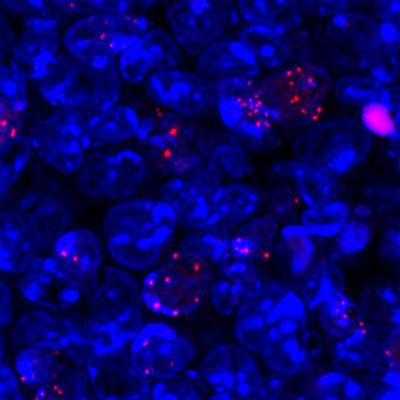
IMAGE

Credit: Pedro Simas Lab, iMM Lisboa

Researchers from Instituto de Medicina Molecular (iMM) Lisboa have created a chimera virus that allows the study of molecules to treat cancers caused by human herpes virus infection in mice models of disease.

There are several types of herpesvirus able to infect humans, such as herpes simplex, chickenpox, cytomegalovirus, Epstein-Barr and Kaposi Sarcoma herpesvirus. One of the main characteristics of herpesviruses is their ability to infect their hosts for life and in a small percentage of these people ultimately lead to cancer.

Cancers associated with Kaposi virus infection have an Achilles heel: their cells' viability is directly dependent on the survival of the virus, which means that if the virus were to be eliminated cancer cells would no longer proliferate, hence the cancer would be cured.

In collaboration with a team from Harvard-Medical School, researchers led by Pedro Simas (iMM) and Kenneth Kaye (Harvard) studied a protein of the Kaposi virus vital for maintaining infection. Without this protein, called LANA, the virus looses its ability to cause cancer.

The team found that when LANA is cloned into a virus similar to Kaposi, but which infects mice instead of humans, it preserves its functionality. This finding came as a surprise since it was assumed that as a consequence of the evolutionary divergence between human and other animal viruses, the genes that code for LANA could not be switched.

However, the work now published in PlosPathogens, showed that even though there are more than 60 million years of evolutive divergence between the human Kaposi sarcoma herpesvirus and its rodent homologue, LANA's functional mechanisms are preserved.

These findings allowed researchers to create a chimera virus: a mouse virus with a human viral gene that can be used to test molecules that inhibit human LANA protein in an animal model of disease, treating not only human herpes virus infection but also its associated cancers. These molecules will hopefully be used in the future as drugs to treat Kaposi virus associated lymphomas.

"In addition to Kaposi virus the same experimental strategy to create chimera viruses, previously thought to be theoretically non-viable, can now be used for other viruses that use proteins similar to LANA, such as the Epstein-Barr virus which infects greater than 90% of the world population or the human papillomavirus responsible for cervical cancers," said Pedro Simas.

###

Media Contact

Ana de Barros
[email protected]

https://imm.medicina.ulisboa.pt/en/

Original Source

https://imm.medicina.ulisboa.pt/en/imm-lisboa/news/archive/chimera-viruses-can-help-fight-against-lymphomas/ http://dx.doi.org/10.1371/journal.ppat.1006555

Share31Tweet8Share2ShareShareShare2

Related Posts

Han directs new $15M NIH center for organ-on-chip technology

Han directs new $15M NIH center for organ-on-chip technology

July 11, 2026
Bacteriophages Enable Next-Gen Smart Pathogen Detection Sensors

Bacteriophages Enable Next-Gen Smart Pathogen Detection Sensors

July 10, 2026

Temperature Fluctuations Have Greater Impact Than Previously Believed

July 10, 2026

New Study Uncovers Biology Behind Glioma Cancer Progression

July 10, 2026
Please login to join discussion

POPULAR NEWS

  • Detection of EDCs in Breast Milk and Infant Urine Up to Six Months Highlights Early Exposure Risks

    77 shares
    Share 31 Tweet 19
  • New Drug Candidate Developed at McMaster Shows Potential for Treating Brain Cancer

    58 shares
    Share 23 Tweet 15
  • KTU Researchers Explore Ultrasound’s Role in Enhancing Blood Flow Beyond Diagnostics

    53 shares
    Share 21 Tweet 13
  • Experimental Therapy Simultaneously Destroys Prostate Tumor Cells and Reactivates Antitumor Immunity

    46 shares
    Share 18 Tweet 12

About

BIOENGINEER.ORG

We bring you the latest biotechnology news from best research centers and universities around the world. Check our website.

Follow us

Recent News

Bioinspired Microcapsule Reactor Using Engineered Probiotics for IBD Treatment

KAIST Uncovers Key to Overcoming Semiconductor Electrical Bottleneck

Nationwide Study Reveals Multimorbidity Factors in Older Chinese Adults

Subscribe to Blog via Email

Enter your email address to subscribe to this blog and receive notifications of new posts by email.

Join 85 other subscribers
  • Contact Us

Bioengineer.org © Copyright 2023 All Rights Reserved.

Welcome Back!

Login to your account below

Forgotten Password?

Retrieve your password

Please enter your username or email address to reset your password.

Log In
No Result
View All Result
  • Homepages
    • Home Page 1
    • Home Page 2
  • News
  • National
  • Business
  • Health
  • Lifestyle
  • Science

Bioengineer.org © Copyright 2023 All Rights Reserved.