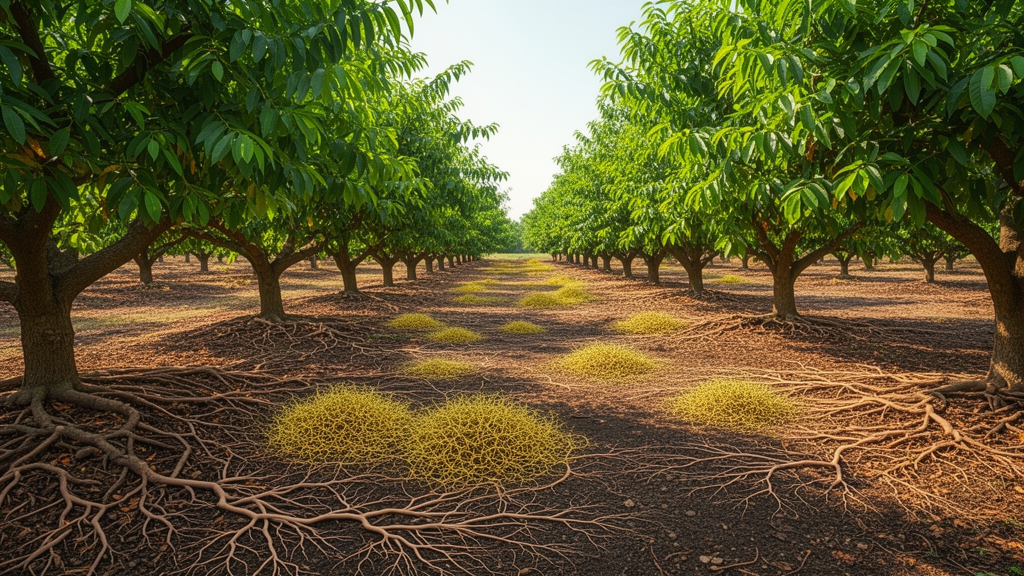
Researchers mapping a cultivated truffle orchard have found strikingly uneven distribution of Tuber lyonii, the pecan truffle, across soil collected beneath trees of different ages. Using species-specific quantitative PCR, the team measured fungal DNA in 60 soil cores drawn from ten trees in each of five orchard sections, including one outlier site, in an effort to understand why truffle abundance varies so dramatically within a single planting. The orchard combined 9-year-old pecan trees in sections A through D with 4-year-old trees in section E, allowing the researchers to test whether orchard age, soil chemistry, and microbial communities were associated with spatial variation in truffle abundance.
Such variability is a persistent obstacle for growers trying to improve productivity of this native North American truffle species. Quantitative PCR results showed the highest T. lyonii DNA abundance in section E, the youngest block, averaging 1.95 × 10⁴ ± 3.91 × 10³ nanograms per gram of soil. The older sections A through D showed lower values, ranging from 3.60 × 10⁻¹ ± 0.18 in section A to 1.14 × 10⁴ ± 4.72 × 10⁴ in section C, with substantial variability among them.
No truffle DNA was detected at the outlier site. To characterize the broader soil environment, the team sequenced ITS and 16S rRNA marker genes, which capture fungal and bacterial communities respectively. Fungal communities across the orchard were dominated by Mortierellomycota, Ascomycota, and Basidiomycota.
Among sequences assigned to the genus Tuber, T. lyonii accounted for 92.2 percent, indicating that this species dominates the detected truffle sequences in the orchard. Bacterial communities were dominated by Proteobacteria (Pseudomonadota), Acidobacteriota, and Actinobacteriota. Beta-diversity analyses, which measure differences in community composition between samples, revealed that microbial communities differed among orchard sections, indicating that each block of trees supports a distinct below-ground assemblage of fungi and bacteria.
Soil physicochemical analyses added a further layer of detail. Soil pH and organic matter content did not differ across the orchard, suggesting these commonly measured factors do not explain the observed patchiness in truffle DNA. The authors interpret these patterns as evidence of spatial heterogeneity in T. lyonii abundance and microbial community composition within the orchard.
Their data suggest that orchard age and localized soil conditions may be associated with the distribution of truffle DNA, though the study design, based on a single orchard and DNA abundance rather than harvested fruit, supports associations rather than proven causal effects. Because the findings come from one cultivated site with a limited number of cores per section, generalizing them to other pecan truffle orchards will require further work. Even so, the study demonstrates how pairing qPCR monitoring of truffle DNA with microbial community profiling and soil chemistry can document the fine-scale spatial structure of a cultivated truffle population.
Subject of Research: Spatial distribution of Tuber lyonii truffle DNA and soil microbial diversity in a cultivated pecan orchard
Article Title: Quantitative Assessment of Tuber lyonii DNA Distribution and Microbial Diversity in a Pecan Orchard
Article References: Udombang, N. S., MensahBonsu, M., Anike, F. N., & Isikhuemhen, O. S. (2026). Quantitative Assessment of Tuber lyonii DNA Distribution and Microbial Diversity in a Pecan Orchard. Microbial Ecology. https://doi.org/10.1007/s00248-026-02898-w
Image Credits: AI Generated
DOI: 10.1007/s00248-026-02898-w
Keywords: Tuber lyonii, pecan truffle, qPCR, soil microbiome, fungal ecology, bacterial communities, cation exchange capacity, orchard age, mycorrhiza, soil chemistry, beta-diversity, Quantitative
News Source: Alan Morgan. (October 23, 2026). Pecan Orchard Survey Reveals Patchy Spread of Native American Truffle DNA. Scienmag.