A new modeling study reports that anisotropy in parts produced via binder jetting does not act as a fixed material property during sintering: it evolves nonlinearly with structural hierarchy, and cross-scale coupling plays a critical role in determining the effective behavior of the finished component. The work, published open access in npj Advanced Manufacturing on 23 October 2026 by Thomas Grippi, Elisa Torresani, Runjian Jiang, Andrii Maximenko, Diletta Giuntini, Marc van Maris, John Kang, Nicholas Saterlee, Rajendra Bordia and Eugene Olevsky, investigates anisotropy during sintering across multiple scales using a coupled kinetic Monte Carlo and finite element simulation framework.
The process begins at the mesoscale, where the team calibrated and validated a kinetic Monte Carlo sintering model. Rather than relying on final measurements alone, the researchers benchmarked the model against experimental data obtained through X-ray computed tomography, discrete element modeling and optical microscopy. Interrupted thermal cycles allowed them to capture the evolving structure at key densification stages, giving the simulation concrete experimental checkpoints along the sintering pathway.
Once validated, the mesoscale model supplies directional descriptors such as strain rate and pore orientation. These are incorporated as anisotropic sintering stress inputs into a continuum-level sintering model based on the Skorohod-Olevsky Viscous Sintering finite element framework, tailored for 316 L stainless steel. The continuum formulation is designed to account for several material behaviors at the part scale: the influence of initial relative density, grain growth kinetics, the delta-ferrite phase transformation that occurs at elevated temperatures, and the effects of friction and gravity.
The approach links the two scales through a combination of experimental imaging, tensor-based quantification and numerical simulations, connecting mesoscopic directional dependencies to macroscopic responses of the whole part. The central results are twofold. First, anisotropy evolves nonlinearly with structural hierarchy, meaning the directionality observed at the part scale depends on how microstructural features are organized and how that organization changes during sintering. Second, cross-scale coupling is critical: the mesoscale descriptors feed the continuum model with inputs that determine effective material behavior, so the macroscopic prediction cannot be separated from the microscopic description of the same sintering process.
The study’s scope is specific. It concerns 316 L stainless steel produced via binder jetting, and its conclusions rest on experimental imaging, tensor-based analysis and numerical simulation rather than on broad mechanical testing of finished components. The published version is being shared early to provide faster access to peer-reviewed, accepted research; it is citable and carries a permanent DOI, but remains subject to further edits and will be replaced automatically by the final Version of Record. Within those limits, the work demonstrates a concrete route from microstructural directionality to part-scale sintering prediction for binder-jetted steel.
Subject of Research: Multiscale continuum modeling of sintering-induced anisotropy in binder-jetted 316 L stainless steel
Article Title: Continuum meso-macro multiscale modeling of anisotropy during sintering of parts produced via additive manufacturing
Article References: Grippi, T., Torresani, E., Jiang, R., Maximenko, A., Giuntini, D., van Maris, M., Kang, J., Saterlee, N., Bordia, R., & Olevsky, E. (2026). Continuum meso-macro multiscale modeling of anisotropy during sintering of parts produced via additive manufacturing. npj Advanced Manufacturing. https://doi.org/10.1038/s44334-026-00118-4
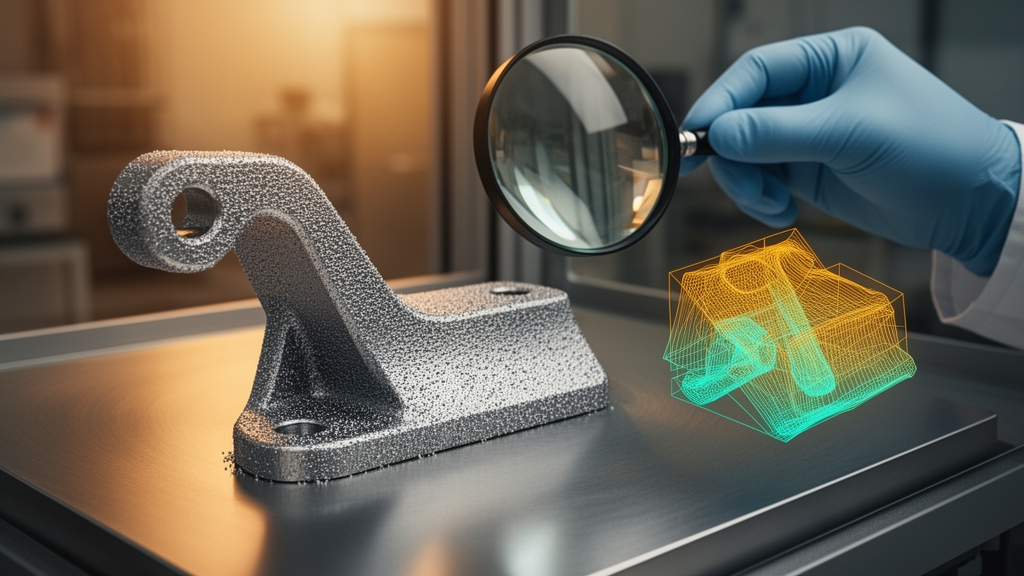
Image Credits: AI Generated
DOI: 10.1038/s44334-026-00118-4
Keywords: binder jetting, sintering, anisotropy, multiscale modeling, kinetic Monte Carlo, finite element analysis, 316 L stainless steel, additive manufacturing, X-ray computed tomography, Skorohod-Olevsky viscous sintering, Continuum, meso-macro
News Source: Denise Maddox. (October 23, 2026). Multiscale Simulation Reveals Nonlinear Anisotropy in Sintered Binder-Jetted Steel Parts. Scienmag.