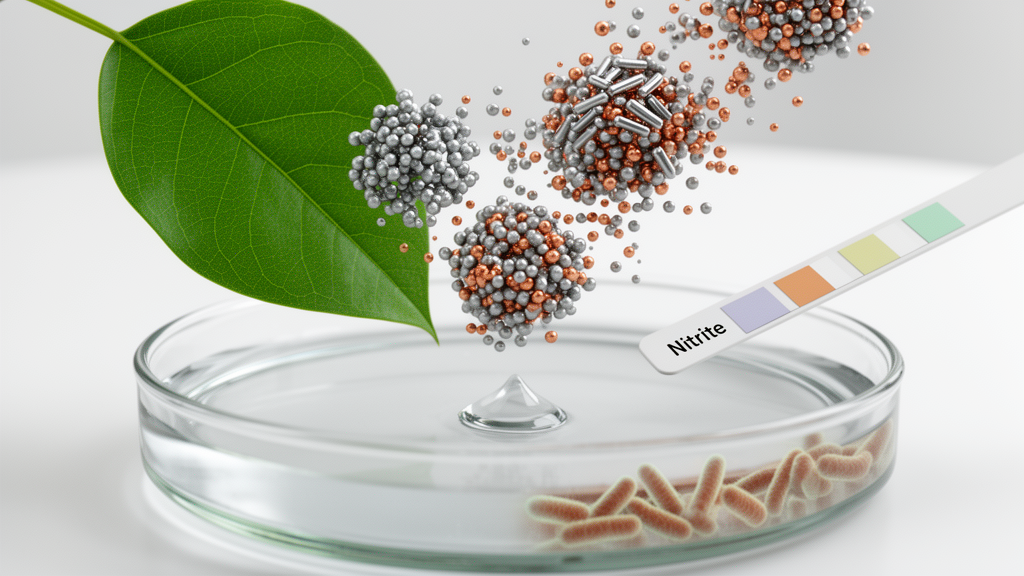
A nanocomposite of silver and copper oxide, synthesised using the plant Caesalpinia bonducella as a green source, has been reported to combine two functions in a single material: electrochemical detection of nitrite at very low concentrations and antibacterial activity against two common bacterial strains. The study, published in the journal Ionics, describes the material’s preparation, its structural characterisation and its measured performance in both roles.
The researchers characterised the Ag/CuO nanocomposite with a suite of analytical techniques, including X-ray diffraction, scanning electron microscopy, atomic force microscopy, Fourier transform infrared spectroscopy and X-ray photoelectron spectroscopy, alongside electrochemical measurements. The antibacterial activity of the nanocomposite was evaluated at different concentrations against Staphylococcus aureus, a Gram-positive bacterium, and Escherichia coli, a Gram-negative one. According to the authors, the bactericidal property of the nanocomposite was comparable to that of a standard, although the available summary does not name the standard agent or report quantitative measures such as minimum inhibitory concentrations. Activity against two bacterial strains in laboratory culture does not by itself establish clinical or environmental effectiveness.
For sensing, the as-synthesised nanoparticles were drop-cast onto a graphite electrode that served as the working electrode in electrochemical experiments. Using cyclic voltammetry, the modified electrode showed a linear response to nitrite across a range from 0.3 nanomolar to 13.5 nanomolar, with a limit of detection of 0.1 nanomolar. Selectivity, often a weak point for electrochemical sensors, held up in these tests: the electrocatalytic activity of the Ag/CuO nanocomposite toward nitrite remained unaffected in the presence of common interfering ions.
The sensor response was also analysed under flow conditions using amperometry, a configuration suited to continuous monitoring. To assess performance beyond clean laboratory solutions, the team evaluated the modified electrode in real-sample analysis by detecting nitrite in water samples with the standard addition method. Recoveries fell between 98.3 and 100.2 percent, with an average relative standard deviation of 2.17 percent, indicating accurate and repeatable measurement in the matrices examined. Stability and reproducibility studies carried out with the devised sensor gave what the authors describe as encouraging results, although the summary does not specify the storage period or the number of repeat cycles behind that assessment.
Several caveats temper the findings. The antibacterial evaluation covered only two bacterial strains at laboratory scale, and the sensing validation involved water samples analysed by standard addition rather than a broader survey of environmental matrices. The linear detection window, spanning roughly 0.3 to 13.5 nanomolar, is narrow in absolute terms, so measurements at higher nitrite concentrations would depend on dilution protocols or an extended calibration range. The reported limit of detection was obtained with cyclic voltammetry, and the amperometric flow measurements are described separately without quantified figures in the available summary. Further studies would be needed to establish long-term electrode lifetime, performance in more complex field samples and any practical deployment of the antibacterial function outside the culture dish.
Subject of Research: Green synthesis of an Ag/CuO nanocomposite for electrochemical nitrite sensing and antibacterial activity
Article Title: Sustainable Ag/CuO nanocomposite with dual functionality for nitrite sensing and antibacterial activity
Article References: S, S. L., Saranya, S., T, S. J. T., & Deepa, P. N. (2026). Sustainable Ag/CuO nanocomposite with dual functionality for nitrite sensing and antibacterial activity. Ionics. https://doi.org/10.1007/s11581-026-07600-1
Image Credits: AI Generated
DOI: 10.1007/s11581-026-07600-1
Keywords: Ag/CuO nanocomposite, green synthesis, Caesalpinia bonducella, nitrite sensor, electrochemistry, cyclic voltammetry, amperometry, antibacterial activity, Staphylococcus aureus, Escherichia coli, graphite electrode, water analysis
News Source: Denise Maddox. (October 23, 2026). Plant-based silver-copper oxide nanocomposite senses nitrite and curbs bacteria. Scienmag.