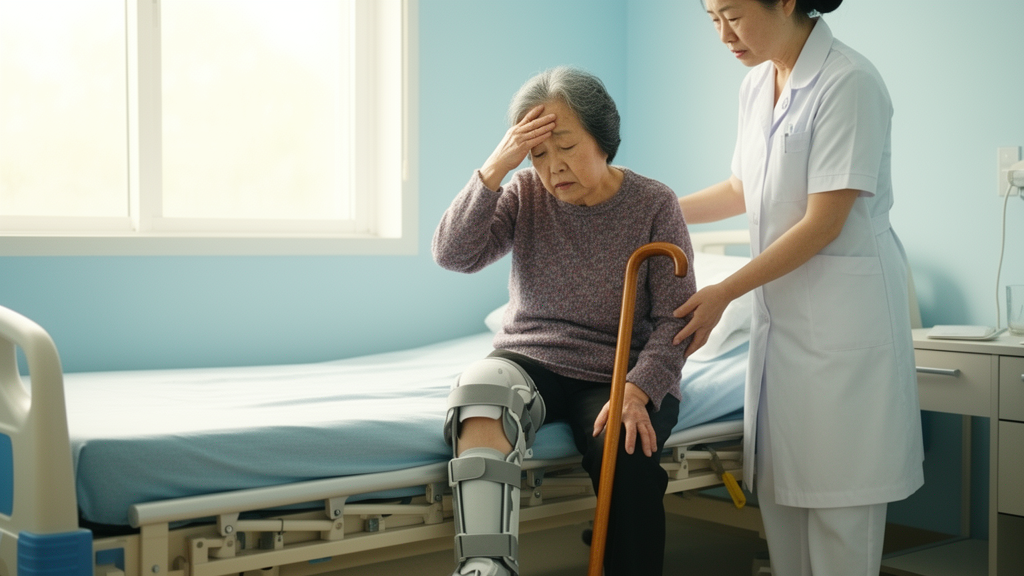
Middle-aged and older adults in China whose anxiety-related symptoms grew more severe over time faced a higher risk of breaking a hip than people whose symptoms stayed low or eased, according to a secondary analysis of the China Health and Retirement Longitudinal Study (CHARLS) published in Archives of Osteoporosis. Among 9,271 participants assessed repeatedly for anxiety-related symptoms, those on a higher-increasing symptom trajectory had roughly one and a half times the risk of a first hip fracture compared with people on a lower-decreasing trajectory, even after statistical adjustment for demographic, behavioural and functional differences.
The study drew on CHARLS, a nationally representative cohort of Chinese adults aged 45 years and older. Researchers measured anxiety-related symptoms at three waves, in 2011, 2013 and 2015, using three anxiety-related items from the Center for Epidemiologic Studies Depression Scale. Rather than treating anxiety as a single snapshot, the team applied latent class mixed models to identify distinct longitudinal patterns, or trajectories, of symptoms across those repeated assessments. Incident hip fractures were ascertained from self-reports during follow-up interviews conducted in 2018 and 2020.
Two trajectories emerged from the modelling. The large majority of participants, 84.7 percent, followed a lower-decreasing trajectory, meaning their anxiety-related symptoms were relatively low and declined over the three measurement waves. The remaining 15.3 percent followed a higher-increasing trajectory, starting with more symptoms and becoming more anxious over time. Participants had a mean age of 61.7 years, and 52.8 percent were women. During follow-up, 170 participants experienced an incident hip fracture.
In crude analyses that made no statistical adjustments, the higher-increasing trajectory was associated with more than double the risk of hip fracture compared with the lower-decreasing trajectory, with a hazard ratio of 2.07 and a 95 percent confidence interval of 1.48 to 2.91. The researchers then fitted Cox proportional hazards models with sequential adjustment, first for sociodemographic characteristics, then for health behaviours, and finally for functional status. After this multivariable adjustment, the association was attenuated but remained statistically significant, with a hazard ratio of 1.49 and a 95 percent confidence interval of 1.02 to 2.17. Sensitivity analyses restricted to a fixed complete-case sample showed similar results.
The study’s design carries important caveats. As a secondary analysis of observational cohort data, it can establish association but not causation; unmeasured characteristics could still explain part of the link. Hip fractures were identified by self-report rather than verified against clinical records, which introduces the possibility of misclassification. The anxiety measure relied on three items from a depression scale rather than a dedicated clinical diagnostic instrument, so the findings speak to anxiety-related symptoms rather than diagnosed anxiety disorders. The cohort covers adults in China aged 45 and older, and the authors frame their results as informing future prevention research that considers mental health, not as a basis for clinical recommendations.
Even with those limitations, the longitudinal approach adds value over single-time-point studies. Because symptoms were measured repeatedly over four years before fracture ascertainment, the analysis captured patterns of change rather than one-off levels, distinguishing a group whose psychological distress was worsening from one whose distress was low and easing. The authors conclude that a higher-increasing trajectory of anxiety-related symptoms is associated with increased hip fracture risk among middle-aged and older adults in China, and that repeated assessment of anxiety-related symptoms may improve understanding of fracture vulnerability in ageing populations and inform future prevention research that considers mental health.
Subject of Research: Longitudinal anxiety-related symptom trajectories and incident hip fracture risk in middle-aged and older Chinese adults
Article Title: Longitudinal trajectories of anxiety-related symptoms and risk of incident hip fracture among middle-aged and older adults in China: a CHARLS analysis
Article References: Yi, Y., Shi, L., Qiu, C., & Yu, X. (2026). Longitudinal trajectories of anxiety-related symptoms and risk of incident hip fracture among middle-aged and older adults in China: a CHARLS analysis. Archives of Osteoporosis, 21(1), Article 146. https://doi.org/10.1007/s11657-026-01784-9
Image Credits: AI Generated
DOI: 10.1007/s11657-026-01784-9
Keywords: hip fracture, anxiety symptoms, CHARLS, longitudinal trajectories, ageing, China, cohort study, latent class mixed models, Cox proportional hazards, osteoporosis, mental health, fracture risk
News Source: Glenn Wilkins. (October 23, 2026). Rising Anxiety Symptoms Linked to Higher Hip Fracture Risk in China. Scienmag.