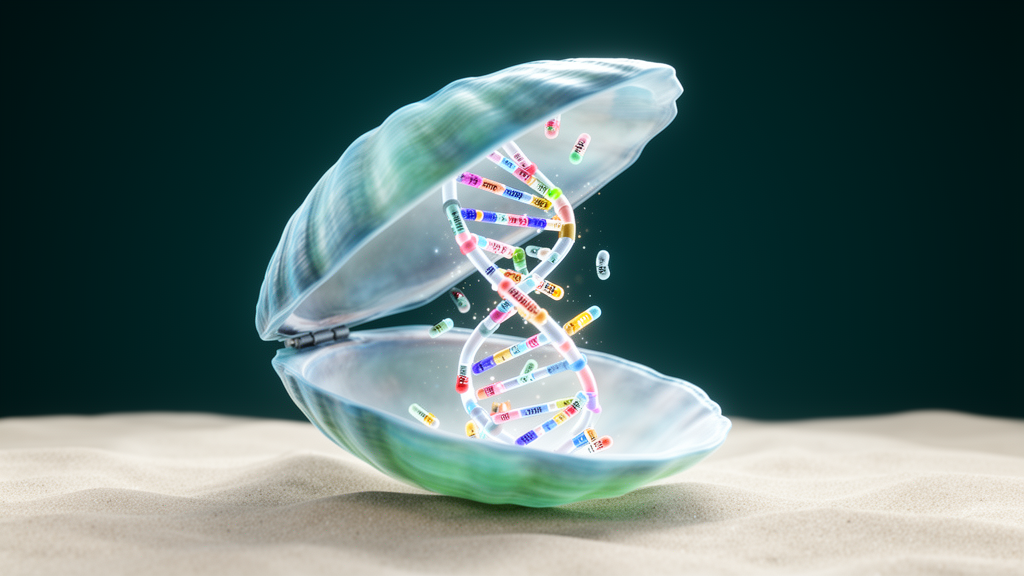
The jingle shell Anomia chinensis, a cementing bivalve that glues itself to rocks in the intertidal zone, is the subject of a new genomic study published in BMC Biology. A team led by Baojun Zhao, Yuting Yang and Zhenmin Bao reports a near-complete genome assembly spanning 572.90 megabases, arranged on seven chromosomes with a contig N50 of 79.37 megabases. The work targets the Anomioidea, an understudied bivalve superfamily, and delivers findings that reach beyond this single species: a phylogenomic result concerning relationships within the bivalve group Pteriomorphia, and the first evidence that bivalves have reassigned a mitochondrial stop codon to instead encode the amino acid tyrosine.
The genome-based phylogeny, reconstructed from the major lineages of Pteriomorphia, the subclass that includes oysters, mussels, scallops and their relatives, supported that the order Pectinida is not monophyletic. Because the assembly is anchored to chromosomes, the researchers could also reconstruct twenty ancestral linkage groups for bivalves, representing the presumed chromosomal inheritance of their last common ancestor, and then compare how modern lineages have preserved that ancient karyotype.
The macrosynteny analysis produced a notable ecological pattern. Within Pteriomorphia, cementing bivalves living in the intertidal zone showed significantly lower conservation of the ancestral bivalve karyotypes than other groups. The comparative data establish this association between the cementing intertidal lifestyle and reduced karyotype conservation, though they cannot by themselves establish whether genome architecture and lifestyle are causally linked.
The second major result concerns the mitochondrial genetic code. In most organisms, the codon UAA signals the end of a protein during translation. Yet in several metazoan lineages, UAA has been reassigned to specify tyrosine, and the number of reported cases keeps growing as new mitochondrial genomes are sequenced. The Anomia chinensis mitochondrial genome adds bivalves to this list. The researchers then integrated these scattered cases to ask what molecular changes make such a reassignment possible.
Their answer points to coordinated evolutionary change. Reassignment generally requires the co-evolution of two components: the release factor mtRF1a, the protein that normally recognizes UAA and terminates translation, and the transfer RNA that decodes the reassigned codon. In both hemichordates and mollusks, the team identified parallel mutations in mtRF1a and in the tyrosine tRNA with the GUA anticodon, the molecule that would need to read UAA as tyrosine. The same genetic changes appearing independently in distant animal phyla suggest a repeatable evolutionary route by which the stop signal is recruited into the coding vocabulary. The authors suggest these insights could inform efforts to reprogram mitochondrial genetic codes in metazoans, and potentially across a broader range of cellular life.
Beyond the codon story, the study supplies essential genomic resources for a superfamily that had been largely absent from bivalve genomics. The near-complete chromosome-scale assembly, combined with the reconstructed ancestral linkage groups, gives researchers a framework for studying karyotype evolution across bivalves and for placing newly sequenced bivalve genomes into a coherent chromosomal history. The article, published open access on 22 October 2026, was authored by Baojun Zhao, Yuting Yang, Yongyu Huang, Hongyu Lv, Hanwen Liu, Yuhan Jiang, Lingyun Tang, Lisui Bao, Hao Wang and Zhenmin Bao.
Subject of Research: Bivalve genome evolution and mitochondrial genetic code reassignment in Anomia chinensis
Article Title: A near-complete genome assembly of Anomia chinensis provides insights into bivalve phylogenomic evolution and mitochondrial UAA stop-to-Tyr codon reassignment in metazoans
Article References: Zhao, B., Yang, Y., Huang, Y., Lv, H., Liu, H., Jiang, Y., Tang, L., Bao, L., Wang, H., & Bao, Z. (2026). A near-complete genome assembly of Anomia chinensis provides insights into bivalve phylogenomic evolution and mitochondrial UAA stop-to-Tyr codon reassignment in metazoans. BMC Biology. https://doi.org/10.1186/s12915-026-02767-5
Image Credits: AI Generated
DOI: 10.1186/s12915-026-02767-5
Keywords: Anomia chinensis, bivalve genomics, Pteriomorphia, phylogenomics, macrosynteny, ancestral linkage groups, mitochondrial genome, codon reassignment, genetic code evolution, mtRF1a, tRNA, Mollusca
News Source: Juliet Wilcox. (October 23, 2026). Cementing bivalve genome reveals codon reassignment and reshuffled karyotypes. Scienmag.