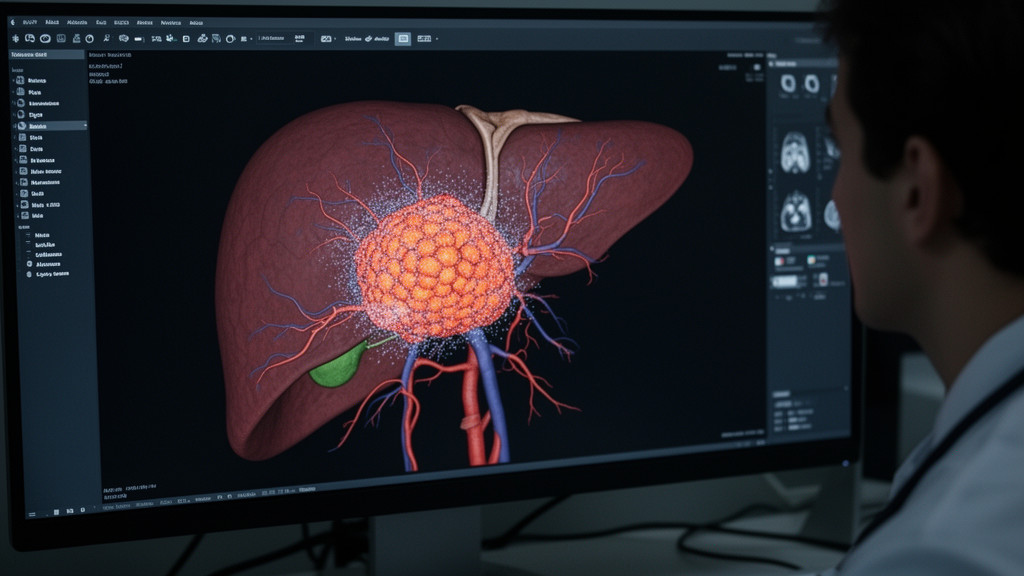
A retrospective study of 115 surgically treated patients found that a machine-learning model using cross-phase variations in contrast-enhanced MRI achieved an area under the receiver operating characteristic curve of 0.850 when predicting microvascular invasion in hepatocellular carcinoma tumors smaller than 3 cm. The best-performing combination used a Fourier-inspired temporal encoding method, an ExtraTrees classifier, and a tumor region of interest expanded by 5 mm into surrounding tissue; its 95% confidence interval was 0.675–0.978. Microvascular invasion prediction is a preoperative challenge in hepatocellular carcinoma, according to the research published in BMC Medical Imaging .
The investigators examined 115 consecutive patients with a mean age of 57.2 ± 10.7 years, of whom 95 were men. Every patient had undergone preoperative MR imaging and surgical resection of a hepatocellular carcinoma tumor measuring less than 3 cm. The dataset was randomly partitioned into training and testing cohorts at an 8:2 ratio.
The imaging analysis encoded how features varied across the arterial, venous, and delayed phases of contrast-enhanced MRI. Investigators manually segmented intratumoral regions of interest for each phase and created expanded regions at distances of 3 mm, 5 mm, and 10 mm around the tumor. Five temporal-encoding methods were evaluated with four machine-learning classifiers in models that combined radiomics features and clinical characteristics.
Across the study’s comparisons, models incorporating multi-phase temporal encoding consistently performed better than single-phase models and models relying only on clinical characteristics. The Fourier-inspired temporal encoding method combined with ExtraTrees produced the strongest reported diagnostic performance when applied to the original tumoral region with a 5-mm expansion, yielding an AUC of 0.850 and a 95% confidence interval of 0.675–0.978. The reported result was a performance estimate from the study’s internal training and testing split rather than evidence from prospective or independent external validation.
The findings show that variations across MRI contrast phases contained predictive information for microvascular invasion in this surgically treated population. By encoding changes among arterial, venous, and delayed images rather than analyzing a single phase in isolation, the framework converted cross-phase imaging variation into measurements that could be evaluated by machine-learning classifiers. The study therefore supports the use of multi-phase MRI radiomics as a candidate quantitative approach to preoperative risk stratification, although the evidence reported here comes from a single retrospective cohort of 115 patients with tumors smaller than 3 cm.
The wide confidence interval around the best AUC also indicates substantial uncertainty in the model’s estimated performance.
Subject of Research: Preoperative prediction of microvascular invasion in small hepatocellular carcinoma using multi-phase MRI radiomics and machine learning
Article Title: Preoperative prediction of microvascular invasion in small hepatocellular carcinoma (≤ 3 cm) by leveraging cross-phase variations of MRI contrast phases
Article References: Dou, Y., Liu, Y., Yuan, W., Wu, S., & Yao, Z. (2026). Preoperative prediction of microvascular invasion in small hepatocellular carcinoma (≤ 3 cm) by leveraging cross-phase variations of MRI contrast phases. BMC Medical Imaging. https://doi.org/10.1186/s12880-026-02984-y
Image Credits: AI Generated
DOI: 10.1186/s12880-026-02984-y
Keywords: microvascular invasion, hepatocellular carcinoma, contrast-enhanced MRI, multi-phase imaging, radiomics, machine learning, temporal encoding, ExtraTrees, preoperative prediction, liver cancer, Preoperative, prediction
News Source: Nathaniel Bowman. (October 22, 2026). MRI radiomics predicts microvascular invasion in small hepatocellular carcinoma. Scienmag.