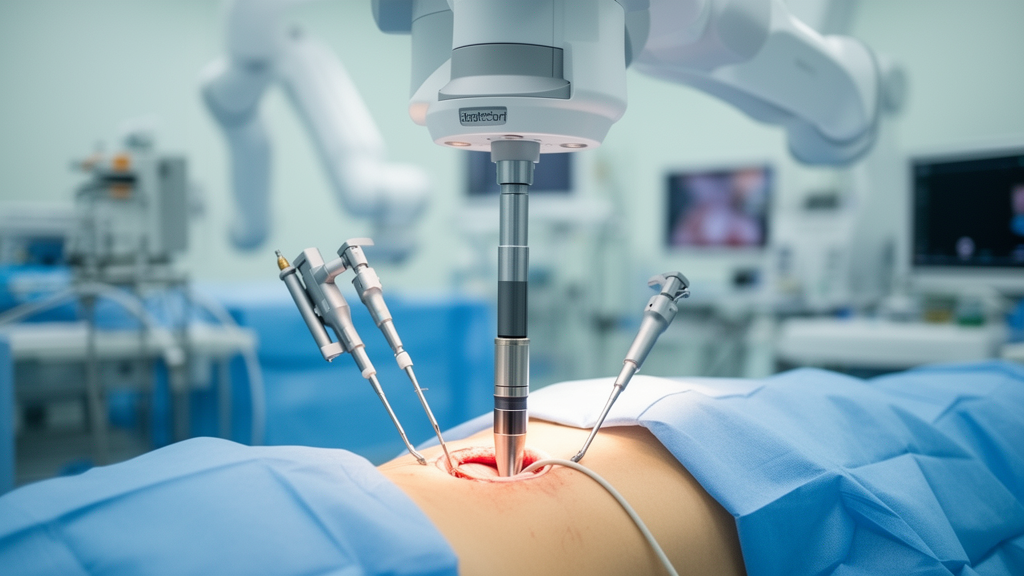
A single-port robotic technique for repairing inguinal hernias without entering the peritoneal cavity was completed in all 12 patients in a retrospective series, including cases with incarceration, dense adhesions and recurrent defects. Surgeons used the da Vinci SP system with a “floating docking” configuration that suspended the robotic cannula about 9–10 cm above the skin, allowing the instruments to achieve full wrist articulation before entering the confined preperitoneal operative field. No procedure required conversion to open surgery or conventional laparoscopy, and no additional trocars were inserted. The median skin-to-skin operative time was 42.5 minutes, while the median console time was 40.0 minutes. Three patients developed minor postoperative complications, and there were no major complications, readmissions or reoperations within 30 days. No recurrence was detected during a median follow-up of 6.9 months, although the small series and short follow-up do not establish long-term effectiveness.
The report describes a development-stage case series conducted by one surgeon at a single institution between August 2025 and May 2026. Patients of any hernia type scheduled for elective repair were eligible, and none were excluded because of defect size or previous surgery. The cohort included 11 men and one woman with a mean age of 57.2 years and mean body mass index of 24.9 kg/m². Six hernias were on each side; eight were indirect and four were direct, with a median defect size of 2.0 cm. Two patients, or 16.7%, had recurrent hernias. The cases also spanned several European Hernia Society categories, and one patient had a large inguinoscrotal hernia containing an incarcerated segment of small bowel. The investigators designated the study as stage 2a within the IDEAL framework, indicating a development phase focused on refining a technique before comparative evaluation.
At the center of the method is a geometric problem created by the da Vinci SP platform. Its wristed instruments must extend at least 9 cm beyond the cannula tip before full articulation becomes available, but the retrorectus and preperitoneal spaces at the start of a totally extraperitoneal inguinal hernia repair are too shallow to accommodate that extension internally. If the cannula remains at abdominal-wall level, the instrument joints cannot fully articulate within the operative space. Floating docking changes where that distance is used: the cannula is held suspended above the patient rather than fixed at the incision, allowing the required extension to occur outside the body. The instruments therefore enter the operative field already articulating. Unlike many single-port procedures performed in a large abdominal cavity, this arrangement must be preserved through most of the operation, with the cannula height dynamically adjusted as dissection progresses.
For access, the surgeon began with a 2.5-centimeter longitudinal incision just below the umbilicus. The anterior rectus sheath on the hernia side was opened transversely, the rectus muscle was retracted laterally, and the posterior rectus sheath was exposed. A low-profile single-port device with a soft patient-contact surface was then inserted into the retrorectus space, where carbon dioxide insufflation was started. The da Vinci SP cannula was floated approximately 9–10 cm above the skin. Robotic docking was completed in one to two minutes in every case. The investigators selected this configuration instead of the manufacturer’s dedicated SP Access Port Kit, whose bulky chamber and rigid abdominal-wall component could compress the skin around the narrow infraumbilical incision. In their view, floating docking offered an accessory-independent way to obtain instrument extension without enlarging the incision.
Dissection followed the familiar anatomical sequence of totally extraperitoneal repair. Working through the retrorectus plane with fenestrated bipolar forceps in the left robotic arm and monopolar scissors in the right, the surgeon first developed the retropubic space and then the retroinguinal space. Direct hernia sacs were identified and reduced. For indirect hernias, the spermatic cord structures were dissected and identified before the spermatic fascia was opened to isolate the sac. The sac was ligated at the level of the preperitoneal fat with a Hem-o-lok clip, and its distal portion was excised. A mesh was introduced by the bedside assistant, positioned with the robotic instruments, and secured with fibrin glue after it covered the myopectineal orifice. Desufflation, undocking and closure of the anterior rectus sheath completed the procedure.
The operative results suggest that the floating configuration was compatible with a range of anatomical conditions rather than being limited to small, uncomplicated defects. One recurrent hernia contained dense adhesions, and opening the peritoneum during that repair was the sole intraoperative complication. The opening was closed by intracorporeal suturing without conversion. The incarcerated inguinoscrotal hernia was also reduced and repaired through the single port. These two cases are relevant because dense adhesions and large sacs have been viewed as potential limitations of single-port instrumentation, particularly in instruments with less grasping strength. In this series, however, articulating tools allowed the surgeon to manage both situations without adding ports or abandoning the extraperitoneal approach.
The early postoperative course was similarly uncomplicated under the study’s grading system. Three patients, representing 25.0% of the cohort, had inguinal-area fluid collections identified by the operating surgeon with bedside ultrasonography at outpatient visits. Aspiration was considered only when estimated collection volume exceeded 10 mL, but none met that threshold, and all three resolved with observation by the one-month visit. One patient also developed urinary retention and was treated with an alpha-blocker. All complications were classified as Clavien–Dindo grade I or II. There was no wound seroma, 30-day readmission or reoperation, and the mean hospital stay was 1.1 days. Recurrence was assessed by clinical examination rather than routine imaging, and no recurrence was observed during a median 6.9 months of follow-up, with an interquartile range of 4.1–8.7 months.
Totally extraperitoneal access offers a specific advantage over the more common transabdominal preperitoneal route: the surgeon does not enter the peritoneal cavity, open the peritoneum to reach the preperitoneal plane, or close that opening over the mesh afterward. This avoids an intra-abdominal dissection and closure step, but it also confines the operation to a shallow working space. The da Vinci SP system is designed for single-port procedures and supplies an articulating camera and three wristed instruments through one arm, reducing the instrument collisions that can constrain multi-arm platforms used through a single incision. Its dedicated design also supports the rapid docking recorded in this series. Floating docking appears to combine that platform-specific dexterity with the anatomical limitations of extraperitoneal surgery, but the present data describe feasibility rather than superiority over conventional laparoscopy or other robotic methods.
Several limitations sharply constrain the conclusions. The retrospective series included only 12 consecutive patients, one surgeon and one institution, with no concurrent comparison group. Such a sample cannot provide precise estimates of uncommon complications or establish whether the operative time, fluid-collection rate or recovery profile differs from standard techniques. It also cannot characterize a learning curve or show that outcomes would be reproducible across surgeons and hospitals. Follow-up was too short to evaluate long-term recurrence, and recurrence was assessed clinically without routine imaging, so small asymptomatic defects could have been missed. The investigators also used no patient-reported outcome instrument to quantify chronic pain or quality of life. Larger prospective, preferably multicentre comparative studies with longer follow-up and standardized patient-reported outcomes are needed to determine whether the technique offers meaningful advantages beyond technical feasibility and early safety.
Subject of Research: Feasibility of floating-docked single-port robotic totally extraperitoneal inguinal hernia repair
Article Title: Single-port robotic totally extraperitoneal inguinal hernia repair using a floating docking technique with the da Vinci SP system: feasibility across a spectrum of hernia complexity
Article References: Park, J., Oh, S.-T., & Lee, J. (2026). Single-port robotic totally extraperitoneal inguinal hernia repair using a floating docking technique with the da Vinci SP system: feasibility across a spectrum of hernia complexity. Journal of Abdominal Wall Surgery, 5, Article 17632. https://doi.org/10.3389/jaws.2026.17632
Image Credits: AI Generated
Keywords: inguinal hernia, robotic surgery, da Vinci SP, single-port surgery, floating docking, totally extraperitoneal repair, mesh repair, surgical technique, Single-port, robotic, totally, extraperitoneal
News Source: Ophelia Keating. (October 22, 2026). Floating docking feasible for single-port robotic groin hernia repair in 12-patient series. Scienmag.