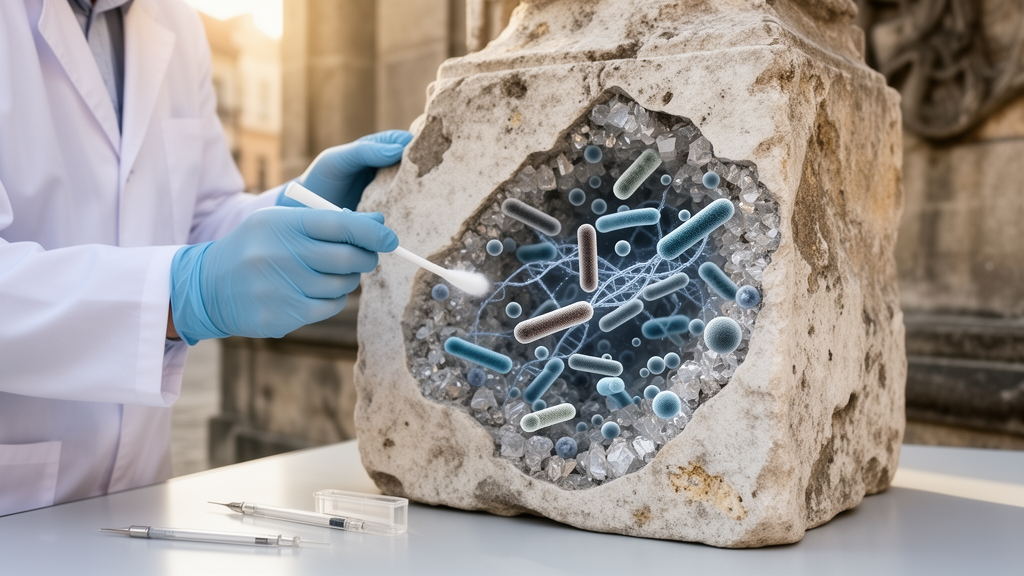
A study of 10 sub-aerial biofilm samples from Kraków found that fungi, bacteria, algae and cyanobacteria on urban stone formed communities with contrasting co-occurrence patterns. Fungal networks were highly integrated, bacterial assemblages were more modular, and phototrophic networks were fragmented, indicating that the microbial groups differed in how they were associated within the sampled biofilms. The researchers also identified substrate-related patterns in colonization, while concluding that the overall taxonomic composition was consistent with earlier culture-dependent surveys.
The study examined eight samples collected from a historic cemetery in Kraków and two taken from retaining walls within the city. Investigators used a low-invasive method to collect material directly from the stone surfaces. They then applied Illumina environmental DNA metabarcoding targeting fungi, algae and bacteria, allowing the composition of all three microbial groups to be assessed from the samples. The small number of samples and concentration in one city limit the scope of the findings, which should not be interpreted as a comprehensive survey of microbial life on urban stone everywhere.
Among the detected bacterial taxa, Proteobacteria and Actinobacteria together accounted for approximately 60%. Fungal communities were dominated by representatives of the classes Dothideomycetes and Eurotiomycetes. Within the algal assemblages, Chlorophyta constituted the majority of algal taxa, and cyanobacteria were also highly represented among the phototrophic organisms. The researchers compared the taxonomic composition of the sub-aerial biofilms in relation to the type of stone substrate. Their results highlighted substrate-related patterns in microbial colonization, although the sampled cemetery and retaining-wall locations did not provide a broad test across many kinds of urban stone.
Beyond identifying organisms, the analysis used co-occurrence networks to characterize the statistical associations among detected taxa. Fungal communities displayed the highest degree of integration, whereas bacterial assemblages had a more modular structure. Networks formed by phototrophic organisms were comparatively fragmented. The authors interpret these domain-specific patterns as evidence that the organization of a stone-associated biofilm may depend not only on its taxonomic composition but also on relationships among members of different microbial domains. The network results describe statistical co-occurrence patterns; the study did not directly demonstrate interactions such as competition, cooperation or resource exchange among the organisms.
The findings are relevant to the biodeterioration of stone cultural heritage, where sub-aerial biofilms are recognized as an important factor. The simultaneous detection of fungi, algae, cyanobacteria and bacteria shows that these stone-associated communities can contain several microbial groups with different patterns of organization. However, the research did not directly measure rates of stone decay or establish that a particular microbial group or network structure caused greater deterioration. Instead, it demonstrated the suitability of environmental DNA metabarcoding for comprehensive characterization of sub-aerial biofilms and documented differences in how bacterial, fungal and phototrophic taxa were associated. The network analysis also suggests that taxonomic inventories alone may not capture the full community structure of biofilms on exposed stone surfaces.
Subject of Research: Environmental DNA analysis of microbial communities on urban stone surfaces
Article Title: Sub-aerial biofilms on urban stone surfaces: community structure and microbial co-occurrence networks
Article References: Owczarek-Kościelniak, M., Okrasińska, A., & Pawłowska, J. (2026). Sub-aerial biofilms on urban stone surfaces: community structure and microbial co-occurrence networks. Frontiers in Microbiology, 17, Article 1904600. https://doi.org/10.3389/fmicb.2026.1904600
Image Credits: AI Generated
DOI: 10.3389/fmicb.2026.1904600
Keywords: sub-aerial biofilms, urban stone, environmental DNA, metabarcoding, microbial communities, co-occurrence networks, fungi, cyanobacteria, biodeterioration, cultural heritage, Sub-aerial, biofilms
News Source: Morgan Morrow. (October 22, 2026). eDNA study maps microbial networks on Kraków urban stone. Scienmag.