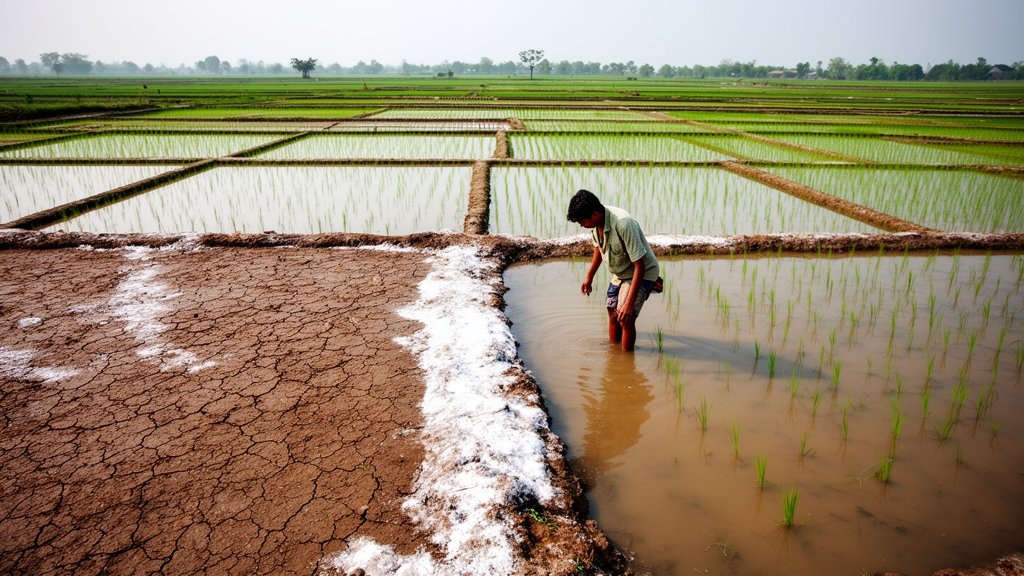
Alternate wetting and drying saved irrigation water across coastal Bangladesh but produced sharply different rice-growing outcomes depending on local salinity. In two years of on-farm trials, the water-saving method increased irrigation water productivity without reducing Boro rice yield in the low-salinity Barishal region. In the medium-salinity Khulna region, however, the same method was associated with higher soil salinity and an average grain yield about 14% below continuous flooding. The results indicate that alternate wetting and drying, commonly abbreviated AWD, is not a universally suitable replacement for flooded irrigation in saline rice systems.
The researchers conducted trials during the 2021–22 and 2022–23 dry seasons at five locations each in Barishal and Khulna, giving the study ten on-farm sites across two coastal agroecological environments. Each 1,320-square-metre field was divided among three irrigation regimes: continuous flooding, saturation without standing water, and AWD. Under continuous flooding, a 5–7-centimetre water depth was maintained through most of the growing season, with the field drained 15 days before harvest. Saturation treatments were irrigated whenever standing water disappeared, while AWD fields were reirrigated after the water table fell about 15 centimetres below the soil surface. The experiments used a randomized complete block design with three replicates per location.
All plots were planted with BRRI dhan67, a salt-tolerant, medium-duration rice variety with an approximately 145-day growth period. Thirty-five- to 40-day-old seedlings were transplanted at 20-by-20-centimetre spacing. Irrigation was supplied from nearby rivers and canals through pipes fitted with flowmeters, allowing the researchers to measure applied water throughout each season while excluding rainfall. Soil samples were taken at four stages—before transplanting, maximum tillering, flowering, and after harvest—to measure salinity in a one-to-five soil-to-water suspension. Grain yields were measured from 10 square metres per plot and adjusted to 14% moisture, while irrigation water productivity was calculated as grain yield divided by the volume of irrigation water applied.
In Barishal, irrigation treatment did not significantly affect grain yield, tillering, or thousand-grain weight. AWD did produce more spikelets per panicle than either continuous flooding or saturation, with 129 spikelets under AWD compared with 122 and 124, respectively. Although soil salinity rose as the crop developed, the differences among irrigation treatments were relatively small. At harvest, the reported one-to-five electrical conductivity values were about 0.27 under continuous flooding, 0.28 under saturation, and 0.30 dS per metre under AWD. This low level of variation meant that AWD could reduce water demand without a detectable yield penalty under the conditions tested in Barishal.
The clearest water-saving benefit appeared in the amount of irrigation applied. In 2021–22, AWD plots in Barishal received between 679 and 808 millimetres of irrigation, compared with 917–1,200 millimetres under continuous flooding and 855–937 millimetres under saturation. During 2022–23, AWD required 686–900 millimetres, while continuous flooding required 900–1,140 millimetres and saturation 828–1,000 millimetres. AWD consistently used the least water and required fewer irrigations. Irrigation water productivity was correspondingly higher: AWD values ranged from 0.78 to 0.98 kilograms per cubic metre in 2021–22 and from 0.73 to 0.79 kilograms per cubic metre in the following season, exceeding the ranges recorded under continuous flooding and saturation.
Khulna presented a more difficult trade-off between water conservation and crop performance. Irrigation-water salinity was consistently greater there than in Barishal and increased as the dry season advanced. In 2021–22, water salinity rose from about 1.5 dS per metre in January to 4.3 dS per metre in April in Khulna; the corresponding increase in Barishal was from 0.2 to around 1.5 dS per metre. Soil salinity also climbed through the crop cycle. At flowering, the reported one-to-five electrical conductivity reached approximately 0.56 under continuous flooding, 0.64 under saturation, and 0.72 dS per metre under AWD. The values declined slightly after flowering but remained highest under AWD, at about 0.67 dS per metre at harvest, compared with 0.60 under saturation and 0.54 under continuous flooding.
Those salinity differences coincided with significant treatment effects on yield and yield components. Continuous flooding produced the highest average grain yield in Khulna, at 5.8 tonnes per hectare, followed by saturation at 5.5 tonnes and AWD at 5.0 tonnes. It also produced the greatest number of tillers per square metre, 503, the largest number of spikelets per panicle, 122, and the highest thousand-grain weight, 21.0 grams. AWD recorded the lowest values for these components. Across both seasons, AWD therefore reduced irrigation water application by about 27.5% in 2021–22 and 22% in 2022–23, yet the water saved did not translate into a comparable grain yield.
Despite its yield penalty, AWD still delivered the highest irrigation water productivity in Khulna. The measure was 0.75 kilograms per cubic metre under AWD in 2021–22, compared with 0.66 under saturation and 0.58 under continuous flooding, an improvement of approximately 30% over continuous flooding. In 2022–23, the corresponding values were 0.69, 0.64, and 0.57 kilograms per cubic metre, making the AWD advantage approximately 21%. The productivity gain therefore reflects a combination of less irrigation water and the amount of grain produced per unit of water, rather than an improvement in absolute yield. In both regions, higher irrigation inputs were generally associated with lower irrigation water productivity, while water-saving treatments used less water in 97% of comparisons with continuous flooding.
The authors did not directly measure salt leaching, plant sodium uptake, or the root-zone salt balance, so they could not establish the precise mechanism behind the yield differences. They proposed that periodic drying under AWD may concentrate salts in the surface soil through evaporation, potentially increasing plant exposure to sodium and impairing grain development. Continuous flooding may instead facilitate salt movement below the root zone, while saturation retains a wetter surface and showed intermediate salinity and yield in most comparisons. The researchers caution that saturation was not a consistent replacement for flooding either: in the second Khulna season, its yield was significantly lower than that of continuous flooding, suggesting that its performance may weaken under prolonged or more severe salinity stress.
The study supports site-specific irrigation planning rather than a blanket shift to AWD in coastal Bangladesh. Its strongest evidence applies to the tested environments, seasons, irrigation-water qualities, and the BRRI dhan67 variety. Validation across more locations, years, water-salinity conditions, and rice varieties is still needed before wider recommendations can be made. Within the experiment, AWD was clearly effective at conserving water and improving irrigation water productivity in low-salinity Barishal without reducing yield. In medium-salinity Khulna, the same approach saved water and improved water productivity but came with greater soil salinity and lower yields, making careful control of irrigation water and salinity central to any decision to use it in saline-prone coastal fields.
Subject of Research: Field assessment of alternate wetting and drying irrigation for saline coastal Boro rice in Bangladesh
Article Title: Assessing the impact of alternate wetting and drying irrigation on soil salinity, water productivity, and Boro rice yield in coastal saline regions of Bangladesh
Article References: Paul, P. L. C., Roy, D., Shamsudduha, M., Hossain, M. B., Alam, M. M., Shultana, R., Mila, A. J., & Hasnat, J. (2026). Assessing the impact of alternate wetting and drying irrigation on soil salinity, water productivity, and Boro rice yield in coastal saline regions of Bangladesh. Discover Agriculture, 4(1), Article 325. https://doi.org/10.1007/s44279-026-00804-z
Image Credits: AI Generated
DOI: 10.1007/s44279-026-00804-z
Keywords: alternate wetting and drying, Boro rice, soil salinity, irrigation water productivity, coastal Bangladesh, grain yield, saline agriculture, water management, BRRI dhan67, Assessing, impact, alternate
News Source: Alan Morgan. (October 22, 2026). AWD saves water but raises salinity in Bangladesh rice fields. Scienmag.