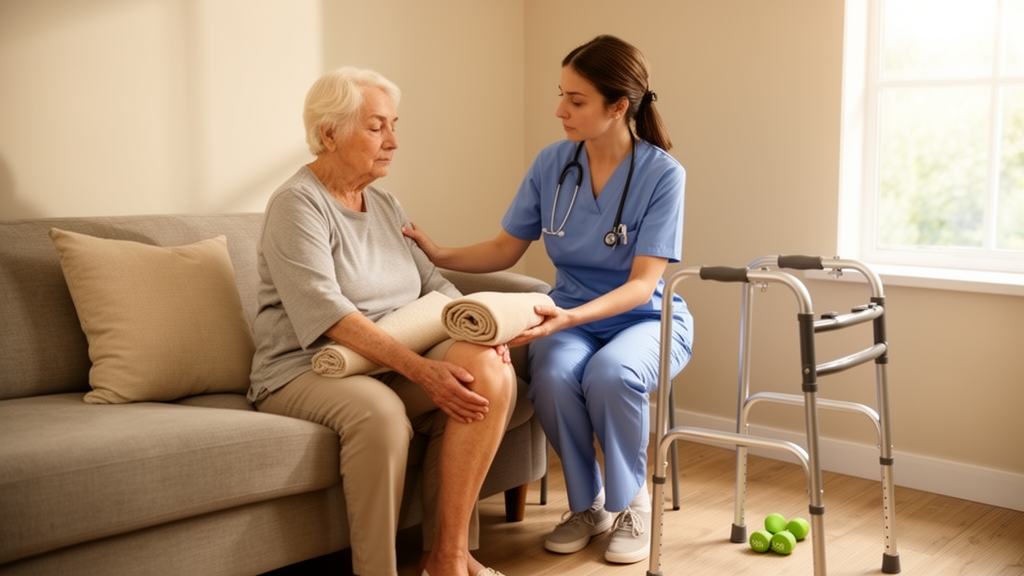
A randomized controlled trial of 72 patients undergoing total knee replacement found that a nine-session, nurse-led coaching program was associated with lower pain and anxiety and greater self-care agency through 90 days after discharge. Participants receiving coaching also reported substantially higher satisfaction with nursing care, while adjusted differences in activities of daily living were significant at discharge and 15 days after discharge but not at 45 or 90 days. The researchers said the findings should be interpreted as supportive rather than confirmatory because the trial was conducted at one center, outcome assessors were not blinded, baseline scores were imbalanced, and the statistical analysis did not fully account for comparisons across outcome variables.
The parallel-group trial randomly assigned 36 participants to each group. The intervention consisted of nine scheduled, in-person coaching sessions that began during the preoperative outpatient phase, continued throughout the hospital stay and included sessions on days 15, 45 and 90 after discharge. Researchers assessed pain with the Visual Analog Scale, anxiety with the State-Trait Anxiety Inventory, self-care agency with the Self-Care Agency Scale and functional independence with the Modified Barthel Index.
Satisfaction with nursing care was measured using the Newcastle Satisfaction with Nursing Scale. Because the investigators had not defined a single primary endpoint, they evaluated the findings across multiple outcomes. The primary intention-to-treat analysis used baseline-adjusted linear mixed-effects models and included all 72 randomized participants in their originally assigned groups.
Each participant provided at least one post-baseline measurement for the Visual Analog Scale, State-Trait Anxiety Inventory, Self-Care Agency Scale and Modified Barthel Index, and the models used all available follow-up observations without imputing missing values. Across follow-up, the coaching group had lower pain scores, with an overall group effect of χ² = 51.16 and p < 0.001, and lower anxiety scores, with an overall group effect of χ² = 60.71 and p < 0.001. Self-care agency scores were higher in that group, with an overall group effect of χ² = 56.73 and p < 0.001.
At day 90, the adjusted between-group difference was −1.97 points for pain on the Visual Analog Scale, with a 95% confidence interval of −2.71 to −1.22 and standardized effect size d = −1.48. The adjusted anxiety difference was −14.36 points on the State-Trait Anxiety Inventory, with a 95% confidence interval of −18.58 to −10.13 and d = −2.01. For self-care agency, the adjusted difference was 26.81 points, with a 95% confidence interval of 19.87 to 33.74 and d = 2.39.
Adjusted Modified Barthel Index differences favored coaching at discharge and on day 15, but the differences were not statistically significant on days 45 or 90. Nursing-care satisfaction was higher in the intervention group, with a mean difference of 18.25 points, a 95% confidence interval of 11.98 to 24.52, a Hedges’ g of 1.40 and p < 0.001. In a complete-case sensitivity analysis, analgesic use decreased in 87.9% of the intervention group, or 29 of 33 patients, compared with 70.6% of the comparison group, or 24 of 34 patients; Cramér’s V was 0.31.
Hospital readmission did not differ significantly: the reported relative risk was 0.26, with a 95% confidence interval of 0.06 to 1.12 and p = 0.083. Although multiple-comparison correction covered the four post-baseline comparisons within each longitudinal outcome, it did not account for multiplicity across the different outcome variables. The results therefore associate the structured coaching program with favorable patient-centered outcomes, including lower pain and anxiety and higher self-care agency, but the trial’s design and analytical limitations constrain stronger conclusions.
Subject of Research: Randomized trial of perioperative nurse-led coaching after total knee replacement
Article Title: Effects of perioperative nurse-led coaching on pain, anxiety, and self-care outcomes up to 90 days following total knee replacement: a randomized controlled trial
Article References: Durmaz, M., & Kurşun Kural, Ş. (2026). Effects of perioperative nurse-led coaching on pain, anxiety, and self-care outcomes up to 90 days following total knee replacement: a randomized controlled trial. BMC Nursing. https://doi.org/10.1186/s12912-026-05481-3
Image Credits: AI Generated
DOI: 10.1186/s12912-026-05481-3
Keywords: total knee replacement, nurse-led coaching, postoperative pain, anxiety, self-care agency, nursing care satisfaction, activities of daily living, randomized controlled trial, patient-centered care, rehabilitation, Effects, perioperative
News Source: Glenn Wilkins. (October 22, 2026). Nurse-led coaching linked to lower pain and anxiety after knee replacement. Scienmag.