In medical teams responding to simulated emergencies, the meaning of shared physiological signals depended on the complexity of their interaction patterns. A quasi-experimental study of 19 teams found that greater heart-rate synchrony was associated with better self-reported adaptation during relatively simple behavioral sequences, while lower skin-conductance synchrony accompanied better adaptation during more complex sequences. Among the most complex interaction patterns, greater regularity in electrodermal activity was associated with better trainer-rated performance. These conditional associations suggest that no single measure of physiological coordination can serve as a universal indicator of whether a team is adapting or performing well.
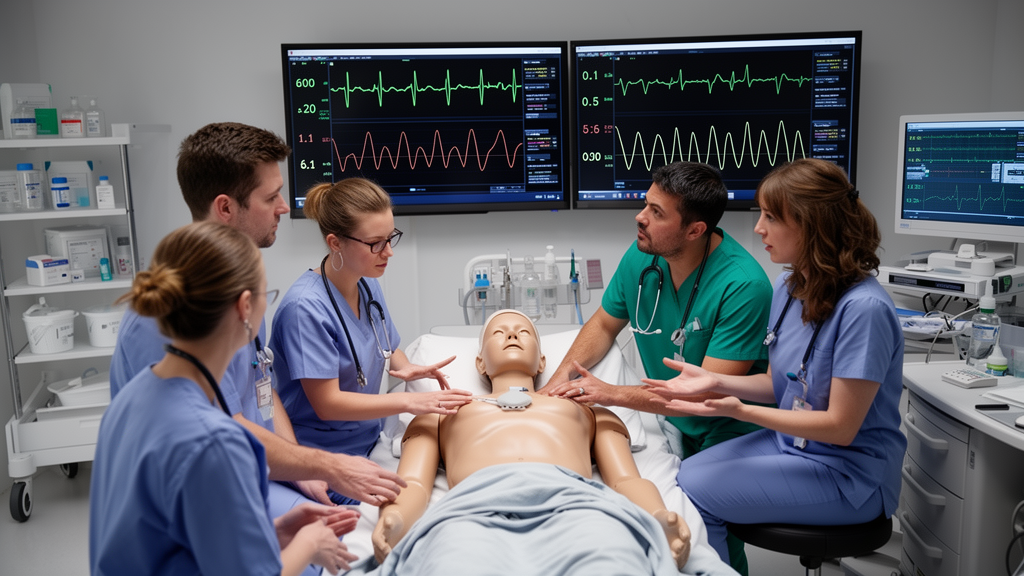
The study combined 360-degree video analysis with wrist-worn sensors to examine 150 medical professionals completing 37 simulation-based emergency scenarios across two hospitals in the Netherlands. The analyzed sample represented 19 teams of nurses, midwives, physician assistants, residents and medical specialists. Scenarios included breech presentation, pneumonia with septic shock, supraventricular tachycardia, hypovolemic shock and bronchiolitis with respiratory failure. Each case required communication, role escalation, decision-making and coordinated treatment under time pressure, providing a controlled environment in which to observe team dynamics during changing clinical demands.
Researchers used a coding framework to classify team behavior along two dimensions: coordination of actions versus coordination of information, and explicit versus implicit coordination. They then searched the resulting event sequences for team behavioral interaction patterns, or TBIPs, using T-pattern analysis. A T-pattern is a recurring sequence whose order and timing are organized rather than random. The complexity of each pattern was defined by the number of hierarchical levels: a simple request followed by an answer occupied one level, whereas nested exchanges involving clarification and decision-making could form a higher-level structure. The full set of detected patterns ranged from two to 13 behavioral elements and from one to seven levels of complexity, showing that emergency interactions included both compact routines and extensively nested sequences.
Video was paired with heart rate and electrodermal activity, the latter reflecting changes in skin conductance associated with sympathetic arousal. The investigators calculated collective physiological coordination for patterns that met the analysis threshold. Patterns shorter than 30 seconds were excluded because the recurrence analysis required a longer observation window to identify recurring states reliably. For each retained pattern, coherence quantified synchrony, or the extent to which team members’ signals moved together in the frequency domain. Multidimensional recurrence quantification analysis quantified regularity by identifying repeated states and predictable sequences in the multivariate time series. Team adaptation was assessed through a three-item questionnaire completed by trainees, while trainers rated observable communication and teamwork performance on a 19-item, four-category scale before each debrief. Both outcome measures were transformed to 0–100 scales.
When the researchers first asked whether behavioral complexity alone was related to outcomes, the answer was not straightforward. Mean TBIP complexity was not significantly related to self-reported team adaptation. Its unadjusted association with team performance was positive and statistically significant, but it disappeared after accounting for hospital, suggesting that the apparent relationship was largely attributable to differences between the two sites. Because the hospitals also differed in training structure, clinical setting and team composition, the study could not identify which site-specific factor produced the variation in performance ratings. The adjusted analysis found no evidence that a uniform increase in interaction complexity was consistently beneficial.
The more informative results emerged from the interaction between physiological coordination and behavioral complexity. In multilevel models based on 496 retained pattern-level observations, the relationship between adaptation and heart-rate synchrony changed significantly with complexity. Higher heart-rate synchrony corresponded to better adaptation at low-complexity levels, whereas lower electrodermal synchrony corresponded to better adaptation at high-complexity levels. Both interaction terms had standardized coefficients of −0.16 and p-values below 0.001. Follow-up analyses located the significant adaptation associations below 0.86 standard deviations of mean complexity for heart rate and above 0.72 standard deviations for electrodermal activity.
Skin conductance told a different story about performance. The association between team performance and electrodermal regularity became significant only at high levels of behavioral complexity, with a standardized interaction coefficient of 0.13 and p = 0.008. The relationship was significant at complexity more than 1.13 standard deviations above the mean. In other words, teams rated as performing better tended to show more predictable electrodermal patterns when their interaction structure was especially elaborate. Heart-rate synchrony and regularity showed no significant interaction with performance, and the physiological coordination measures did not show significant main effects on either outcome. Because physiological coordination was modeled as the dependent variable, the results describe contemporaneous associations rather than showing that synchronized bodies cause better adaptation or performance.
One possible interpretation is that simple sequences represent routine coordination supported by shared expectations, in which synchronized heart rates may accompany efficient execution, while more elaborate sequences require teams to reorganize around unfamiliar or changing demands. Under those conditions, reduced skin-conductance synchrony could be compatible with creative disruption rather than poor teamwork. The authors also note that heart rate is sensitive to attention, effort and engagement, whereas electrodermal activity is more closely linked to arousal and stress-related activation. The data cannot establish which explanation is correct because the study did not directly measure shared mental models, communication frequency, cognitive workload or task demands. The direction of causation remains unresolved, and the findings should not be read as evidence that increasing or reducing physiological synchrony would improve a team’s results.
Several limitations constrain how the findings can be applied. Patterns shorter than 30 seconds were excluded, and because shorter sequences are often less complex, this filtering may have biased the retained sample. Heart rate had to be estimated from noisy photoplethysmographic data using a 120-second moving window, smoothing rapid fluctuations and incorporating some physiological activity that occurred before or after a pattern. A 60-second coordination window was imposed because the recurrence analysis required sufficient observations, so estimates for shorter retained patterns extended beyond the interaction they were meant to characterize. The adaptation measure also had only modest reliability when aggregated to the team level, and the small sample could not test whether task complexity, familiarity, leadership or experience also moderated the relationships.
Simulation, observation and measurement may further limit generalizability. Although the exercises used realistic hospital equipment and emergency cases, they could not reproduce all uncertainty, workload and consequences of actual patient care. Participants knew they were being video-recorded and monitored, potentially altering both their behavior and their physiological responses. The sample was also drawn from only two hospitals and was predominantly female because nursing, obstetrics and gynecology were major specialties represented, while the clinical specialties differed between sites. The models explained only about 3–7% of variance through their fixed effects, making the observed relationships small and emphasizing their limited predictive value. Prospective, out-of-sample studies would be required before wearable monitoring could be used for real-time team assessment. For now, the clearest takeaway is that a team’s physiological signals must be interpreted alongside the behavioral structure and circumstances in which they occur.
Subject of Research: Physiological coordination and behavioral complexity in medical emergency teams
Article Title: Linking physiological coordination and behavioral pattern complexity to team adaptation and performance in medical simulations
Article References: Hałgas, E. A., Westerink, J. H. D. M., Wiltshire, T. J., Rispens, S., van Eijndhoven, K. H. J., Fransen, A., & Gevers, J. M. P. (2026). Linking physiological coordination and behavioral pattern complexity to team adaptation and performance in medical simulations. Frontiers in Neuroergonomics, 7, Article 1743312. https://doi.org/10.3389/fnrgo.2026.1743312
Image Credits: AI Generated
DOI: 10.3389/fnrgo.2026.1743312
Keywords: medical simulations, team adaptation, physiological coordination, heart rate, electrodermal activity, wearable sensors, behavioral patterns, team performance, healthcare teamwork, medical emergencies, Linking, physiological
News Source: Gavin Prescott. (October 22, 2026). Linking physiological coordination and behavioral pattern complexity to team adaptation and performance in medical simulations. Scienmag.