A physics-informed spatiotemporal graph neural network identified high-risk cascading trips in simulated photovoltaic power plants more accurately than several conventional deep-learning baselines, according to a study based on 500 electromagnetic fault scenarios. The proposed PI-STGNN classified low-, medium- and high-risk collector-line conditions with an overall accuracy of 0.972 and a macro-averaged F1 score of 0.943 on an independent test set. For the high-risk category, which included upstream breakers operating before branch fuses and disconnecting healthy branches, precision reached 0.92 and recall reached 0.91. These results apply to a modeled 100 MW plant and have not yet been demonstrated across operating photovoltaic facilities.
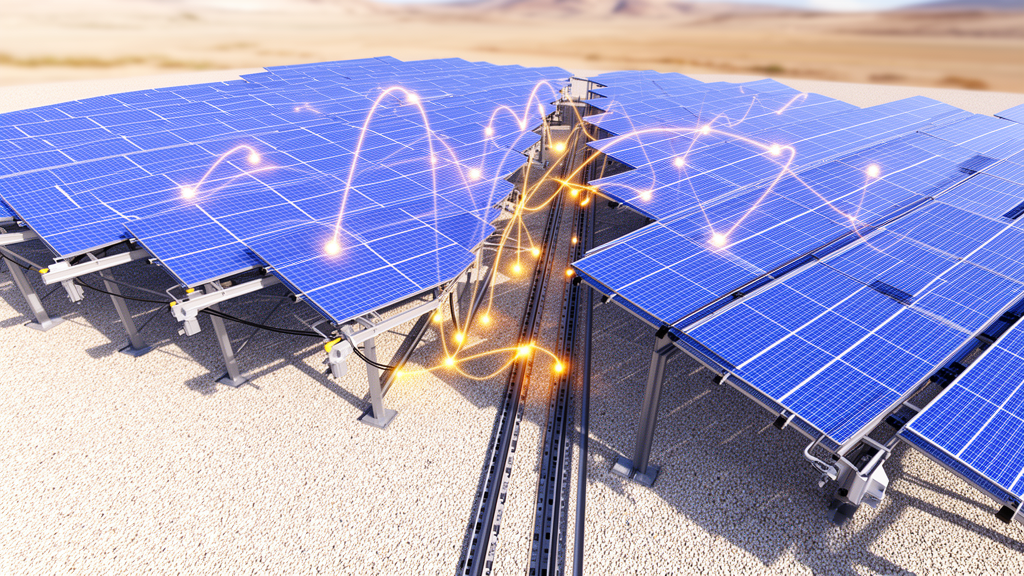
The problem addressed by the model is known as leapfrog tripping: a fault on one branch of a medium-voltage photovoltaic collector network is followed by operation of protection farther upstream, disconnecting equipment or generating branches that were not themselves faulted. This can happen because photovoltaic inverters behave differently from synchronous generators. Their fault currents depend on converter controls, current limiting, low-voltage ride-through strategies and grid conditions, often producing limited current magnitudes, altered phase relationships and little or no negative-sequence injection. Long collector cables add impedance between the fault and upstream protective devices, while changes in irradiance, array switching and network configuration further alter the current available to local protection.
Collectors commonly use fuses at branch connection points, with upstream feeder and transformer backup protection providing wider clearance if a local device fails. When the fault current is too weak to move a fuse rapidly into its instantaneous operating region, the fuse follows an inverse-time curve and may remain closed for longer than the upstream breaker is designed to wait. The resulting race between local and upstream protection can turn a branch fault into a wider outage. The researchers formalized this risk through low-, medium- and high-risk domains. A safety margin describes robust coordination in the low-risk domain, while a critical-sensitivity index identifies unstable states in which a small physical disturbance could push protection toward a false or cascading trip. A third measure combines the likelihood of coordination failure with potential loss from disconnected healthy branches.
Because serious collector-line cascading events are rare, the original simulations contained only 25 high-risk scenarios, making a conventional machine-learning dataset heavily imbalanced. The study addressed this problem with a conditional diffusion probabilistic model that generated candidate voltage and current sequences under specified operating, fault and risk conditions. A forward diffusion process progressively added Gaussian noise to real samples, while a learned reverse process reconstructed waveforms. Risk labels and physical variables acted as conditions during generation, and classifier-free guidance steered denoising toward specified classes. Every generated candidate was then screened against the protection-coordination criterion. Only 3,000 physically accepted synthetic high-risk windows were added to the training data; validation and test sets remained original and unaugmented.
The classifier itself represents the plant as a dynamic graph whose nodes include inverter units, collection branches and the step-up substation busbar. Rather than using simple on-or-off connections, the graph weights were derived from cable impedance, allowing the model to represent how current may divide through electrically unequal paths. Inverter control states were incorporated as self-connection information. Two graph-convolution layers and a physics-informed spatial-attention layer aggregated information among nodes, while causal temporal attention focused on pre-trip changes in current and on the interval in which a fuse’s operating time approached that of an upstream breaker. The critical-sensitivity and protection-timing criteria were embedded as attention biases and loss terms rather than added only after classification.
For input, the model used pre-trip voltage, current, sequence components, irradiance, temperature, topology, line impedance, inverter states and static protection settings. It excluded fuse and breaker operating times, breaker status and the final trip outcome, allowing the framework to produce risk probabilities before the protection sequence was complete. The architecture converted its fused spatiotemporal features into probabilities for the three risk domains. Its training objective combined weighted cross-entropy with a physics-consistency regularizer that penalized predictions inconsistent with the modeled protection race. During inference, the selected model used only measurements and physical priors, not synthetic data or known protection outcomes.
The experiments used PSCAD/EMTDC simulations of a modified 100 MW photovoltaic plant with four 35 kV feeders, 20 inverter-transformer units rated at 5 MW, and a 120 MVA main transformer. Cable lengths ranged from 1.2 to 6.8 km, and waveforms were sampled at 2 kHz. Before window extraction, the researchers divided the 500 complete scenarios into 350 training, 50 validation and 100 test scenarios, keeping all windows from a scenario in the same subset. Windowing produced 7,000 training samples, 1,000 validation samples and 2,000 test samples. Risk labels were assigned from the actual protection-operation sequence after each complete simulation, rather than from model inputs, and the test set was evaluated only after checkpoint selection by validation performance.
Under matched data partitions and training protocols, PI-STGNN outperformed a bidirectional long short-term memory network, a temporal convolutional network, a spatio-temporal convolutional network, an attention-based spatio-temporal convolutional network and a vanilla spatiotemporal graph network. Their accuracies ranged from 0.885 to 0.941, with macro-averaged F1 scores from 0.808 to 0.863, compared with 0.972 and 0.943 for PI-STGNN. High-risk recall among the other models ranged from 0.60 for the bidirectional long short-term memory network to 0.80 for the vanilla graph model. A feature visualization also showed less overlap among the three risk classes for PI-STGNN, particularly near the medium- and high-risk boundary, while a nearest-neighbor analysis found fewer mixed local neighborhoods than in the baselines.
Ablation tests indicated that the physical constraints contributed materially to high-risk recognition. Removing the complete set of physical enhancements produced the largest reduction in recall, while configurations retaining either the critical-sensitivity term or the protection-miscoordination term performed better than the version without both. High-risk recall increased by 6.7% when the critical-sensitivity constraint was restored and by 5.1% when the timing constraint was restored; using both produced an 11.6% gain relative to the configuration without physical priors. The diffusion augmenter also outperformed alternatives tested under the same conditions: CDPM achieved 0.972 accuracy, 0.943 macro-averaged F1 and 0.910 high-risk recall, compared with 0.963, 0.928 and 0.880 for targeted physics-based sampling, the strongest alternative. CDPM generated more diverse samples, with an average pairwise distance of 1.48 versus 1.12, and a lower maximum mean discrepancy from the original high-risk training distribution, 0.019 versus 0.058.
The findings show that combining network topology, time-resolved measurements and explicit protection rules can improve detection of an important failure mode in simulated PV collector systems. The study does not establish performance in live plants, however, and the authors identify limits involving scenario coverage, topology and protection-setting granularity, equipment uncertainty and cross-station generalization. The training protocol also required substantially more computation for the conditional diffusion model—about 12 hours—than for the graph classifier, whose reported 300-epoch run took about 35 minutes. Future work would need to test variable settings and independent photovoltaic plants, while investigating lightweight architectures and incremental learning for practical online warning. Until then, the results are best understood as promising evidence from a controlled simulation study rather than a field-validated early-warning system.
Subject of Research: Physics-informed spatiotemporal graph learning for assessing cascading collector-line protection trips in simulated photovoltaic plants
Article Title: PI-STGNN model-driven risk assessment method for leapfrog tripping in photovoltaic power plants
Article References: Xu, W., Wang, J., Wang, L., Zhou, J., Li, J., & Hong, S. (2026). PI-STGNN model-driven risk assessment method for leapfrog tripping in photovoltaic power plants. Frontiers in Energy Research, 14, Article 1930452. https://doi.org/10.3389/fenrg.2026.1930452
Image Credits: AI Generated
DOI: 10.3389/fenrg.2026.1930452
Keywords: photovoltaic plants, cascading tripping, graph neural networks, physics-informed AI, conditional diffusion, power protection, collector networks, fault risk, electrical engineering, renewable energy, PI-STGNN, model-driven
News Source: Katie Riggs. (October 22, 2026). Physics-informed graph model flags leapfrog tripping risk in simulated PV plants. Scienmag.