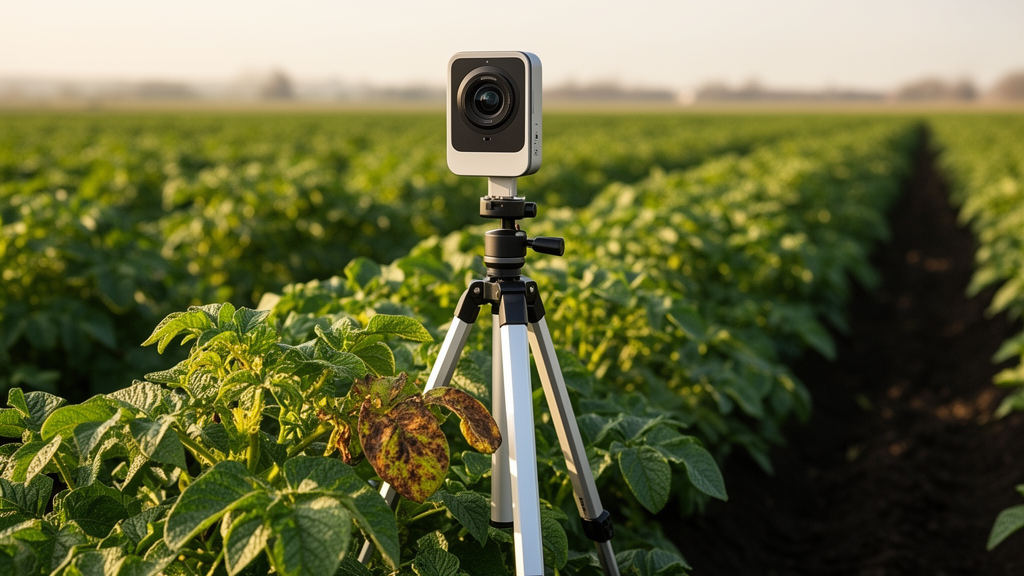
A lightweight artificial-intelligence model developed for detecting potato leaf diseases achieved 90.6% mAP50 on the DLOP dataset while using 6.5 million parameters and 15.6 GFLOPs, according to research published in BMC Plant Biology. The FEPL-DETR system was designed to locate diseased lesions on potato foliage under complex field conditions and was also tested on an edge-computing device.
Potato foliar diseases pose a threat to crop growth and yield, making timely and accurate disease detection important for early intervention and field management. Reliable detection remains challenging in field environments, where lesions may have varied edges, textures and irregular boundaries. FEPL-DETR is an adaptation of the efficient detection transformer RT-DETR, with three principal components intended to improve lesion representation, feature integration and training supervision.
Its first component is a Faster Frequency-domain Dynamic Convolution CSPDarknet backbone, which was built to adaptively represent lesion edges, textures and irregular boundaries. The second is BF-RepELAN, a feature network that incorporates RepNCSPELAN4 into a bidirectional multi-scale fusion topology. Together, these modules are intended to strengthen the representation of disease-related features at different scales.
The third component is DSI-GAM, a semantic-distillation framework adapted to FEPL-DETR. The researchers used it to strengthen semantic supervision during training. The model therefore combines a more adaptive visual backbone, multiscale feature processing and a training framework designed to provide additional semantic guidance.
On the DLOP dataset, FEPL-DETR reached 90.6% mAP50 and 65.4% mAP50:95. Compared with RT-DETR-R18, the model improved mAP50 by 5.7 percentage points and mAP50:95 by 0.6 percentage points. Its parameter count was 67.0% lower and its computational cost was 72.6% lower than that comparator, indicating a substantial reduction in model size and processing demand while maintaining the reported detection results.
The edge-device test found that FEPL-DETR processed 13.1 frames per second when deployed on an NVIDIA Jetson Orin Nano. This result demonstrates operation on a resource-constrained device in the study’s tested deployment setup. The reported speed should be understood in that context rather than as a general guarantee of performance across all hardware or field conditions.
External-dataset evaluations also indicated that the model could generalize beyond the DLOP dataset. The supplied research evidence does not specify the additional datasets, image sources or measured results from those evaluations, so the extent of that generalization cannot be independently characterized from the abstract. It does establish that the authors assessed performance beyond the primary dataset.
The work is a computational detection study, not a trial of disease-control outcomes. The reported results concern model accuracy, computational efficiency and inference speed; they do not establish effects on treatment decisions, crop yield or farm productivity. The article was published as open-access, peer-reviewed research in BMC Plant Biology and was available as an early version subject to further editing before replacement by the final Version of Record. Within the reported scope, FEPL-DETR offers a compact computer-vision approach for potato leaf-disease detection, including operation on edge hardware.
Subject of Research: Lightweight transformer-based detection of potato leaf diseases under complex field conditions
Article Title: FEPL-DETR: an efficient lightweight detector for potato leaf diseases under complex field conditions
Article References: Hou, Q., Zhang, Z., Tian, Y., Fu, Q., & Deng, L. (2026). FEPL-DETR: an efficient lightweight detector for potato leaf diseases under complex field conditions. BMC Plant Biology. https://doi.org/10.1186/s12870-026-10190-9
Image Credits: AI Generated
DOI: 10.1186/s12870-026-10190-9
Keywords: potato diseases, machine learning, object detection, FEPL-DETR, RT-DETR, edge computing, plant pathology, computer vision, crop monitoring, efficient detection, efficient, lightweight
News Source: Alan Morgan. (October 22, 2026). Lightweight AI detects potato leaf diseases under field conditions. Scienmag.