Researchers have measured X-ray emissions from plutonium, uranium and neptunium with unprecedented accuracy using ultrasensitive transition-edge sensors developed at the National Institute of Standards and Technology. The peer-reviewed measurements address a persistent obstacle in nuclear monitoring: X-rays from some radioactive elements occupy the same energy range as gamma rays carrying the distinctive signals used to identify and characterize nuclear material. By quantifying the confounding X-ray background, the researchers say the results can improve assessments of the amount, type and isotope composition of material at nuclear power plants and weapons facilities. The experimental study was conducted by teams from NIST, the University of Colorado Boulder, Los Alamos National Laboratory, Houghton University in New York and the Kastler Brossel Laboratory at Sorbonne University in Paris.
Gamma-ray emission patterns are among the principal signals used to monitor nuclear materials. Each radioactive element produces a recognizable pattern of gamma rays, allowing investigators to assess which substances are present and, under suitable conditions, determine their relative abundance. Some elements also emit X-rays within the same energy range, and those emissions can mask the gamma-ray signal. That interference makes it harder to evaluate how much nuclear material is present and whether it has the composition expected for civilian fuel or weapons material. Rather than trying to eliminate the interfering radiation, the NIST-led team characterized it in detail so it could be subtracted more accurately from measurements made with gamma-ray detectors.
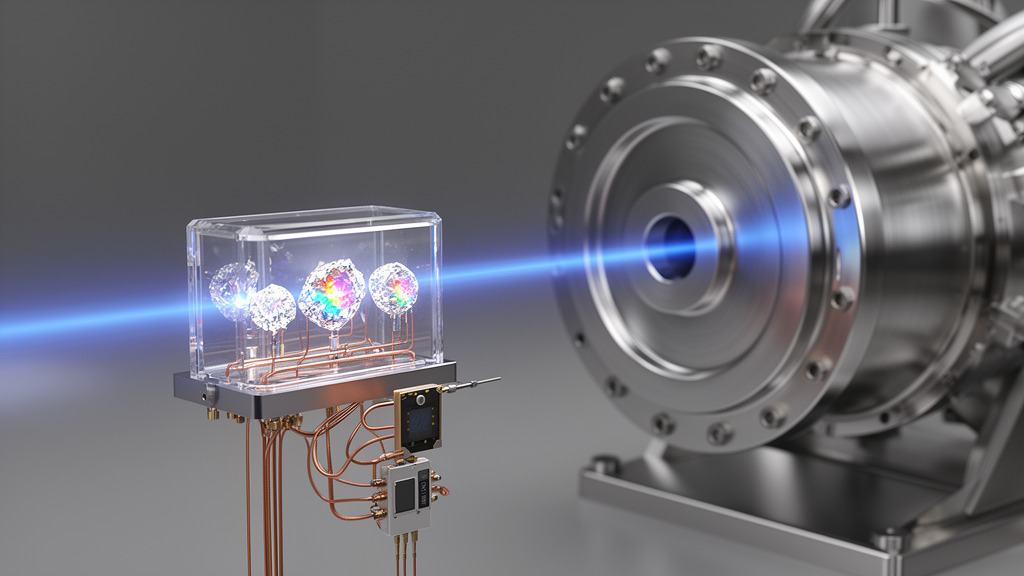
At the center of the experiment is an array of about 250 quantum sensors that function as exceptionally sensitive thermometers. These devices, known as transition-edge sensors, or TESs, contain a superconducting film maintained at a temperature just a fraction of a degree above absolute zero. At this operating point, the film lies at the transition between a zero-resistance superconducting state and an ordinary metallic state with measurable resistance. When an individual particle of light, such as an X-ray photon, strikes the sensor, it transfers a minuscule amount of energy and produces a sharp increase in resistance. Because the resistance change is directly proportional to the energy deposited by the photon, the sensor can resolve individual photons and make high-resolution energy measurements.
The team used the array to measure X-rays emitted by uranium, plutonium and neptunium, a nuclear decay product of uranium. The measurements focused on the energy range in which these X-ray emissions overlap with gamma rays of interest for nuclear monitoring. The sensitivity of the TES reduced the uncertainty of the X-ray energy measurements by between one-third and one-eighth compared with previous measurements. This improvement in precision is the central experimental result. The study did not directly measure nuclear inventories at operating facilities or demonstrate that routine safeguards procedures have already become more accurate; instead, it established a more detailed characterization of interfering X-ray emissions that can support combined X-ray and gamma-ray analysis.
The potential benefit for safeguards follows from the complementary information supplied by the two forms of radiation. By measuring the obscuring X-ray radiation and effectively subtracting it from a recorded signal, an instrument can more closely isolate the characteristic gamma-ray pattern associated with a particular element. Such measurements can also help determine the ratio of isotopes within a material. Isotopes are atoms of the same element with different numbers of neutrons in their nuclei, and their relative abundance can indicate whether material is intended for use in a nuclear power plant or a nuclear weapon. Jonathan Dean, a physicist at NIST and the University of Colorado Boulder, said the measurements support international nuclear safeguards by enabling more precise accounting of material in nuclear facilities.
Uranium illustrates why isotope ratios matter. Uranium-235 accounts for about 0.7% of the total abundance of uranium in nature, but it must be enriched to a relative abundance of a few percent for fuel and to about 90% for weapons-grade material, according to the research report. Detecting and quantifying such differences requires sufficiently precise measurements against a well-characterized background. The reported reduction in uncertainty does not specify the degree to which any particular operational measurement will improve, but it provides a more accurate experimental basis for isotope accounting. The work should therefore be viewed as an enabling measurement advance rather than a new safeguards technology already validated for routine deployment.
Speed could be another potential advantage. Nuclear electricity generation is a multistep process in which the composition of nuclear fuel must be reassessed before the next stage proceeds, and more rapid assessments could shorten the hold-up time between steps. Dean said that measuring fuel composition more quickly has the potential to increase efficiency and reduce costs at nuclear power plants. That operational benefit remains prospective. The reported experiment characterized the X-ray emissions of three radioactive elements; it did not quantify the effect of the new measurements on the time required for fuel analysis, plant throughput or production costs in a working power plant.
A practical limitation is that TESs must be cooled to within a fraction of a degree above absolute zero, and the necessary refrigeration equipment is too bulky for handheld use. Arrays of TES detectors can nevertheless operate at fixed locations that have enough electrical power to support the cooling system. Where a TES is not immediately available, scientists can collect samples of radioactive material and send them to a separate laboratory equipped for the measurements. Dean said the instruments are compatible with both approaches. NIST scientists and Los Alamos National Laboratory personnel have already installed TES detectors at three Department of Energy laboratories to monitor nuclear material at those sites, showing that the technology has been used in monitoring environments even though the X-ray benchmark reported here came from a dedicated experiment.
The same NIST-developed detector arrays have also been deployed in research projects at the SLAC National Accelerator Laboratory at Stanford University, the Advanced Photon Source synchrotron at Argonne National Laboratory and the National Synchrotron Light Source at Brookhaven National Laboratory. They have also been used at international facilities, including CERN in Switzerland. The team is pursuing further improvements in detector accuracy in collaboration with CERN for searches for new types of fundamental particles and plans to install a detector at NASA’s Goddard Space Flight Center to help investigate extreme environments in space. Separately, NIST is working to simplify, miniaturize and reduce the cost of the equipment used to chill the sensors. Two U.S. companies have adapted and now manufacture a NIST-designed compact refrigeration system for the TESs, an effort that could make the high-resolution detectors more accessible for precise nuclear-material measurements.
Subject of Research: Quantum-sensor measurement of X-ray backgrounds for nuclear material monitoring
Article Title: NIST-developed quantum sensors improve nuclear monitoring
Article References: NIST-developed quantum sensors improve nuclear monitoring. Original publication (Bibliographic details unavailable.)
Image Credits: AI Generated
DOI: Not provided
Keywords: transition-edge sensors, nuclear monitoring, uranium, plutonium, neptunium, gamma rays, X-ray emissions, nuclear safeguards, isotope analysis, quantum sensing, NIST-developed, quantum
News Source: Katie Riggs. (October 22, 2026). Quantum sensors sharpen X-ray measurements for nuclear monitoring. Scienmag.