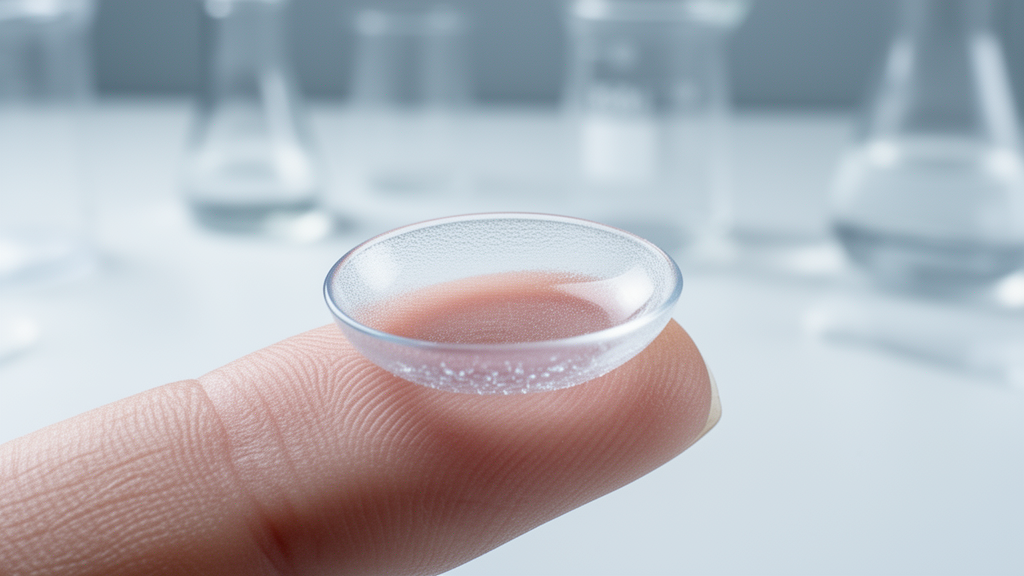
Researchers engineered a nanoscale poly(2-hydroxyethyl methacrylate), or poly(HEMA), coating that made three commercial silicone hydrogel contact lenses more wettable and resistant to protein and cell fouling without measurably reducing oxygen permeability, optical transparency, ultraviolet protection, bulk mechanical properties, or equilibrium water content. The study combined gas cluster ion beam X-ray photoelectron spectroscopy, time-of-flight secondary ion mass spectrometry, and a new atomic force microscopy algorithm to quantify the coating’s chemical gradients, layer thicknesses, and mechanical transitions on curved, hydrated lenses. The results support the approach as a platform for engineering buried interfaces, but the experiments involved laboratory lenses and cell and protein assays rather than clinical testing in people.
The coating was designed to solve a specific weakness of silicone hydrogels. Their siloxane-rich networks transport oxygen unusually well, but hydrophobic domains segregate toward the surface in water, creating chemically uneven interfaces associated with poor wettability, protein adsorption, unstable tear films, and friction. The researchers sought a hydrophilic outer layer without obstructing the oxygen-carrying channels inside the lens. Poly(HEMA) was grafted to Acuvue Oasys, Clariti 1 Day, and Ultra One Day lenses by free-radical polymerization at 80 degrees Celsius, using formulations containing 2.5%, 10%, or 20% HEMA. Linear poly(HEMA) chains became entangled with the existing crosslinked lens matrix, creating a semi-interpenetrating polymer network rather than a sharply separated film.
Surface analysis showed that the modification masked the underlying silicone chemistry. The proportion of surface oxygen increased in every lens type after treatment, while signals associated with silicon and nitrogen declined as the HEMA layer thickened. A new ester signal characteristic of poly(HEMA) appeared in high-resolution XPS spectra. Calculated surface coverage ranged from 34.90% ± 4.70% for 10% HEMA-treated Clariti to 88.92% ± 2.27% for 20% HEMA-treated Acuvue. Acuvue’s comparatively low swelling ratio, 47.2% ± 1.0%, was associated with greater coverage than in Clariti and Ultra, whose swelling ratios exceeded 98%. These relationships describe the tested materials and preparation conditions; they do not establish that swelling alone determines performance across all silicone hydrogels.
Depth profiling revealed that the interface was graded rather than a simple veneer. During incremental argon-cluster sputtering, the poly(HEMA) ester signal declined gradually with depth, indicating chemical intermingling with the substrate. ToF-SIMS provided a complementary three-dimensional view. In Acuvue-20HEMA, a fragment attributed to poly(HEMA) dominated the outermost region, while HEMA and siloxane signals coexisted in the subsurface, directly visualizing penetration and anchoring of the grafted chains. The same general chemical transition appeared in modified Clariti and Ultra lenses. This evidence supports formation of the intended semi-interpenetrating network across the three commercial substrates examined.
The investigators then used a custom AFM algorithm based on Hertz-model fits and force-distance curves to distinguish three mechanical regimes: the soft, hydrated outer poly(HEMA) coating, an intermediate semi-IPN region, and the stiffer base lens. Unlike XPS and ToF-SIMS, the aqueous AFM measurements characterized the interface in a hydrated environment. The method identified the surface contact point and the coating-to-semi-IPN transition, then estimated the thickness of each region. Coating thickness increased with HEMA concentration, ranging from 19.23 ± 1.10 nm to 46.28 ± 0.61 nm for Acuvue, from 36.83 ± 5.31 nm to 71.68 ± 6.74 nm for Clariti, and from 39.60 ± 6.47 nm to 54.31 ± 2.00 nm for Ultra. The 20% formulations generally produced the thickest modifications.
The architecture corresponded with measurable improvements in surface behavior. All HEMA-treated lenses had lower static water contact angles than their untreated counterparts. Acuvue-20HEMA had a contact angle of 55.64° ± 0.85°, compared with 90.31° ± 0.67° for pristine Acuvue. Its advancing angle fell from 38.57° ± 0.39° to 29.28° ± 3.35°, while contact-angle hysteresis decreased from 17.09° ± 0.82° to 7.12° ± 3.40°, indicating reduced surface heterogeneity. Solvent Black 3 stained exposed hydrophobic regions on pristine lenses but produced little visible staining after modification, particularly on Acuvue-20HEMA. Atomic force microscopy topography likewise showed that root-mean-square roughness fell by 42% for Acuvue-20HEMA, 20% for Clariti-20HEMA, and 23% for Ultra-20HEMA.
The antifouling tests linked these structural changes to protein and cell behavior. Poly(HEMA) reduced adsorption of bovine serum albumin and lysozyme relative to untreated lenses, with the 20% formulations generally performing better than the 10% formulations. Acuvue-20HEMA also reduced L929 fibroblast adhesion more effectively than Acuvue-10HEMA despite their similar surface coverage. The investigators attributed this difference to the greater physical thickness of the coating and semi-IPN. Cell viability for L929 and V79 fibroblasts remained above the 70% threshold specified in ISO 10993-5 for all pristine and modified lenses, indicating that washing removed enough residual reagents to satisfy that laboratory cytotoxicity criterion. The assays did not assess safety or effectiveness during human lens wear.
Critically, the sub-100-nanometer interface did not compromise the principal bulk functions tested. Optical transmission across visible, UVA, and UVB wavelengths was virtually unchanged, and each lens retained its original UV class. Oxygen permeability remained statistically unchanged because oxygen continued to diffuse through continuous siloxane channels in the bulk material. Fully hydrated tensile strength, macroscopic Young’s modulus, and equilibrium water content were also preserved, apart from an approximately 5% reduction in equilibrium water content for three modified formulations, which the authors associated with reduced surface roughness and effective surface area. Wettability persisted after 14 days in aqueous media, physiological saline, and simulated tear fluid at physiological temperature. Clariti-20HEMA and Ultra-20HEMA remained consistent through five hydration-dehydration cycles, while Acuvue-20HEMA showed a slight contact-angle increase from the fourth cycle but remained more hydrophilic than the untreated control. Poly(HEMA) also survived three steam-sterilization cycles without loss of its characteristic infrared signals.
The platform additionally accommodated a light-responsive prodrug containing a polymerizable methacrylate, a photocleavable o-nitrobenzyl linker, and dexamethasone. Copolymerizing the prodrug with HEMA anchored it to the Acuvue surface, where exposure to 405-nanometer light triggered release that largely stopped in darkness. The HEMA-containing system showed a small sustained release during dark intervals, attributed to hydrogen bonding and physical retention of cleaved drug within the hydrated polymer mesh. HPLC and mass spectrometry showed that the prodrug retained its structure during steam sterilization at 121 degrees Celsius. At 0.1% prodrug and 0.1% HEMA, the lenses remained optically transparent; raising the prodrug concentration to 0.5% caused phase separation and reduced optical transmission to 38.59% ± 3.52%, demonstrating that loading must remain within a tightly controlled window.
Taken together, the experiments present a quantitative method for linking buried coating chemistry, nanoscale architecture, interfacial mechanics, and biological performance on soft, curved biomedical substrates. The strongest performance occurred where the coating combined high surface coverage with sufficient thickness, while the failure at excessive prodrug loading showed that functionalization can disrupt optical properties. The work is an engineering and proof-of-concept study involving three commercial contact-lens materials, two fibroblast cell lines, and model protein assays; it did not evaluate long-term wear, clinical outcomes, or performance across the wider range of implants and therapeutic devices envisioned by the authors. Its broader contribution is a characterization strategy that can test how a buried interface is built, rather than relying only on fabrication chemistry and surface-level performance measurements.
Subject of Research: Nanoscale poly(HEMA) interface engineering and characterization in silicone hydrogel contact lenses
Article Title: Nanoscale Buried Interface Control in Silicone Hydrogels Enables a Biointerface Engineering Platform
Article References: Chen, P.-H., Wang, J.-H., Chen, C., Fu, S.-H., Chakravarthy, R. D., & Lin, H.-C. (2026). Nanoscale Buried Interface Control in Silicone Hydrogels Enables a Biointerface Engineering Platform. Advanced Science, Article e78148. https://doi.org/10.1002/advs.78148
Image Credits: AI Generated
DOI: 10.1002/advs.78148
Keywords: silicone hydrogels, contact lenses, nanocoatings, poly(HEMA), biointerfaces, atomic force microscopy, ToF-SIMS, X-ray photoelectron spectroscopy, antifouling, drug delivery, Nanoscale, Buried
News Source: Denise Maddox. (October 22, 2026). Nanoscale Coatings Transform Silicone Hydrogel Contact Lenses. Scienmag.