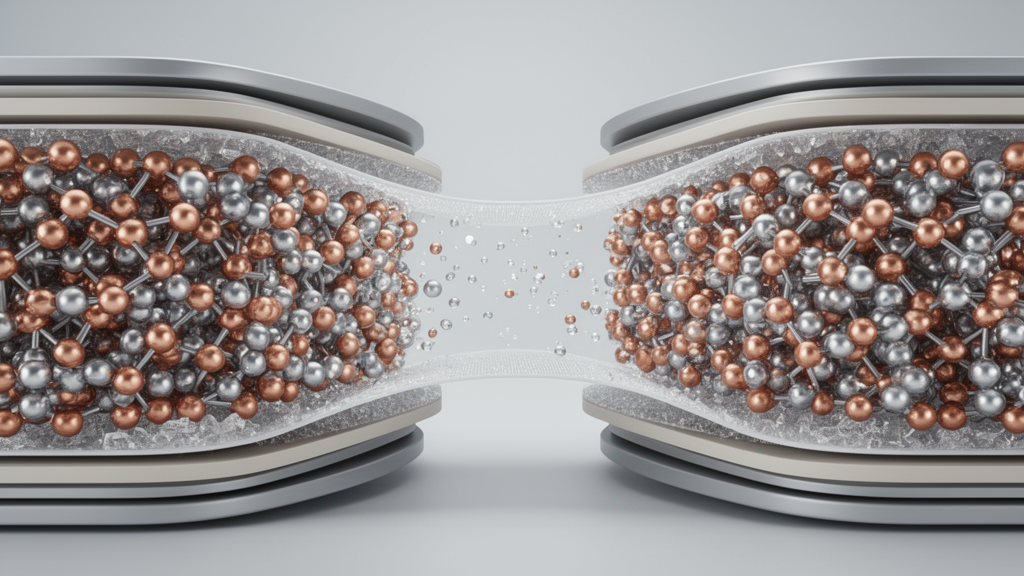
A review identifies elemental doping, morphology control, direct growth on conductive substrates, and composite formation as the principal strategies used to improve bimetallic spinel cobaltite electrodes for hybrid supercapacitors. The review focuses on the six compositions MCo₂O₄, where M is manganese, iron, nickel, copper, zinc, or magnesium, and emphasizes studies that report specific capacity in C g⁻¹ or mAh g⁻¹ as a measure relevant to energy-storage applications.
Hybrid supercapacitors combine capacitive and battery-type electrodes with the aim of delivering high energy and power densities. Within this device architecture, the battery-type component is central to efforts to satisfy industrial requirements for next-generation devices. Bimetallic spinel cobaltites are presented as promising candidates because they provide high theoretical capacity, multiple redox-active sites, and robust structural stability. The review is a synthesis of reported design approaches rather than a new experimental study, so its conclusions summarize work across the existing research literature instead of reporting a newly tested material or device.
Elemental doping is one of the approaches under examination. The available review evidence identifies substitution as a route for modifying spinel cobaltite materials and enhancing electrochemical performance, but it does not provide individual doping results, capacity values, or comparative gains. Morphology control is another major strategy. The review groups this approach with efforts to optimize charge storage and electron transport by refining the structure of the active material. Its graphical summary also places morphology engineering within a broader structure–property–performance relationship for these electrodes, although the supplied evidence does not quantify how any particular morphology changes those properties.
Direct growth on conductive substrates constitutes a third line of development. The review lists this integration among the approaches intended to improve electrode performance, while also emphasizing that specific capacity is the principal reported metric highlighted in the article. Composite construction provides several additional options, including combinations of cobaltites with carbon materials, metal oxides, metal sulfides, layered double hydroxides, conducting polymers, and emerging two-dimensional or framework materials. Both binary and ternary composites are covered. The evidence presents these as active areas of performance-enhancement research, but it does not rank the composite classes, identify a universally preferred formulation, or establish a common improvement across all such systems.
The remaining challenge identified by the review is industrial translation and scalable development of advanced battery-type electrodes. The authors emphasize the need for further work on these practical requirements while surveying advances achieved through doping, morphology engineering, conductive-substrate integration, and composite design. The article’s overall conclusion is that structural and compositional optimization of MCo₂O₄ electrodes remains a central route toward high-performance hybrid supercapacitors. Its scope is limited to a review of material-design strategies and reported capacity metrics; the supplied evidence does not provide new full-device measurements, experimental datasets, or a comparison establishing that one strategy performs better than another.
Subject of Research: Review of performance-enhancement strategies for bimetallic spinel cobaltite electrodes in hybrid supercapacitors
Article Title: Recent advances in performance-enhancement strategies for bimetallic spinel cobaltite battery-type electrodes in hybrid supercapacitors
Article References: Reddy, G. R., & Kang, M. (2025). Recent advances in performance-enhancement strategies for bimetallic spinel cobaltite battery-type electrodes in hybrid supercapacitors. Advances in Industrial and Engineering Chemistry, 1(1), Article 21. https://doi.org/10.1007/s44405-025-00024-x
Image Credits: AI Generated
DOI: 10.1007/s44405-025-00024-x
Keywords: hybrid supercapacitors, spinel cobaltites, battery-type electrodes, specific capacity, elemental doping, morphology engineering, conductive substrates, composite electrodes, electrochemical energy storage, industrial translation, Recent, advances
News Source: Faith Mcneil. (October 21, 2026). Recent advances in performance-enhancement strategies for bimetallic spinel cobaltite battery-type electrodes in hybrid supercapacitors. Scienmag.