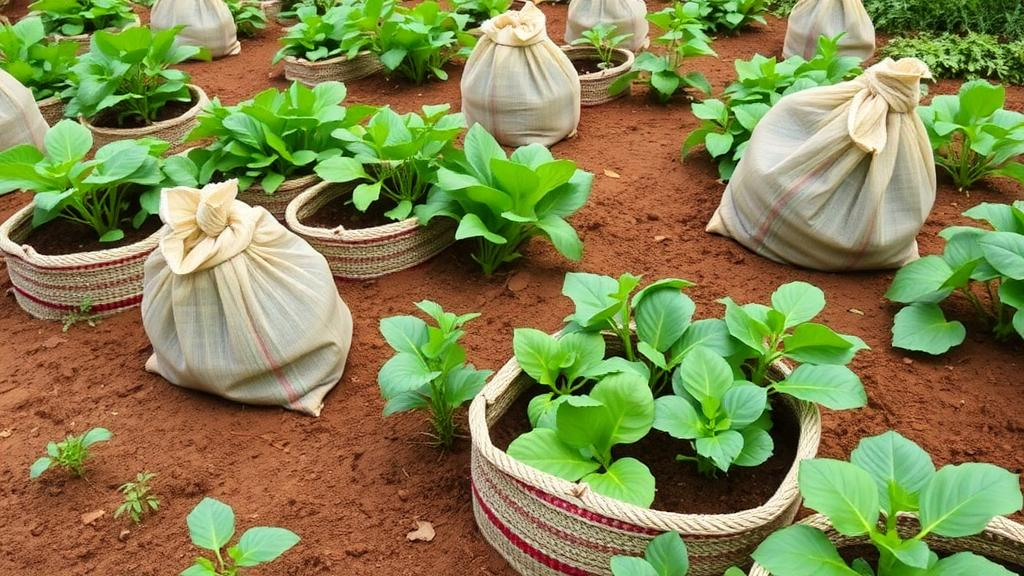
African indigenous vegetables grown in bag gardens contained higher concentrations of some pigments, minerals and plant compounds than vegetables cultivated in conventional flat gardens, but the advantage depended strongly on the vegetable species, growing year and location. Researchers reached that conclusion after a two-year field intervention in Tanzania comparing six leafy vegetables produced in bag and flat gardens in rural and urban districts. The study was quasi-experimental and took place under farmer-managed conditions, so its results associate production methods with measured differences rather than establish that the container system caused every change in food quality.
The trial involved households in Mkuranga, a rural district, and Ilala, a densely populated urban district with broadly similar climatic and soil conditions. Participants received demonstrations and training during approximately 90-day production periods in 2023 and 2024. A total of 160 households participated in the first year and 104 in the second, with participants producing three assigned vegetable species through each method. The researchers established 100 bag gardens and 120 flat gardens, then pooled leaves from four households to form each analyzed sample. Pumpkin leaves were grown only in flat gardens because of their trailing growth, which was considered unsuitable for the bag system.
Six vegetables were examined: Abyssinian mustard, amaranth, Chinese cabbage, pumpkin leaves, African nightshade and jute mallow. The team measured five minerals—magnesium, potassium, calcium, iron and zinc—along with nitrate and four groups of secondary metabolites: chlorophylls, carotenoids, flavonoids and phenolic acids. Glucosinolates were measured in the two Brassicaceae crops, Abyssinian mustard and Chinese cabbage. Carotenoids and chlorophylls were separated by high-performance liquid chromatography, as were flavonoids and phenolic acids; glucosinolates were extracted, desulfated and analyzed by liquid chromatography, minerals by inductively coupled plasma optical-emission spectrometry, and nitrate by reflectometry. The researchers used a four-way analysis of variance to assess production method, year, location and vegetable species, with Tukey’s HSD test for mean comparisons at p ≤ 0.05.
The most consistent observations involved chlorophylls and carotenoids, the green and yellow pigments that also serve as quality markers. Bag-grown Abyssinian mustard and amaranth had significantly higher total chlorophyll contents than flat-garden versions in both years. Overall, bag-grown leaves ranged from 6.2 to 15 milligrams per gram dry weight for total chlorophylls, compared with 5.5 to 15 milligrams in flat gardens. Bag-grown Abyssinian mustard also had higher total carotenoid contents in both years, while bag-grown amaranth had more in 2024. The effects were not universal: bag-grown Chinese cabbage contained less chlorophyll than flat-grown Chinese cabbage in 2024, and several comparisons for African nightshade and jute mallow showed no significant difference. In the overall analysis, year had the strongest statistical effect on chlorophylls and carotenoids, indicating that production conditions and year-to-year variation were important influences alongside the growing method.
Results for flavonoids, phenolic acids and glucosinolates were even more variable, with vegetable identity exerting the strongest influence. Bag-grown Chinese cabbage contained more total flavonoids in 2024, but bag-grown African nightshade and jute mallow contained fewer. Only bag-grown amaranth in 2024 and Chinese cabbage in 2023 had significantly more phenolic acids than their flat-garden counterparts; several other comparisons favored flat gardens or showed no significant difference. In the two Brassicaceae crops, bag gardens produced significantly more glucosinolates in 2023, but the difference disappeared in 2024. These mixed results show why the experiment’s four-way analysis was essential: no single bag-versus-flat contrast applied to every crop and every measurement. The study found that production method, year, location and species interacted in ways that could change the direction of a particular result.
Minerals followed the same species-dependent pattern. Bag-grown amaranth contained significantly more magnesium, potassium, iron and zinc than flat-grown amaranth, while bag-grown Abyssinian mustard had more potassium in 2023. Bag-grown Chinese cabbage had more zinc in 2024, and bag-grown African nightshade had more potassium and iron in 2024. Conversely, flat-grown Chinese cabbage contained more potassium and calcium in both years and more magnesium and iron in 2024. No significant production-method difference was detected for iron in the main analysis, although location and year affected it. The authors therefore characterized the mineral results as a combination of crop-specific, site-specific and method-specific influences rather than a universal effect of bag cultivation. Their comparison with recommended nutrient intakes suggested that both systems could provide meaningful mineral contributions when adults consumed 400 grams of vegetables per day, but the study did not measure how much of those minerals would be absorbed.
Nitrate was also inconsistent across production methods. Bag-grown Abyssinian mustard, amaranth and jute mallow contained significantly more nitrate than flat-grown versions in 2024, but no significant difference occurred for Abyssinian mustard, amaranth and Chinese cabbage in 2023 or African nightshade in 2024. Values ranged from 260 to 1,100 milligrams per kilogram fresh weight in bag-grown samples and from 200 to 1,800 milligrams per kilogram in flat-grown samples. These concentrations remained below the cited European Commission safety range of 2,000 to 4,500 milligrams per kilogram for fresh leafy vegetables. That comparison describes measured nitrate concentrations; the study was not designed to establish the health consequences of particular diets or to test consumer outcomes.
Location also changed the nutritional profile, sometimes in the opposite direction from the bag-versus-flat comparison. Urban-grown Abyssinian mustard generally contained more minerals than rural-grown mustard, whereas rural-grown amaranth and jute mallow often contained more. Rural samples generally carried higher phenolic-acid and flavonoid levels, while urban samples frequently had higher carotenoid levels in 2024. These geographic contrasts were observed within the same two production years and do not show that quality is rising or falling over time. Rather, the results indicate that site, crop and season must be considered when comparing production methods. The authors discuss possible influences including soil properties, water, temperature, light, nutrient availability, root-zone conditions and farmer management, but the field study did not directly measure every household-level environmental factor.
Several limitations constrain what the comparison can establish. Farmers applied different quantities of manure and water to flat gardens according to the space available, whereas inputs for bag gardens were more standardized, creating a potential confounder. Household-level microclimate was not directly recorded. African nightshade and jute mallow could not be sampled in 2023 because growth was poor, and pooled samples from four households limited the resolution of household-level variation. The researchers also did not measure mineral bioavailability, so calculations against recommended nutrient intakes describe the food’s measured composition rather than the amount absorbed by the body. The work therefore cannot show that bag gardens improve human health, and its nutrient calculations for adults do not establish benefits for children or other groups. The relatively small number of pooled samples and the farmer-managed conditions also limit the strength of causal claims.
Even with those qualifications, the study provides evidence that a low-input growing system can produce leafy vegetables with substantial mineral and secondary-metabolite concentrations in places where conventional cultivation space is limited. Bag gardens may therefore be a practical option for improving household access to diverse vegetables, but the results do not justify treating them as a uniformly superior replacement for flat gardens. Crop choice is central: the evidence supports upright or vertically growing species such as amaranth and Abyssinian mustard, whereas trailing crops require a different system. The clearest conclusion is that production method, location, season and species must be considered together when evaluating the food quality of African indigenous vegetables grown close to home.
Subject of Research: Comparison of bag-grown and flat-grown African indigenous vegetables in rural and urban Tanzania
Article Title: Food quality aspects of African indigenous vegetables produced using bag gardens: a rural–urban comparative study
Article References: Chacha, J. S., Förster, N., Huyskens-Keil, S., Ulrichs, C., & Rybak, C. (2026). Food quality aspects of African indigenous vegetables produced using bag gardens: a rural–urban comparative study. Journal of Agriculture and Food Research, 31, Article 103181. https://doi.org/10.1016/j.jafr.2026.103181
Image Credits: AI Generated
DOI: 10.1016/j.jafr.2026.103181
Keywords: bag gardens, African indigenous vegetables, food quality, Tanzania, plant metabolites, mineral content, nitrate, urban agriculture, rural agriculture, field intervention, Food, quality
News Source: Alan Morgan. (October 21, 2026). Bag gardens yield mixed food-quality results for Tanzanian indigenous vegetables. Scienmag.