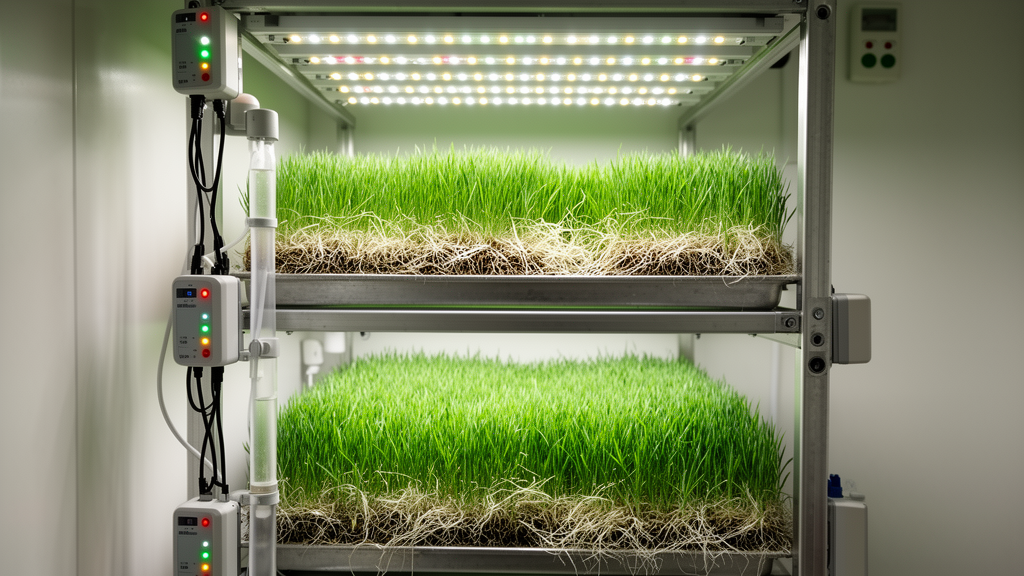
A sequential engineering validation study found that an IoT-integrated hydroponic cell could produce fresh green fodder from yellow maize in three consecutive cycles using municipal tap water at its native chemistry, without chemical adjustment or fertilization. The system combined continuous environmental sensing, rule-based irrigation and ventilation, nine cameras and remote Telegram alerts.
The experiment was conducted in one enclosed indoor location using a 14-day cycle for the first run and 17-day cycles for the next two. It included two production trays in Cycle 1 and three in Cycles 2 and 3. The researchers changed seeding density, cycle length, station count and control logic between cycles, so the study was not a controlled comparison and included no independent biological replication.
Environmental measurements were collected at an effective interval of approximately 33 seconds. The platform monitored temperature, humidity, substrate moisture, pH, electrical conductivity and illuminance, while a Raspberry Pi 5 stored scalar data in InfluxDB and images in Nextcloud. Irrigation and ventilation used fixed thresholds rather than learning-based control, and pH and electrical conductivity were monitored but not regulated.
All three cycles completed the planned dark-germination and illuminated-growth phases and reached harvest. The fresh-biomass conversion index, calculated as harvested fresh mass divided by dry seed mass, was 2.82:1 in Cycle 1, 4.02:1 in Cycle 2 and 4.03:1 in Cycle 3. Fresh biomass ranged from 11.1 to 13.0 kg per square metre of tray area, while inter-station conversion-index coefficients of variation were 1.6% and 3.5% in the two three-station cycles.
The higher conversion indices in the latter cycles coincided with lower seeding density, longer cultivation and substantially longer recorded lamp-on time. Because these factors changed together, the results cannot establish which change produced the higher biomass conversion. The study also measured fresh rather than dry mass, so differences in water content may have influenced the reported index.
Environmental control produced mixed results. Mean temperature was 20.28, 18.42 and 18.93 °C across the three cycles, and nighttime minima reached 13.0 °C because the room was unheated and the installed modules lacked sufficient cooling capacity. Humidity readings within the 50–70% target rose to 67.9% in Cycle 3 but were about 25% in the first two cycles. Substrate moisture also varied substantially among stations and tray zones under a shared pump that irrigated all trays simultaneously.
Valid pump activations delivered 18.27, 37.94 and 15.85 litres of irrigation water per cycle, equivalent to 19.2, 22.7 and 9.9 mL per gram of fresh biomass. These totals excluded seed-soaking, reservoir-filling, cleaning and discarded drainage water. Estimated actuator energy was 5.72, 11.51 and 11.86 kWh per cycle, with LEDs accounting for most energy in the two longer cycles.
Continuous records exposed several operational problems, including delayed or early lamp operation, an empty reservoir, sensor failures, probe artifacts, acquisition gaps and scheduled ventilation pauses. Cycle 3 records ended eight hours before the planned analysis window, underestimating lamp-on time and energy by approximately 2.3 hours and 0.24 kWh. The pH record was also unreliable, and substrate-moisture values represented resistive-probe proxies rather than gravimetric water content.
The study demonstrates operational feasibility under the tested indoor conditions, not optimized production. Its scope was limited to one maize seed source, one location and one season, with no adjusted-water comparator, complete water balance, full energy accounting, dry-matter yield, nutritional analysis or microbiological assessment. The authors identified active thermal regulation, station-specific irrigation, improved probe reliability, automated schedule checks and controlled replicated experiments as priorities for subsequent work.
Subject of Research: Sequential engineering validation of an IoT-integrated hydroponic maize green-fodder system
Article Title: IoT-integrated hydroponic system for green fodder production: Environmental monitoring, automated irrigation, and ventilation
Article References: González-Pedroza, J. A., Garay-Jiménez, L. I., & Escamilla-Ambrosio, P. J. (2026). IoT-integrated hydroponic system for green fodder production: Environmental monitoring, automated irrigation, and ventilation. Results in Engineering, 32, Article 113289. https://doi.org/10.1016/j.rineng.2026.113289
Image Credits: AI Generated
DOI: 10.1016/j.rineng.2026.113289
Keywords: IoT agriculture, hydroponics, green fodder, maize, environmental monitoring, automated irrigation, remote alerts, biomass conversion, precision agriculture, IoT-integrated, hydroponic, system
News Source: Alan Morgan. (October 21, 2026). IoT-controlled hydroponic maize system produced green fodder in three sequential validation cycles. Scienmag.