A deceased-donor kidney was transported more than 1,000 kilometers across Vietnam with portable hypothermic machine perfusion, according to a 2026 single-patient case report from Hue Central Hospital. The organ came from a 61-year-old expanded-criteria donor and was allocated to a 42-year-old man who had received hemodialysis for two years after a previous kidney transplant failed. The graft produced urine immediately after reperfusion and did not require dialysis during the first postoperative week, although its early creatinine course was consistent with slow graft function.
At six months, the recipient had stable graft function, a serum creatinine of 142 µmol/L and an estimated glomerular filtration rate of approximately 55 mL/min/1.73 m². The authors describe the case as evidence of operational feasibility, while emphasizing that it cannot establish superiority over static cold storage or a causal benefit from machine perfusion. The transplant followed a journey from Ho Chi Minh City to Hue involving road transfers and a single direct scheduled commercial flight lasting approximately 1.5 hours.
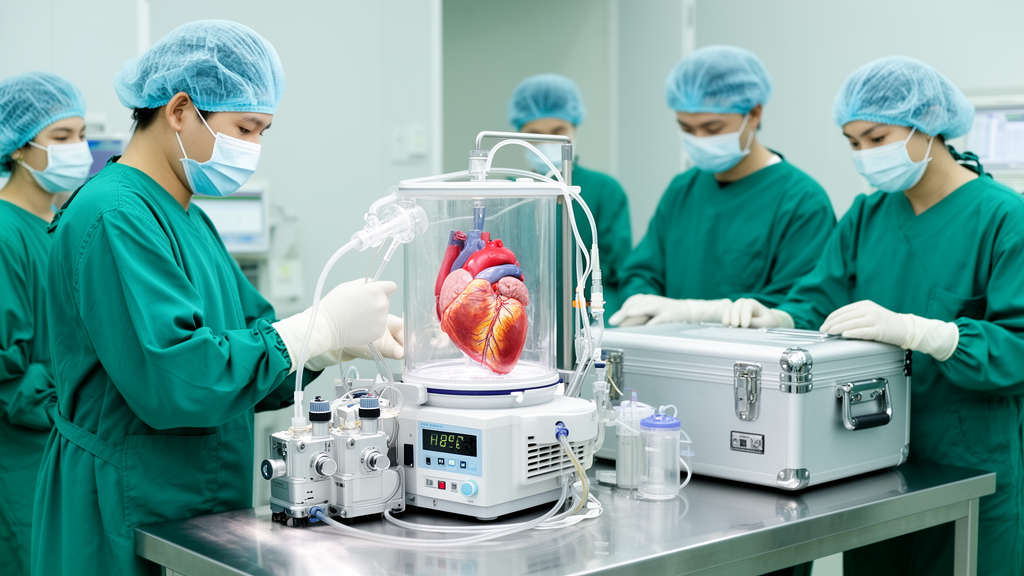
The kidney was connected to a LifePort Kidney Transporter for hypothermic machine perfusion, or HMP, under a pressure setting of 30 mmHg. The system used 1,000 mL of KPS-1 preservation solution. Battery power allowed the device to operate during the flight without an external electrical connection, and recipient-center personnel carried the machine in the business-class cabin under their direct supervision.
Those escorts had been trained to operate the device and reviewed its readings and alarms during transport. They also carried sterile supplies and additional ice. Total cold ischemia time, defined as the interval from the start of cold flushing until the kidney was removed from HMP, was 10 hours 50 minutes.
This comprised 1 hour 35 minutes of pre-HMP static cold storage, including approximately 30 minutes of back-table preparation, and 9 hours 15 minutes of elapsed machine-perfusion time. The elapsed figure included an intentional interruption: approximately 3.5 to four hours after HMP began, the team paused perfusion for about 20 to 30 minutes to replenish ice. During that pause, device-recorded flow, pressure and displayed resistance fell to zero, while the bubble-trap temperature rose transiently to approximately 15°C. Perfusion then resumed.
Active perfusion lasted approximately 8 hours 45–55 minutes after excluding the pause, and no post-HMP static cold storage was used. The machine’s perfusion measurements improved over the journey. At HMP initiation, renal vascular resistance was 1.68 mmHg/mL/min and perfusate flow was 16 mL/min.
At one hour, the corresponding values were 1.55 mmHg/mL/min and 18 mL/min. By arrival in Hue, resistance had decreased to 0.44 mmHg/mL/min and flow had increased to 52 mL/min. The investigators regarded this trend as an objective record of perfusion during transportation, but cautioned that flow and resistance have limited predictive accuracy when considered alone and are not definitive evidence of graft viability.
Decisions to transplant a kidney therefore require assessment of donor characteristics, organ function, ischemic exposure, graft appearance and recipient factors alongside device readings. All three renal arterial openings were contained in an intact aortic patch, allowing the patch to be secured within a single cannula so that all three arteries could be perfused. The recorded flow and resistance consequently reflected aggregate perfusion through the cannulation system rather than the distribution of preservation solution among the individual arteries.
Temperature control was the principal operational limitation. Although ice-compartment readings during active HMP generally ranged from approximately 1.5 to 7°C, bubble-trap readings were predominantly 9 to 10°C and exceeded the protocol target of 2 to 8°C for substantial periods. Renal parenchymal temperature was not measured, and the case included no comparator, so the clinical effect of the sensor excursions could not be determined.
The report suggests that programs using portable HMP need predefined responsibilities for device checks, ice replenishment, temperature thresholds, transport delays and handover at the receiving center. The donor had several features associated with increased risk of early graft dysfunction. He was 61 years old and met the conventional expanded-criteria donor definition by age alone, while also having hypertension, type 2 diabetes mellitus and ischemic heart disease.
He was anti-HCV antibody positive, although donor HCV RNA was unavailable. Serum creatinine transiently increased to 229 µmol/L before decreasing to 82 µmol/L before procurement. Detailed donor hemodynamic data, vasopressor requirements, terminal urine output and intensive-care duration were also unavailable, and no preimplantation biopsy was performed.
The donor had been declared brain dead after severe polytrauma, with a Glasgow Coma Scale score of 3. The contralateral kidney was transplanted elsewhere, but information about its preservation and the recipient’s outcome was unavailable, leaving the present report focused on one kidney and one interregional transport pathway. The recipient had received hemodialysis for two years after a kidney implanted 11 years earlier failed.
The prior graft’s failure was clinically attributed to chronic rejection, although no confirmatory biopsy report was available, and the failed kidney remained in situ. Against the new donor, the recipient had two of six HLA mismatches: none at HLA-A, one at HLA-B and one at HLA-DR. Qualitative screening for anti-HLA class I and class II antibodies was negative, no preformed donor-specific antibodies were detected by a Luminex single-antigen bead assay, and an urgent flow-cytometric lymphocyte crossmatch was negative. A numerical cPRA value and HLA typing data for the first donor were unavailable, limiting retrospective assessment of immunological risk and repeated HLA mismatches.
Basiliximab rather than lymphocyte-depleting induction was selected, while initial maintenance treatment comprised tacrolimus, mycophenolate mofetil and prednisolone. Implantation was technically demanding because the kidney had three renal arteries, each of which was separately anastomosed to the external iliac artery. The second warm ischemia time—the interval from removal of the graft from cold preservation to reperfusion—was 55 minutes, reflecting the vascular complexity and technical considerations associated with retransplantation.
After blood flow was restored, the graft showed uniform cortical coloration, satisfactory turgor and immediate urine production. Urine output reached 4,600 mL during the first 24 hours and remained between 3,000 and 4,000 mL per day thereafter. Serum creatinine was 1,227 µmol/L before transplantation, 1,064.9 µmol/L on postoperative day 1 and 872.1 µmol/L on day 2, producing a day-1-to-day-2 reduction ratio of 18.1%.
It subsequently fell to 664 µmol/L on day 5, 301 µmol/L on day 9 and 154 µmol/L on day 21. Because the recipient did not require dialysis during the first postoperative week, the conventional dialysis-based definition of delayed graft function was not met, although the authors characterized the creatinine trajectory as slow graft function rather than immediate functional recovery. The patient was discharged on postoperative day 28 with stable graft function.
Doppler ultrasonography on postoperative day 10 showed an intrarenal resistive index of 0.66 and a peak systolic velocity of 35 cm/s; at the renal artery origin and anastomotic region, the corresponding values were 0.62 and 70 cm/s. The recipient was also positive for HCV RNA before treatment and began a planned 12-week course of sofosbuvir and velpatasvir during the peri-transplant period. After completing antiviral therapy, tacrolimus was replaced with cyclosporine A because of tremor and sleep disturbance attributed to tacrolimus.
The antiviral course was completed before cyclosporine was introduced, so the drugs were not coadministered. At six months, the graft remained functional, with a serum creatinine of 142 µmol/L and an estimated glomerular filtration rate of approximately 55 mL/min/1.73 m² calculated using the 2021 CKD-EPI creatinine equation. Urinalysis was protein-negative at the available visits around three and six months.
Surveillance was clinical and serological: repeat Luminex single-antigen bead testing remained negative for donor-specific anti-HLA antibodies, and no acute rejection requiring treatment occurred. HCV RNA was undetectable after antiviral treatment, and subsequent cyclosporine trough concentrations were 93–117 ng/mL. The report nevertheless has important limitations, including its single-patient design, absence of a static-cold-storage comparator, lack of preimplantation biopsy data and relatively short follow-up.
It demonstrates that portable HMP can be integrated into a complex interregional sharing pathway, but prospective evidence is still needed to determine comparative clinical outcomes, transport-related complications and cost-effectiveness.
Subject of Research: Single-patient case report of portable hypothermic machine perfusion during interregional deceased-donor kidney transport in Vietnam
Article Title: Case Report: Portable hypothermic machine perfusion for interregional deceased-donor kidney sharing in Vietnam
Article References: Pham, H. N., Nguyen, X. T., Tran, K. N., Nguyen, D. D., Nguyen, A. V. Q., Bui, K. C. L., & Pham, H. N. (2026). Case Report: Portable hypothermic machine perfusion for interregional deceased-donor kidney sharing in Vietnam. Frontiers in Transplantation, 5, Article 1982759. https://doi.org/10.3389/frtra.2026.1982759
Image Credits: AI Generated
DOI: 10.3389/frtra.2026.1982759
Keywords: portable machine perfusion, kidney transplantation, deceased donor, organ preservation, interregional transport, expanded-criteria donor, Vietnam, slow graft function, delayed graft function, hypothermic perfusion, Case, Report
News Source: Ophelia Keating. (October 21, 2026). Research report: Case Report: Portable hypothermic machine perfusion for interregional deceased-donor kidney sharing in Vietnam. Scienmag.