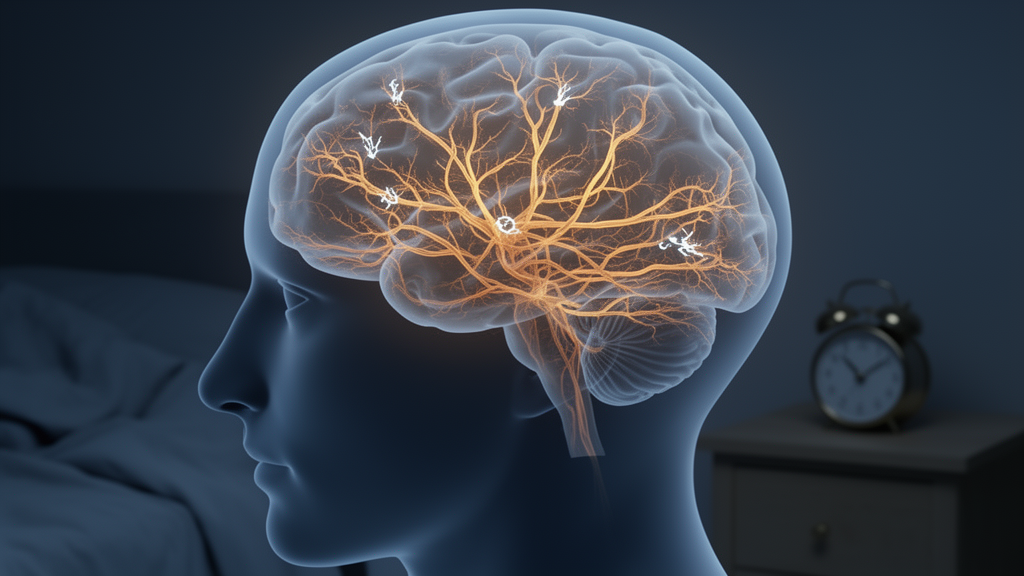
Sleep disturbances and executive dysfunction frequently coexist after stroke, but the neurological process connecting them has not been established. A targeted narrative synthesis of clinical studies, stroke neuroimaging, sleep research outside stroke and intervention evidence proposes that fragmented sleep, insomnia and unstable arousal may burden an already disrupted brain by weakening coordination among the salience, default mode and frontoparietal networks. The authors describe this “sleep-network-executive” pathway as a falsifiable hypothesis rather than a causal mechanism, emphasizing that no study has yet tested the complete sequence in a single stroke cohort.
Post-stroke sleep disturbance is common, with pooled prevalence estimates of roughly 50% to 53% in recent meta-analyses, while post-stroke cognitive impairment varies according to case definitions, assessment methods, population and time since stroke. Greater sleep fragmentation and lower sleep efficiency have been associated with poorer post-stroke cognitive performance. Executive dysfunction is especially consequential because problems with working memory, cognitive flexibility and conflict monitoring can slow functional gains, limit rehabilitation participation and hinder reintegration into community life. These observations nevertheless leave three possibilities open: disturbed sleep may contribute to cognitive impairment, it may emerge as a parallel consequence of brain injury, or both processes may be influenced by inflammation, circadian disruption, mood symptoms, medication and reduced daytime activity.
The clinical problem is also more complex than a single complaint about “poor sleep.” Insomnia, repeated awakening, obstructive sleep apnea, daytime hypersomnolence and circadian misalignment have different biological drivers. Obstructive sleep apnea, for example, involves recurrent arousals and intermittent hypoxia and has been associated with inflammation, oxidative stress and vascular dysfunction. Insomnia and fragmented sleep are more closely tied to hyperarousal and unstable sleep continuity. Likewise, executive dysfunction covers several cognitive domains that cannot be represented accurately by a single screening score. A targeted synthesis is therefore more informative than treating sleep disturbance and cognition as interchangeable symptoms, although the available literature often groups them this way and depends heavily on subjective questionnaires and global cognitive measures.
Stroke is increasingly understood not simply as focal tissue loss but as an event that damages communication across distributed systems. Focal lesions can coexist with diaschisis, disruption of long-range white-matter pathways and altered coordination among large-scale networks. The triple-network model focuses on interactions among the salience network, which is thought to help detect behaviorally relevant signals and switch between internally and externally directed states; the default mode network, which supports internally oriented cognition; and the frontoparietal network, which contributes to working memory, task-set maintenance and top-down control. Efficient executive behavior depends on the ability to disengage default-mode processing and recruit frontoparietal control when external demands rise. Stroke-related injury may therefore create a structural vulnerability that sleep disturbance could amplify at a functional level.
Post-stroke neuroimaging supports the presence of that vulnerable network architecture. One study of 118 patients with internal capsule stroke and 57 healthy controls found increased static coupling between the salience and default mode networks but reduced dynamic interactions between the executive control network and other systems. Patients with right-sided lesions also showed lower modularity and longer persistence of a state with strongly positive connections across all three networks, demonstrating that stronger connectivity can coexist with poorer differentiation. In another study, 17 patients with post-stroke cognitive impairment and 24 controls showed reduced static connectivity between the ventral default mode and salience networks. Patients spent longer in one recurring connectivity state, and longer dwell time correlated with lower Mini-Mental State Examination scores, although the association involved global rather than domain-specific cognition.
Directional analyses provide a further complication. Using spectral dynamic causal modelling, researchers comparing 41 patients with post-stroke cognitive impairment and 41 controls found increased effective influence from the posterior cingulate cortex to bilateral dorsolateral prefrontal regions and from the right insula to the right dorsolateral prefrontal cortex. Greater effective connectivity was associated with poorer cognitive scores. Lesion evidence also points to the salience network: in 144 patients with acute stroke, left insular lesions were associated with poorer set-switching even after accounting for the visual-spatial and motor demands of the task. Together, these studies show that stronger or more persistent communication is not automatically beneficial. They do not, however, reveal whether sleep disturbance causes, follows or amplifies the observed network abnormalities.
Sleep research from populations without stroke supplies biological plausibility but not direct proof. In 26 healthy adults scanned after normal sleep and approximately 24 hours without sleep, total sleep deprivation reduced connectivity within the default mode network and weakened its anticorrelation with task-positive regions during rest and a visual attention task. A separate study of 22 healthy participants found that 36 hours of sleep deprivation coincided with poorer working-memory performance, increased coupling between dorsal attention and default mode regions, and decreased coupling between frontoparietal and default mode regions. Insomnia findings point to reduced flexibility rather than necessarily altered average connectivity: 65 people with insomnia and 65 matched controls showed less temporal variation in connectivity between the anterior salience and left executive control networks. The authors note that experimental sleep loss is not equivalent to chronic post-stroke insomnia, apnea or fragmentation.
Stroke-specific evidence remains limited but includes a small resting-state imaging study of patients with post-stroke insomnia. Among 23 retained participants, imaging showed abnormalities in cortical regions beyond the infarcts, including elevated low-frequency activity in parts of the default mode network, but the measures did not test network switching or whether default-mode activity failed to suppress during executive tasks. In a separate actigraphy study of 35 older adults with chronic stroke and 35 matched adults without stroke, the stroke group had greater objectively measured fragmentation despite similar subjective questionnaire scores, and cognitive differences were larger where fragmentation was greater or sleep efficiency lower. A polysomnography study of 86 patients evaluated within 14 days of minor ischemic stroke found that obstructive sleep apnea was more prevalent among those with cognitive impairment, while shorter sleep time and lower minimum oxygen saturation remained associated with impairment. These observational findings cannot determine causal direction or identify the relevant network process.
To test the proposed pathway, the review recommends studies that combine objective sleep phenotyping with dynamic or effective connectivity, task-based functional MRI, domain-specific executive tests and longitudinal or interventional follow-up in the same participants. A practical initial population would be medically stable adults with imaging-confirmed ischemic stroke assessed within a defined recovery period, although that window is a design proposal rather than an established requirement. Insomnia, fragmentation, obstructive sleep apnea and their coexistence should be measured separately. Lesion location, structural disconnection, stroke stage, vascular burden, medication, mood, pain, fatigue, rehabilitation exposure and premorbid cognition may act as confounders or modifiers, depending on the causal model. Sample size should be determined through simulation because detecting an indirect effect through network function may require more participants than detecting a direct sleep-cognition association.
The framework makes specific predictions that can be contradicted. Greater fragmentation or insomnia severity would be expected to accompany longer dwell time in default-mode-dominant states, fewer transitions toward task-relevant control states and weaker salience-mediated switching. Insufficient suppression of internal activity and delayed frontoparietal recruitment could then impair conflict monitoring, working memory, processing speed and cognitive flexibility. Lesions or disconnection affecting fronto-insular, cingulate or frontoparietal pathways might strengthen these associations. A finding linking objectively measured sleep disruption to executive impairment but not to the prespecified network measure would challenge the proposed bridge. Likewise, an intervention that improves sleep and executive function without producing the predicted network change would weaken the mediation claim, although it would not make the treatment clinically useless. Because evidence is dominated by heterogeneous, largely observational studies and mechanistic inferences from non-stroke populations, the proposed pathway remains a roadmap for direct testing rather than an established basis for treatment selection.
Subject of Research: A mechanistic hypothesis linking post-stroke sleep phenotypes, large-scale brain-network dysfunction and executive impairment.
Article Title: Poststroke sleep phenotypes and executive dysfunction: toward a sleep-network-executive framework
Article References: Xu, J., Zhang, Y., Lin, D., Yan, X., Xie, N., Si, S., & Yang, S. (2026). Poststroke sleep phenotypes and executive dysfunction: toward a sleep-network-executive framework. Frontiers in Neuroscience, 20, Article 1978796. https://doi.org/10.3389/fnins.2026.1978796
Image Credits: AI Generated
DOI: 10.3389/fnins.2026.1978796
Keywords: post-stroke sleep disturbance, executive dysfunction, salience network, default mode network, frontoparietal network, functional connectivity, stroke rehabilitation, sleep fragmentation, insomnia, brain imaging, Poststroke, sleep
News Source: Cassandra Pierce. (October 21, 2026). Stroke sleep disturbances may disrupt executive networks, review proposes. Scienmag.