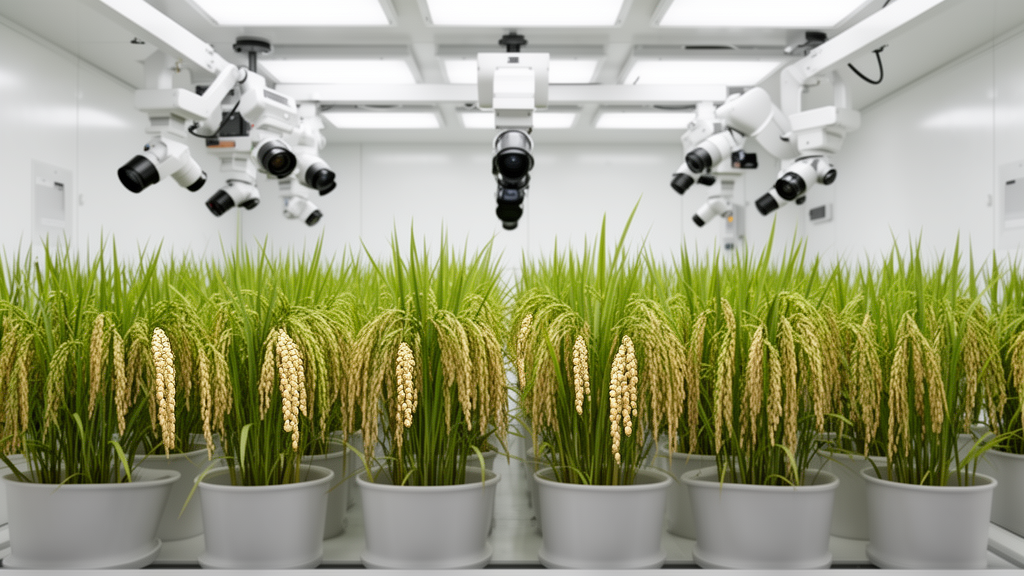
An end-to-end computational workflow called PRSNeRF can reconstruct individual rice grains from multi-view images, separate densely adjacent grains in three dimensions and extract plant-level traits in about 3.3 minutes per plant. The study evaluated rice grown under controlled indoor conditions, combining contour-guided neural radiance field reconstruction with Mamba-based point-cloud instance segmentation. Its reconstructed point clouds supported automated estimation of grain count, grain dimensions and voxel-based occupancy traits.
Adhesion between neighboring grains can make instances difficult to distinguish, while the scale of a plant’s point cloud creates a substantial segmentation problem. PRSNeRF addresses the task in two stages: CoNeRF produces a three-dimensional representation from multi-view images, and PRSNet assigns separate identities to individual grains. The researchers tested reconstruction on the Blur Rice benchmark and assessed segmentation on the RiceNeRF-IS dataset.
CoNeRF integrates image deblurring, contour-guided sampling and a rendering-projection consistency mechanism. These components are designed to improve geometric fidelity and suppress floating artifacts in the reconstruction. Under a fixed budget of 5,000 training iterations, the method reduced the scaled NeRF-space Chamfer distance from 10.61 to 7.81.
It also required substantially less time than the 30,000-iteration NeRFacto baseline: training time decreased from 368 seconds to 77 seconds, and point-cloud export time fell from 120 seconds to 10 seconds. These results apply to the benchmark conditions and comparison setup used in the study. PRSNet handles the next stage by identifying separate grain instances in the reconstructed point clouds.
Its architecture includes a Mamba-based encoder, adaptive Gaussian detail enhancement, multi-scale feature fusion and three-dimensional dynamic anchor boxes. In plant-level five-fold cross-validation on RiceNeRF-IS, PRSNet achieved an overall average precision of 87.31%, outperforming OneFormer3D by 22.30 percentage points. The segmented point clouds then provided the basis for automated measurements of grain number, grain dimensions and voxel-based occupancy.
The study presents PRSNeRF as a connected workflow linking image-based reconstruction, point-cloud instance separation and quantitative trait extraction, with a reported end-to-end processing time of approximately 3.3 minutes per plant. Its demonstrated performance is limited to controlled indoor acquisition and the specific datasets and baselines evaluated. The evidence does not establish equivalent results for field-grown rice, outdoor imaging or other crop species, and the early-access article is described as subject to further editorial revision.
Within the tested setting, however, the workflow shows that improvements in three-dimensional rendering and point-cloud analysis can support faster automated rice phenotyping while producing grain-level measurements.
Subject of Research: Automated three-dimensional rice-grain phenotyping using NeRF reconstruction and Mamba-based point-cloud segmentation
Article Title: A 3D grain-level phenotypic extraction framework for rice using contour-guided NeRF reconstruction and mamba-based point cloud segmentation
Article References: Qu, F., Huang, H., Song, W., Zhang, W., Wu, L., Tang, C., Zhang, J., & Sun, Y. (2026). A 3D grain-level phenotypic extraction framework for rice using contour-guided NeRF reconstruction and mamba-based point cloud segmentation. Plant Methods. https://doi.org/10.1186/s13007-026-01603-9
Image Credits: AI Generated
DOI: 10.1186/s13007-026-01603-9
Keywords: rice phenotyping, 3D reconstruction, neural radiance fields, point-cloud segmentation, Mamba networks, computer vision, grain traits, rice panicles, plant breeding, grain-level, phenotypic, extraction
News Source: Alan Morgan. (October 21, 2026). Controlled indoor rice phenotyping links NeRF reconstruction and grain segmentation. Scienmag.