• HOME
  • NEWS
  • EXPLORE
    • CAREER
      • Companies
      • Jobs
    • EVENTS
    • iGEM
      • News
      • Team
    • PHOTOS
    • VIDEO
    • WIKI
  • BLOG
  • COMMUNITY
    • FACEBOOK
    • INSTAGRAM
    • TWITTER
Wednesday, October 21, 2026
BIOENGINEER.ORG
No Result
View All Result
  • Login
  • HOME
  • NEWS
  • EXPLORE
    • CAREER
      • Companies
      • Jobs
        • Lecturer
        • PhD Studentship
        • Postdoc
        • Research Assistant
    • EVENTS
    • iGEM
      • News
      • Team
    • PHOTOS
    • VIDEO
    • WIKI
  • BLOG
  • COMMUNITY
    • FACEBOOK
    • INSTAGRAM
    • TWITTER
No Result
View All Result
Bioengineer.org
No Result
View All Result
Home NEWS Science News Biology

Review Links Acute GVHD Steroid Refractoriness to Multiple Molecular Mechanisms

by
October 21, 2026
in Biology
Reading Time: 2 mins read
0
Review Links Acute GVHD Steroid Refractoriness to Multiple Molecular Mechanisms

Review Links Acute GVHD Steroid Refractoriness to Multiple Molecular Mechanisms

Share on FacebookShare on TwitterShare on LinkedinShare on RedditShare on Telegram

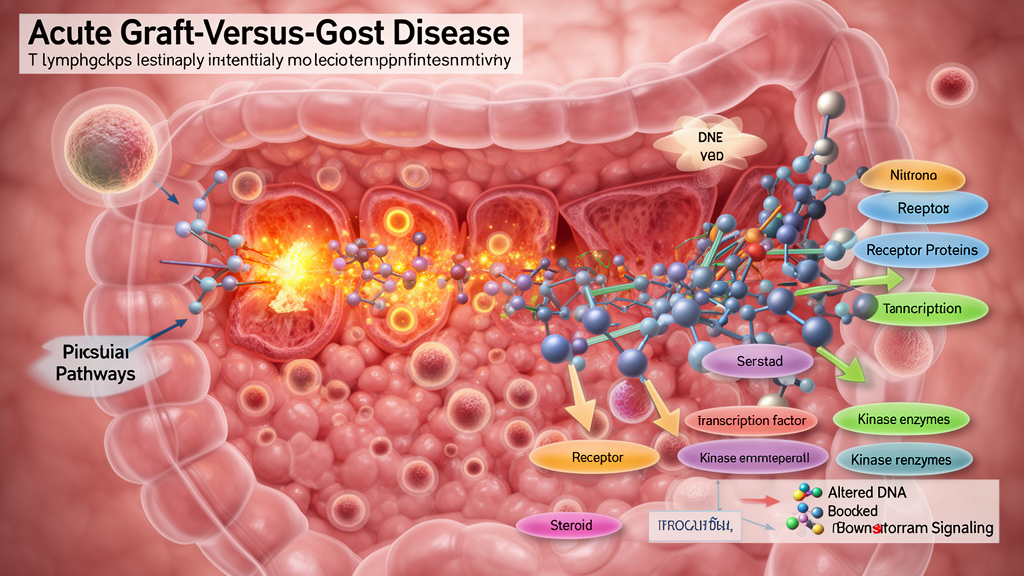
A review of steroid refractoriness in acute graft-versus-host disease concludes that the problem should be understood as a multifactorial, multi-level phenomenon rather than a single molecular defect. The article reports that systemic corticosteroids are first-line therapy for the inflammatory condition, but refractoriness is encountered in about 50% of cases, a group described as having dismal outcomes. The authors organize potential explanations around interruptions in the cascade from glucocorticoid receptor activation to nuclear translocation, DNA binding, and gene transcription.

This is a review of proposed mechanisms, not a clinical trial or a new laboratory investigation. Canonical glucocorticoid signaling begins with activation of the GRα receptor, followed by its movement into the nucleus and interaction with glucocorticoid response elements, or GREs, that regulate gene transcription. The review identifies several points at which this sequence may be altered in acquired steroid refractoriness.

Proposed mechanisms include downregulation of GRα, impaired nuclear translocation, and reduced binding or effectiveness at GREs. These changes may interfere with one or more stages of the receptor’s transcriptional activity. The source presents them as candidate explanations and does not establish which mechanism predominates in an individual patient or across a defined population.

The review also considers increased expression of GRβ, an antagonist isoform of the glucocorticoid receptor, as a possible contributor to resistance. Beyond receptor-level changes, it proposes that alterations in gene transcription and epigenetic effects may also be involved. It additionally raises the possibility of mechanisms not related to T cells, reflecting a scope broader than a single cell type.

The authors frame acquired refractoriness as potentially combining abnormalities in receptor abundance, movement, DNA binding, and downstream regulation. However, the available review evidence summarized in the article does not identify a specific epigenetic lesion or prove a causal role for any one candidate pathway. Steroid refractoriness can be congenital or acquired, generalized or tissue-specific, and complete or partial.

The review’s central contribution is to set out this mechanistic framework and its possible links to acute graft-versus-host disease. It does not report testing a treatment, demonstrate improved steroid responsiveness, or show that any proposed mechanism changes survival, remission, or other clinical outcomes. Instead, it describes a foundation for further investigation and for the design of targeted approaches intended to improve steroid responsiveness.

Subject of Research: Molecular mechanisms of steroid refractoriness in acute graft-versus-host disease

Article Title: Pathogenesis of steroid refractoriness in acute graft versus host disease

Article References: Debes, M., Ali, S. M., Abouzeid, M., Aljrad, M., & Elyasaky, A. (2026). Pathogenesis of steroid refractoriness in acute graft versus host disease. Molecular Biology Reports, 53(1), Article 1769. https://doi.org/10.1007/s11033-026-12935-z

Image Credits: AI Generated

DOI: 10.1007/s11033-026-12935-z

Keywords: acute graft-versus-host disease, steroid refractoriness, allogeneic stem-cell transplantation, glucocorticoid receptor, GRα, GRβ, gene transcription, epigenetic regulation, treatment resistance, Pathogenesis, steroid, refractoriness

News Source: Drew Townsend. (October 21, 2026). Review Links Acute GVHD Steroid Refractoriness to Multiple Molecular Mechanisms. Scienmag.

Tags: acute graft-versus-host diseaseallogeneic stem cell transplantationepigenetic regulationgene transcriptionglucocorticoid receptorGRαGRβpathogenesisrefractorinesssteroidsteroid refractorinessTreatment resistance
Share12Tweet7Share2ShareShareShare1

Related Posts

Nematode model reveals bacterial shifts in chronic Pseudomonas infection

Nematode model reveals bacterial shifts in chronic Pseudomonas infection

October 21, 2026
Belgian cropland study finds divergent soil carbon estimates

Belgian cropland study finds divergent soil carbon estimates

October 21, 2026

Repeated Hydrogen Peroxide Exposure Alters Some Candida Traits in Vitro

October 21, 2026

Comparative mitogenomics of two parasitic isopods, Ione cornuta and Pseudione longicauda, with putatively linear mitochondrial genomes

October 21, 2026

POPULAR NEWS

  • Dietary Intake Fell After Pancreatic Surgery Despite Falling Inflammation

    Dietary Intake Fell After Pancreatic Surgery Despite Falling Inflammation

    29 shares
    Share 12 Tweet 7
  • Review Links Acute GVHD Steroid Refractoriness to Multiple Molecular Mechanisms

    29 shares
    Share 12 Tweet 7
  • Single-arm trial reports orelabrutinib response in high-risk lymphoma

    29 shares
    Share 12 Tweet 7
  • CALLY index shows no independent link to colorectal polyp risk

    29 shares
    Share 12 Tweet 7

About

We bring you the latest biotechnology news from best research centers and universities around the world. Check our website.

Follow us

Recent News

Dietary Intake Fell After Pancreatic Surgery Despite Falling Inflammation

Review Links Acute GVHD Steroid Refractoriness to Multiple Molecular Mechanisms

Single-arm trial reports orelabrutinib response in high-risk lymphoma

Subscribe to Blog via Email

Enter your email address to subscribe to this blog and receive notifications of new posts by email.

Join 85 other subscribers
  • Contact Us

Bioengineer.org © Copyright 2023 All Rights Reserved.

Welcome Back!

Login to your account below

Forgotten Password?

Retrieve your password

Please enter your username or email address to reset your password.

Log In
No Result
View All Result
  • Homepages
    • Home Page 1
    • Home Page 2
  • News
  • National
  • Business
  • Health
  • Lifestyle
  • Science

Bioengineer.org © Copyright 2023 All Rights Reserved.