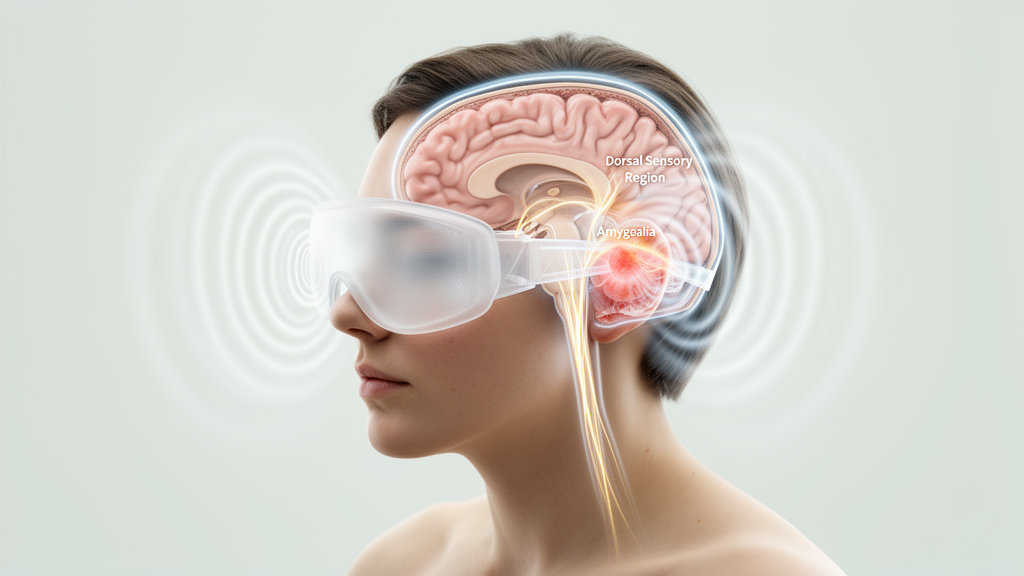
People with high myopia watching emotionally charged films without optical correction showed a distinct neural strategy for handling blurred visual information, according to a functional magnetic resonance imaging study. Their brain responses were less consistent across repeated viewings in visual regions, but more synchronized in the primary auditory cortex. At the same time, the amygdala—the brain structure central to processing fear and other salient emotions—was more strongly connected with the dorsal visual stream during a thriller. The findings suggest that when vision is degraded, the brain may compensate by making greater use of sound and spatial information that survives blur, although the study does not establish whether this strategy improves behavior.
The research, published in Frontiers in Human Neuroscience, examined 24 young adults with high myopia, defined as a spherical equivalent refractive error of −6.00 diopters or worse in both eyes. Their mean age was 22.8 years, and all reported normal hearing and no neurological or psychiatric disorders. During scanning, participants wore neither glasses nor contact lenses and confirmed that the movies appeared substantially blurred. For comparison, the investigators used data from 15 normal-vision participants collected previously with the same scanner, acquisition parameters and movie paradigm. Because the control group was tested in an earlier study rather than recruited and scanned alongside the high-myopia group, the comparison was cross-sectional and cannot establish whether myopia caused the observed differences.
Each participant watched a 15-minute thriller segment from The Conjuring 2 and a 15-minute scenic segment from Time Scapes on two occasions one week apart. Neither clip contained dialogue, reducing the likelihood that differences in language processing would explain the group results. The researchers recorded blood oxygen level-dependent signals with a 3.0-tesla MRI scanner and examined two complementary measures: intra-subject synchrony, or the similarity of each person’s brain activity across repeated viewings, and seed-based functional connectivity between the amygdala and the rest of the brain. Analyses also controlled for basic audiovisual features such as luminance, contrast, motion, spatial frequency, sound energy, spectral centroid and spectral entropy.
The clearest group-level difference appeared in response consistency. Participants with normal vision had significantly greater intra-subject synchrony than those with high myopia in both primary visual cortices and in several other areas. For the thriller, the normal-vision advantage was widespread, extending through orbitofrontal cortex, precuneus, thalamus, inferior frontal gyrus and insula; for the scenic film, the differences were more spatially restricted. This means that people with high myopia did not reproduce exactly the same neural sequence when seeing a film for the second time as they had on the first viewing. The authors interpret the reduced synchrony as consistent with a less stable, more individually variable response to visually degraded material, rather than as evidence that the emotional content itself was understood less well.
Auditory activity moved in the opposite direction. The high-myopia group showed significantly increased intra-subject synchrony in the primary auditory cortex relative to the normal-vision group. In practical terms, sound-related brain activity remained more consistent from one viewing to the next even while visual activity became less consistent. The authors describe this as cross-modal compensation: an intact sensory channel may help sustain coherent perceptual and emotional processing when visual details are difficult to resolve. The result is an association rather than a direct demonstration that the participants consciously relied more on the soundtrack or that they detected events more accurately through sound, because the study collected no behavioral measures of either process.
Amygdala connectivity revealed a content- and viewing-dependent shift. While high-myopia participants watched the thriller on both occasions, they exhibited stronger functional connectivity between the amygdala and dorsal-stream regions than the normal-vision group. The dorsal stream is a network that supports spatial processing, motion analysis and visually guided action, and tends to rely on coarse, low-spatial-frequency information that is less disrupted by blur. Enhanced coupling with this pathway was accompanied by stronger connectivity involving auditory and prefrontal regions. These observations fit the proposal that, when threatening visual details cannot be resolved, the brain favors a broader and potentially more efficient assessment of danger rather than detailed recognition of every visual feature.
The scenic movie produced a different temporal sequence. On the first viewing, high-myopia participants showed stronger amygdala connectivity with both the dorsal and ventral visual streams. The ventral stream is more closely associated with detailed object and scene identification and generally depends on high-spatial-frequency information, which blur tends to obscure. By the second viewing, the dorsal-stream advantage remained significant, whereas the ventral-stream connectivity was markedly reduced. The pattern therefore suggests a state-dependent reweighting: after repeated exposure to blurred content, emotional processing appears to become less dependent on detailed ventral-stream analysis and more consistently centered on the dorsal pathway. Control analyses using the parahippocampal place area and primary sensory cortices as seeds did not reproduce the specific visual-stream differences, suggesting that the effect was concentrated in the amygdala-centered emotional network.
The study also found reduced separation between shared and individual-specific amygdala responses in the high-myopia group. The investigators defined a consensual component using the average amygdala time course of all other participants and an idiosyncratic component using each person’s own response. In normal-vision participants, repeated viewing had previously produced a clear dissociation between these group-shared, stimulus-driven patterns and more individualized, experience-related patterns. That separation was substantially reduced or absent among participants with high myopia under blur. The authors interpret this as evidence that degraded bottom-up visual information may lead the brain to rely more heavily on top-down and subjective experience when interpreting stimuli. Their findings therefore challenge a simple model in which clearly visible threats automatically produce identical neural responses in every viewer.
Several limitations constrain the conclusions. The high-myopia participants were scanned only without optical correction, so the design could not cleanly distinguish an immediate response to blur from a long-term adaptation associated with chronic myopia. Although eligibility was confirmed through clinical records, uncorrected visual acuity was not measured inside the scanner, meaning that the precise amount of subjective blur could have varied. The sample was also modest: a post hoc analysis indicated that it was mainly able to detect large effects, with limited sensitivity to small or moderate ones. The participants were predominantly young adults, and only two clips—one threatening and one scenic—were used. Consequently, the results may depend on the particular films, emotional contexts and editing styles, and cannot yet be generalized to other ages or emotions such as happiness, disgust or sadness.
Because the researchers did not measure threat-detection accuracy, reaction times, emotional intensity or recognition performance, the neural patterns cannot be labeled adaptive or maladaptive. The cross-sectional group comparison also establishes association rather than causation. The authors propose that similar compensation might occur in other forms of visual degradation, such as cataracts, corneal opacities or uncorrected refractive error, but this study did not test those populations and does not support clinical recommendations. The clearest next experiment would compare normal-vision viewers presented with artificial blur, high-myopia viewers wearing their optical correction, and high-myopia viewers remaining uncorrected. Linking the resulting connectivity patterns to real-world threat detection and reaction times would also be necessary to determine whether the brain’s apparent shift toward sound and dorsal processing is helpful, harmful or dependent on the situation.
Subject of Research: How blurred vision in high myopia alters functional brain networks involved in emotional processing
Article Title: State-dependent responses of emotional brain networks in high myopia under blurred vision: a shift towards dorsal stream and cross-modal processing
Article References: Cui, L., Zeng, X., Chang, S., Yu, X., & Meng, M. (2026). State-dependent responses of emotional brain networks in high myopia under blurred vision: a shift towards dorsal stream and cross-modal processing. Frontiers in Human Neuroscience, 20, Article 1927265. https://doi.org/10.3389/fnhum.2026.1927265
Image Credits: AI Generated
DOI: 10.3389/fnhum.2026.1927265
Keywords: high myopia, blurred vision, emotional processing, amygdala connectivity, dorsal visual stream, auditory compensation, functional MRI, naturalistic movies, cross-modal processing, threat processing, State-dependent, responses
News Source: Cassandra Pierce. (October 21, 2026). Blurred Vision Shifts Emotional Processing Toward Sound and Dorsal Pathways. Scienmag.