A six-person field team observed five specimens of the Critically Endangered Jamaican cave velvet worm Speleoperipatus spelaeus in Pedro Cave on January 18, 2025. These were the first recorded observations of the species in the cave since 1974, when the four specimens used in its original description were collected.
The observational study was conducted to assess the status of S. spelaeus, a troglobitic onychophoran known from Pedro Cave in Clarendon Parish. The team searched different sections of the cave and documented associated fauna, including bats, cave crickets, spiders, a whip-spider, a harvestman and several animals that are not cave-adapted.
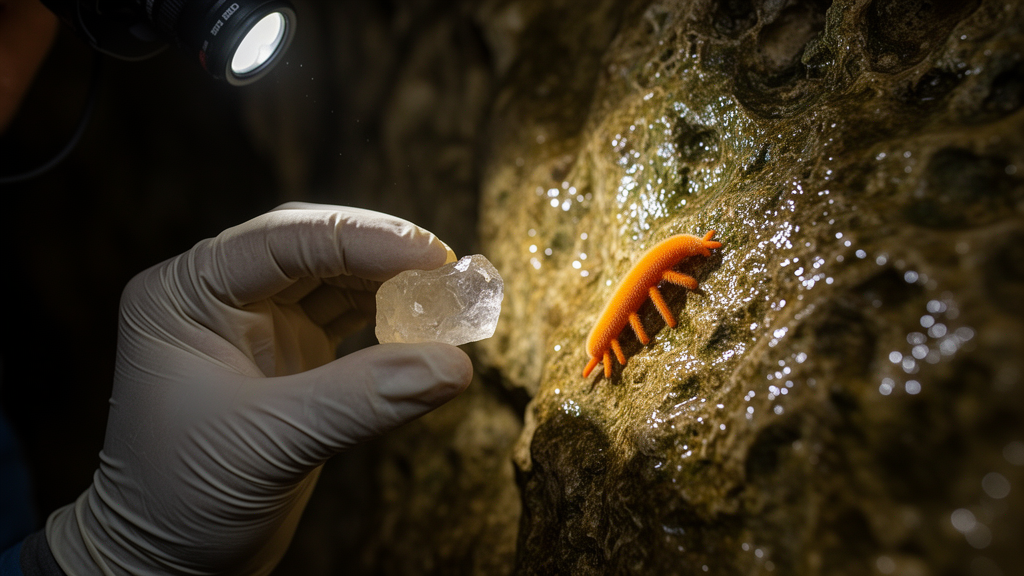
Five velvet worms were found near the section known as Three Ways. They were walking on bat guano accumulated over a layer of clay beside water running from the cave roof. The animals were observed and photographed but not collected. They were not properly measured because the researchers sought to avoid manipulating the specimens.
One animal quickly retreated into crevices in porous rock, while another buried itself in mud until it disappeared. These observations indicate that Pedro Cave provides hiding places for the species, although the study did not determine its abundance or population size.
The five Pedro Cave animals showed variation in leg-pair number and in development of the final pair. Three had 19 pairs of legs, one had 23, and the largest had 22. The last pair could be fully developed, though small, or highly reduced and directed backward without touching the ground while the animal walked. By comparison, the specimens studied in the original description had 22 or 23 pairs, with one having 23 legs on the left and 22 on the right.
The newly observed leg-pair counts require the diagnosis of the genus and species to include a range of 19 to 23 pairs. This finding is based on visual documentation of animals encountered during the expedition rather than measurements of collected specimens.
Earlier Jamaican Cave Organisation work produced an additional apparent record at Swansea Cave in Saint Catherine Parish. One blind, depigmented velvet worm was observed on February 13, 2010, and two were photographed on November 6, 2021. None was collected or studied, and the researchers describe these Swansea animals as probably conspecific with S. spelaeus rather than as confirmed specimens of the species.
Pedro and Swansea caves are separated by less than 6 km in linear distance through an area containing numerous known caves. The Pedro Cave search was limited to selected sections, whereas the five animals were found in less than one hour of sampling. The authors therefore suggest that S. spelaeus may be less rare than previously thought, while stating that future work may help re-evaluate its Critically Endangered classification. Its ecology, distribution, population size and evolutionary history remain insufficiently understood.
The authors also call for investigation of the species’ phylogenetic placement to determine whether its closest relatives are other Jamaican velvet worms or species elsewhere. They identify phylogenetic methods using ultraconserved elements as a possible approach for addressing that question.
Subject of Research: Observational status assessment of the Critically Endangered Jamaican cave velvet worm Speleoperipatus spelaeus
Article Title: On the troglobitic velvet worm Speleoperipatus spelaeus Peck, 1975 ( Onychophora , Peripatidae ): assessing the status of a Critically Endangered Jamaican invertebrate
Article References: Giribet, G., Anilkumar, P. A., Goodwin, A., Stewart, R. S., Watkis, C. A., Whyte, D., & Hormiga, G. (2025). On the troglobitic velvet worm Speleoperipatus spelaeus Peck, 1975 (Onychophora, Peripatidae): assessing the status of a Critically Endangered Jamaican invertebrate. Subterranean Biology, 51, 49-59. https://doi.org/10.3897/subtbiol.51.151034
Image Credits: AI Generated
DOI: 10.3897/subtbiol.51.151034
Keywords: Speleoperipatus spelaeus, velvet worm, Onychophora, Pedro Cave, Swansea Cave, Jamaica, cave biodiversity, field observations, conservation status, troglobitic species, troglobitic, velvet
News Source: Gavin Prescott. (October 21, 2026). Five cave velvet worms observed in Pedro Cave; Swansea records remain probable. Scienmag.