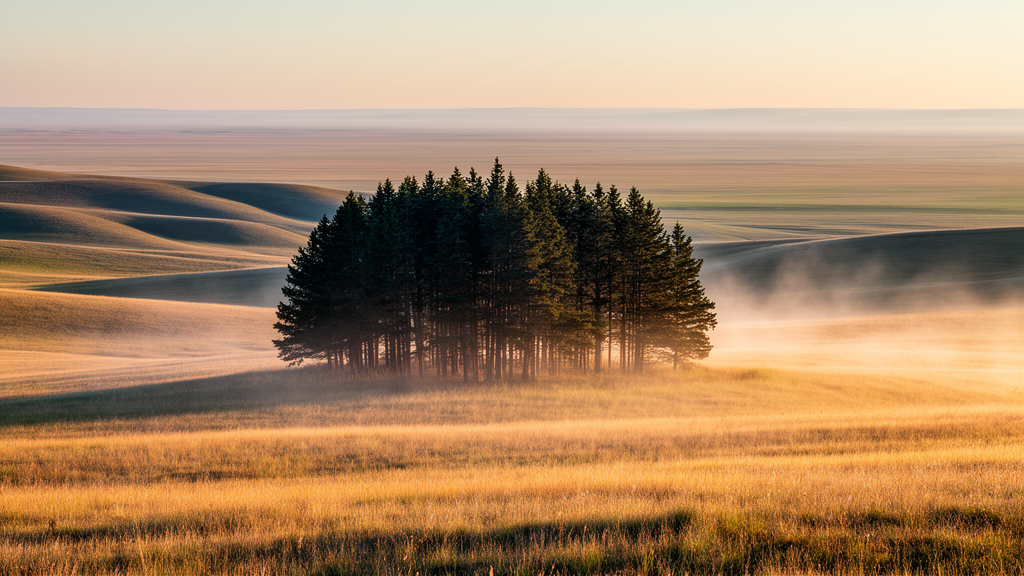
A newly released dataset documents 117 vegetation relevés collected in the Kazakh Uplands between 2014 and 2025. The records cover forests, steppes, grasslands, floodplains, forest edges, post-fire forest sites and abandoned agricultural land across Central Kazakhstan, with all sampling locations georeferenced in the WGS84 coordinate system.
The dataset was assembled from five field projects: Bisons, PermanentPlots, Scabiosa, CentralKZ and Kendara. Sampling occurred in the Qaraghandy and Ulytau regions and, in part, in southern Akmola Region. Coordinates span 47.46957–51.63357 degrees north and 66.963623–76.22422 degrees east.
Vegetation was surveyed using the relevé method and either the Braun–Blanquet or Drude cover-abundance scale. Investigators estimated total and species-level cover for vascular plants in the tree canopy, understorey or shrub, and herb layers where those layers were present. Plot sizes were 100 or 1,600 square metres.
Most sampling locations were forests: 76 relevés were in forest stands, two in forest sites after fires and five at forest edges. Another 21 surveys represented dry xerophytic forb, forb–feather grass and forb–grass meadow steppe habitats. Eight plots were in grassland, two in floodplains and three on abandoned agricultural land. Pine-dominated stands accounted for 28 forest relevés; other surveys covered birch, aspen, mixed and black alder stands.
The records contain 481 unique scientific names representing 60 families and 238 genera. Of these, 420 taxa were identified to species level, 12 to subspecies and three to variety. Species were identified by Margarita Ishmuratova using regional floras and identification keys, with herbarium specimens deposited in the QAR collection. Scientific names were checked through the GBIF species-matching tool.
Eight alien plant species are represented in the relevés: Agropyron cristatum, Echinops sphaerocephalus, Echium vulgare, Cota tinctoria, Malus baccata, Caragana arborescens, Stellaria media and Acer negundo. The dataset includes fields describing how each was introduced, its degree of establishment and its pathway, drawing on previous research into the flora of Central Kazakhstan.
Boxelder maple, Acer negundo, was recorded twice. One occurrence was in an aspen stand in the Ortau Mountain forests, where it accounted for 25% cover of the understorey layer. The second was a young individual in a mixed forest stand in Karkaraly State National Natural Park. The authors describe the species as potentially the most dangerous among the alien plants in the dataset, citing its invasive status in Russia and unpublished field observations of initial colonisation in Central Kazakhstan.
Field data were digitised and standardised in Darwin Core. They were first released through GBIF as sampling-event datasets, but the GBIF Relevé Darwin Core Extension was not then indexed, so the authors merged the records and published the full dataset through Zenodo. It comprises an event table with plot characteristics and an occurrence table containing species-abundance data.
The dataset offers field observations from a defined geographic area and sampling period rather than a systematic estimate of vegetation across all Central Kazakhstan. Its habitat representation is uneven, with forests accounting for most plots, and the field records alone do not establish the regional prevalence, long-term trend or ecological effect of the alien species recorded.
Subject of Research: Vegetation plot dataset for forests, steppes and other habitats in the Kazakh Uplands
Article Title: Forest and steppe communities of Kazakh Uplands: vegetation plot dataset
Article References: Ivanova, N., Ishmuratova, M., & Tyrzhanova, S. (2026). Forest and steppe communities of Kazakh Uplands: vegetation plot dataset. Biodiversity Data Journal, 14, Article e189416. https://doi.org/10.3897/bdj.14.e189416
Image Credits: AI Generated
Keywords: Kazakh Uplands, vegetation relevés, plant diversity, forest communities, steppe vegetation, Darwin Core, GBIF, alien plants, Central Kazakhstan, open biodiversity data, Forest, steppe
News Source: Drew Townsend. (October 21, 2026). Kazakh Uplands vegetation dataset documents 117 plots across forests, steppes and other habitats. Scienmag.