• HOME
  • NEWS
  • EXPLORE
    • CAREER
      • Companies
      • Jobs
    • EVENTS
    • iGEM
      • News
      • Team
    • PHOTOS
    • VIDEO
    • WIKI
  • BLOG
  • COMMUNITY
    • FACEBOOK
    • INSTAGRAM
    • TWITTER
Wednesday, October 21, 2026
BIOENGINEER.ORG
No Result
View All Result
  • Login
  • HOME
  • NEWS
  • EXPLORE
    • CAREER
      • Companies
      • Jobs
        • Lecturer
        • PhD Studentship
        • Postdoc
        • Research Assistant
    • EVENTS
    • iGEM
      • News
      • Team
    • PHOTOS
    • VIDEO
    • WIKI
  • BLOG
  • COMMUNITY
    • FACEBOOK
    • INSTAGRAM
    • TWITTER
No Result
View All Result
Bioengineer.org
No Result
View All Result
Home NEWS Science News Technology

Global study finds 25% of 9,347 operational data centers in water-stressed areas

by
October 21, 2026
in Technology
Reading Time: 2 mins read
0
Global study finds 25% of 9,347 operational data centers in water-stressed areas

One-Quarter of Global Data Centers Sit Where Water Runs Short, Study Finds

Share on FacebookShare on TwitterShare on LinkedinShare on RedditShare on Telegram

A global analysis of 9,347 operational data centers found that about 25% are located in areas where water demand exceeds supply for at least one month each year, according to the peer-reviewed study published in Environmental Science & Technology. Around 6% of the facilities are in areas stressed for most of the year. The researchers also estimated that 33% of today’s data centers could be in regions where demand will exceed supply under a future climate scenario.

Lead and corresponding author Lorenzo Rosa and colleagues mapped the locations of data centers against local water availability and demand from cities and municipalities, agriculture, manufacturing, and power generation. The analysis assessed where water use by existing users was already greater than available supply and examined how the balance could change in a modeled future climate. The researchers said the map was needed because, unlike electricity use, which is metered and reported, water scarcity is measured locally and often inconsistently or not at all.

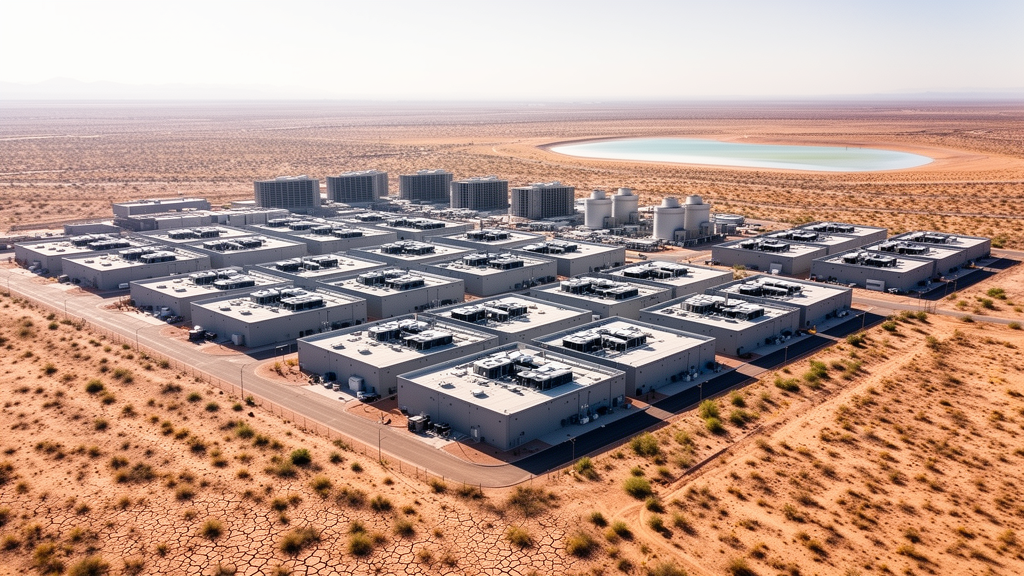
The current analysis found that cities and municipalities were the largest water users near 41% of the data centers, while agriculture was the primary consumer near another 28%. Data centers use water to cool servers and prevent overheating, and they draw from the same local rivers, lakes, and aquifers used by nearby communities and industries. Rosa said the facilities were “landing on top of the water supply of cities and farms,” rather than being situated in landscapes without existing water use.

For the future projection, the researchers used several climate models representing average global temperatures 3 degrees Celsius, or 5.4 degrees Fahrenheit, warmer than in 1900. The authors described this scenario as representing a time frame from 10 to 40 years from now. Under those assumptions, the model estimated that 33% of today’s data centers could be located in regions where water demand will exceed supply. Most of the additional facilities potentially affected were in the United States, where 39% of the global data-center total was already located at the time of the analysis.

The findings indicate that data-center operations may add pressure to local water resources in places already experiencing, or projected to experience, water stress. The study does not establish what consequences would follow for particular water users, and the authors said future studies would be needed to determine whether projected scarcity translates into actual effects. They nevertheless argued that data-center planning should account for local water-management and infrastructure needs. The authors also disclosed that Saoradh Enterprise Partners LLC supported the work by providing access to the data-center dataset.

Subject of Research: Global analysis of water stress around operational data centers under current and future climate scenarios

Article Title: Many data centers are located where water resources are limited

Article References: Many data centers are located where water resources are limited. Original publication (Bibliographic details unavailable.)

Image Credits: AI Generated

DOI: Not provided

Keywords: data centers, water stress, water demand, water supply, climate models, global analysis, environmental science, infrastructure, Many, data, centers, located

News Source: Denise Maddox. (October 21, 2026). Global study finds 25% of 9,347 operational data centers in water-stressed areas. Scienmag.


Tags: centersclimate modelsdatadata centersenvironmental scienceglobal analysisinfrastructurelocatedManywater demandwater stresswater supply
Share12Tweet7Share2ShareShareShare1

Related Posts

Mizzou researchers see promise in tongue exercise for ALS

Mizzou researchers see promise in tongue exercise for ALS

October 21, 2026
Adversarial domain adaptation for false-positive reduction in hospital-to-robotic echocardiographic screening under limited target-domain data

Adversarial domain adaptation for false-positive reduction in hospital-to-robotic echocardiographic screening under limited target-domain data

October 21, 2026

Reused Industrial Meter Feeds 30-Day Electrical Monitoring Trial

October 21, 2026

Research report: Translational Barriers and AI‐Driven Challenges of Microfluidics‐Enabled Wearables and Implantable Systems in Personalized Medicine

October 21, 2026

POPULAR NEWS

  • Cross-country survey finds greater body dissatisfaction among French sports science students

    Cross-country survey finds greater body dissatisfaction among French sports science students

    29 shares
    Share 12 Tweet 7
  • Global study finds 25% of 9,347 operational data centers in water-stressed areas

    29 shares
    Share 12 Tweet 7
  • Perspective and review finds DNA and morphology both needed for parasitoid wasp taxonomy

    29 shares
    Share 12 Tweet 7
  • SwiVirScan profiles viral antibody histories in 127 adult breeding pigs

    29 shares
    Share 12 Tweet 7

About

We bring you the latest biotechnology news from best research centers and universities around the world. Check our website.

Follow us

Recent News

Cross-country survey finds greater body dissatisfaction among French sports science students

Global study finds 25% of 9,347 operational data centers in water-stressed areas

Perspective and review finds DNA and morphology both needed for parasitoid wasp taxonomy

Subscribe to Blog via Email

Enter your email address to subscribe to this blog and receive notifications of new posts by email.

Join 85 other subscribers
  • Contact Us

Bioengineer.org © Copyright 2023 All Rights Reserved.

Welcome Back!

Login to your account below

Forgotten Password?

Retrieve your password

Please enter your username or email address to reset your password.

Log In
No Result
View All Result
  • Homepages
    • Home Page 1
    • Home Page 2
  • News
  • National
  • Business
  • Health
  • Lifestyle
  • Science

Bioengineer.org © Copyright 2023 All Rights Reserved.