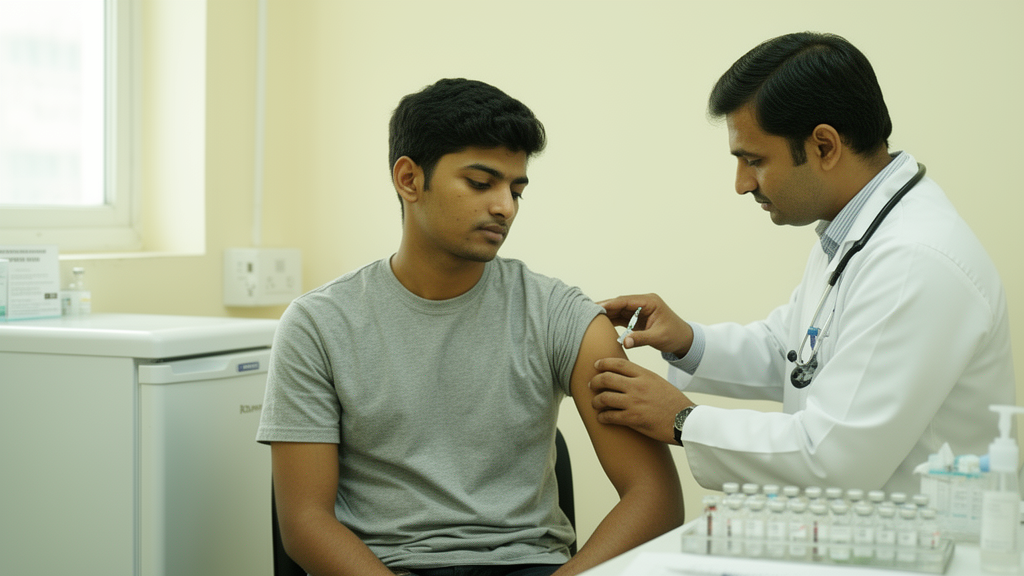
A mixed-method study in India’s Delhi National Capital Region found that favorable attitudes toward HPV vaccination among male healthcare professionals and students did not translate into high uptake. In the quantitative survey, 299 participants achieved an overall knowledge score of 59% and an attitude score of 89%. Although 83.9% were willing to promote HPV vaccination among men in India, only 11.4% reported having received the vaccine.
The results identify a pronounced gap between support for male vaccination and personal vaccination practice in the studied population. Researchers surveyed young male healthcare professionals and students from diverse backgrounds working in public and private healthcare settings across Delhi NCR between March 2022 and April 2023. The quantitative arm used convenience sampling and included 299 complete responses, while the qualitative arm consisted of interviews with 37 participants.
Quantitative responses were analyzed with descriptive statistics in SPSS version 30.0. For the interviews, the researchers manually transcribed the data and used a Grounded Theory Approach to identify themes. The study examined knowledge, attitudes and practices related to HPV vaccination, with the interviews exploring participants’ perceptions of HPV infection and vaccination.
Participants in the quantitative arm had a mean age of 24.6 years. Their relatively high attitude score, compared with their knowledge score, suggests that support for HPV vaccination was more widespread than detailed understanding of the subject. The contrast was especially apparent when researchers compared willingness to promote vaccination with vaccination uptake: more than eight in ten participants supported promoting HPV vaccination among Indian men, but roughly one in nine reported being vaccinated.
The study also found that engagement in unsafe sexual practices was significantly associated with age (p = 0.006), occupation (p = 0.004), education (p less than 0.001) and marital status (p = 0.003). These were statistical associations within the survey, not evidence that any listed characteristic caused the reported practices. Marital status was also significantly associated with willingness to engage in HPV-related awareness activities within personal networks (p less than 0.001).
The 37 interviewees had a mean age of 32.4 years, with a standard deviation of 6.2 years. Four themes emerged from the thematic analysis: HPV being seen as a female-specific issue, awareness not translating into action, systemic silence and missed opportunities, and cost-consciousness despite awareness. In the qualitative sample, 27% of interviewees held misconceptions about HPV, 18.9% felt there was a lack of a male-focused HPV vaccination drive, and 29.7% expressed affordability concerns because of the high vaccine cost.
These findings offer accounts of the gap observed in the survey. The authors concluded that the findings provide a foundation for larger studies of the barriers and facilitators to HPV vaccination among male healthcare professionals. They called for comprehensive educational, institutional and policy interventions to improve uptake and support equitable implementation of gender-neutral HPV vaccination.
Within that scope, the study documents a clear mismatch between willingness to promote male HPV vaccination and reported uptake, while identifying misconceptions, missed opportunities and cost concerns as issues that may merit further investigation.
Subject of Research: Knowledge, attitudes and vaccination practices among male healthcare professionals and students in Delhi NCR
Article Title: Assessing knowledge, attitudes and practices towards HPV vaccination among male healthcare professionals and students in Delhi National Capital Region: a mixed-method study
Article References: Kaur, K. N., Nandi, D., Chandrasekaran, S., Joseph, A., & Saeed, S. (2026). Assessing knowledge, attitudes and practices towards HPV vaccination among male healthcare professionals and students in Delhi National Capital Region: a mixed-method study. BMC Public Health. https://doi.org/10.1186/s12889-026-28719-w
Image Credits: AI Generated
DOI: 10.1186/s12889-026-28719-w
Keywords: HPV vaccination, male health, Delhi NCR, healthcare professionals, vaccine uptake, mixed-method study, public health, India, Assessing, knowledge, attitudes, practices
News Source: Ophelia Keating. (October 21, 2026). Mixed-method study finds low male HPV vaccination uptake in Delhi NCR. Scienmag.