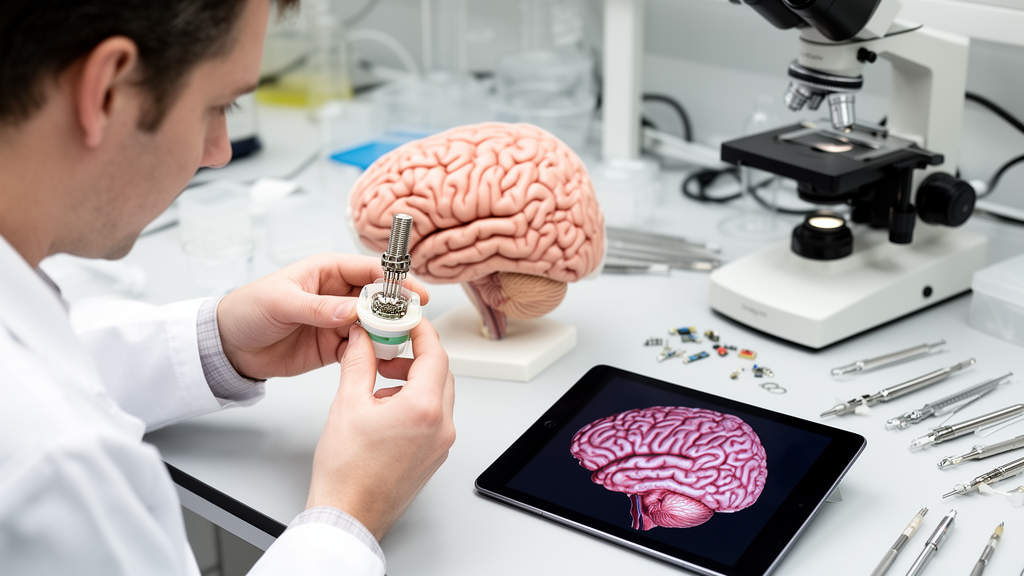
A 2026 hypothesis paper proposes an “Auxilium,” an extracranial system designed to restore functions lost when a stroke destroys not only connections in the brain but also the neural tissue that performs the relevant computation. The architecture is anchored in the case of Dr. G., an orthopedic surgeon who suffered a large left middle cerebral artery stroke while exercising on a stationary bicycle. He developed right-sided spastic hemiplegia and aphasia; rehabilitation and paired vagus nerve stimulation improved his upper-limb function but did not meaningfully improve speech. The proposal is theoretical, and no Auxilium device or clinical trial has yet established safety or efficacy.
Dr. G.’s infarct involved the left frontal lobe, insula and basal ganglia, followed by encephalomalacia and gliosis across much of the left middle cerebral artery territory. His recovery illustrates a problem that conventional brain-computer interfaces cannot necessarily solve: these systems generally decode signals from cortex that remains capable of producing the relevant intention or computation. Adding channels to a recording array can provide more access to surviving activity, but it cannot recover a representation from tissue that no longer exists. The author argues that the Auxilium is intended for people whose chief limitation is the loss of usable brain substrate, making it an extension of, rather than a replacement for, neuromodulation and conventional brain-computer-interface approaches.
The proposed system is independent of both the communication technology and the material used to build it. Its read-write interface could use stereoelectroencephalography depth probes, dense surface or penetrating arrays, biological electrodes, focused ultrasound or quantum magnetometry. The auxiliary substrate could be digital software, neuromorphic hardware, cultured neural tissue or a hybrid. In parallel with the patient’s residual brain, it would exchange information in real time and supply either missing connectivity or missing computation. The distinction is central: “virtual white matter” could record from one surviving region and stimulate another, functioning as a connectivity prosthesis, while “virtual gray matter” could execute processing that damaged tissue can no longer perform.
The architecture draws on recurring features of the human brain, including cortical columns, thalamocortical loops, basal ganglia, hippocampus and cerebellum. These are not proposed as a ready-made recipe for replacing language, but as a design hypothesis: an auxiliary system may integrate more effectively if its internal organization respects established patterns of recurrent processing, action selection, prediction, sequencing and memory. The paper warns that filling a stroke cavity with randomly dissociated neurons is unlikely to recreate lost function, and that adding cortical tissue without corresponding subcortical architecture could create a bottleneck. These statements remain hypotheses, not established rules for engineered tissue.
Several implementations are considered. The simplest would connect residual perilesional language areas in real time, creating a possible “virtual arcuate fasciculus” between frontal regions involved in phonological assembly and temporal regions involved in lexical access. A more ambitious version could use implanted neuromorphic circuits to model the input-output transformations of lost cortical networks, or place living tissue inside the skull. Another proposal relocates a bioengineered “third cerebral hemisphere” to the abdomen, where living electrodes in the brain connect through axonal conduits to vascularized tissue containing cortical, thalamic, basal-ganglionic and cerebellar components. A still more external option would link implanted interfaces by low-latency telemetry to an in vitro “bioserver” containing organoids, assembloids or neural aggregates.
The extracranial system is defined as a nested series of experimental classes rather than a single technology. A relay can pass a signal unchanged; a memoryless transform can apply a fixed rule; a stateful module can maintain internal information; an adaptive module can change its parameters during use; and an autonomous dynamical substrate can evolve even without new input. The first two classes primarily provide connectivity, whereas the latter three add computation. This arrangement allows a falsifiable comparison in which the simplest module that improves performance can be identified. A positive result with a fixed relay would support the view that routing was the principal deficit, while benefit specific to adaptive or autonomous systems would suggest that the module supplied computational dynamics rather than merely moving information.
To begin testing those possibilities, the author proposes using people who are already undergoing stereoelectroencephalographic monitoring for epilepsy evaluation. With the same electrode set used for clinical care, signals from one cortical area could trigger stimulation in another, while participants serve as their own controls. Candidate external modules would include threshold rules, PID controllers, expert systems, artificial neural networks, neuromorphic devices, in vitro neural specimens and human helpers. Tasks would range from delayed matching and semantic prediction to virtual navigation and the multiple errands test, which assesses planning, timing and accuracy in everyday scenarios. Matched controls such as sham stimulation, replayed output, time-shuffled output and frozen adaptation would help distinguish module-specific effects from latency, practice, arousal or stimulation artifacts.
Functional integration would not be inferred from laboratory performance alone. The proposal calls for transfer to untrained tasks, cross-task interference, spontaneous correlation between brain and module during rest, and perturbation of the external system. The participant’s own preselected goal, measured against their baseline, is proposed as the decisive endpoint. Such integration would also require acclimatization. Drawing an analogy with cochlear implant users, the paper argues that a new auxiliary substrate may need prolonged exposure to the changing statistical relationships between action and consequence before it becomes useful. Occupational, physical and speech therapy could therefore become part of calibrating the system, with exercises tailored to a participant’s preserved interests, deficits and everyday goals rather than restricted to repeating isolated clinical tasks.
Translation is organized as a staged hierarchy that rises in regulatory and surgical risk. Initial work would use existing stereoelectroencephalography implants, followed by real-time bridging between recorded regions and testing in people with acquired neurological deficits. Later stages would involve temporary research implants, chronic removable devices, implanted biological replacements and finally an ectopic third hemisphere connected by living tissue. Each stage has a proposed gate: reproducible percepts, a module-specific performance change, benefit despite damaged substrate, durable user-defined improvement with acceptable safety, and finally evidence that biological tissue offers a margin worth the additional surgical risk. Ethics would require repeated consent, bounded stimulation firmware, authenticated control paths, audit logs, strict data protection and the ability to disconnect the module.
The proposal remains explicitly speculative and acknowledges major uncertainties. People undergoing epilepsy monitoring usually retain neural circuitry absent in severe stroke, so a positive result in that cohort would not prove that lost tissue can be functionally replaced. Biological grafts pose risks including tumor formation, seizures, inflammation, blood-brain-barrier disruption and surgical complications, while organoids have limitations in maturation, vascularization and reproducibility. The paper does not claim that a kHz neural interface can be made to think at MHz speed, nor that adding ports will automatically increase cognitive capacity. Instead, it advances a falsifiable architectural question: when conventional therapies and brain-computer interfaces have reached a ceiling because critical neural substrate is missing, can an external system supply both the connections and the computations needed for functional restoration? Stereoelectroencephalography and linked neural-tissue experiments could begin testing that proposition, but the proposed “third hemisphere” remains a far-off prospect whose clinical value is unproven.
Subject of Research: A proposed extracranial brain-restoration architecture for severe stroke and lost neural substrate.
Article Title: From a surgeon's stroke to a third hemisphere—The auxilium architecture for brain restoration and extension
Article References: Serruya, M. D. (2026). From a surgeon's stroke to a third hemisphere—The auxilium architecture for brain restoration and extension. Frontiers in Human Neuroscience, 20, 1893045. https://doi.org/10.3389/fnhum.2026.1893045
Image Credits: AI Generated
DOI: 10.3389/fnhum.2026.1893045
Keywords: brain-computer interfaces, stroke rehabilitation, aphasia, neural prostheses, brain architecture, neurotechnology, neuromorphic computing, neural organoids, neuroplasticity, neuroethics, surgeon's, stroke
News Source: Cassandra Pierce. (October 21, 2026). Hypothesis proposes auxiliary brain for severe stroke restoration. Scienmag.