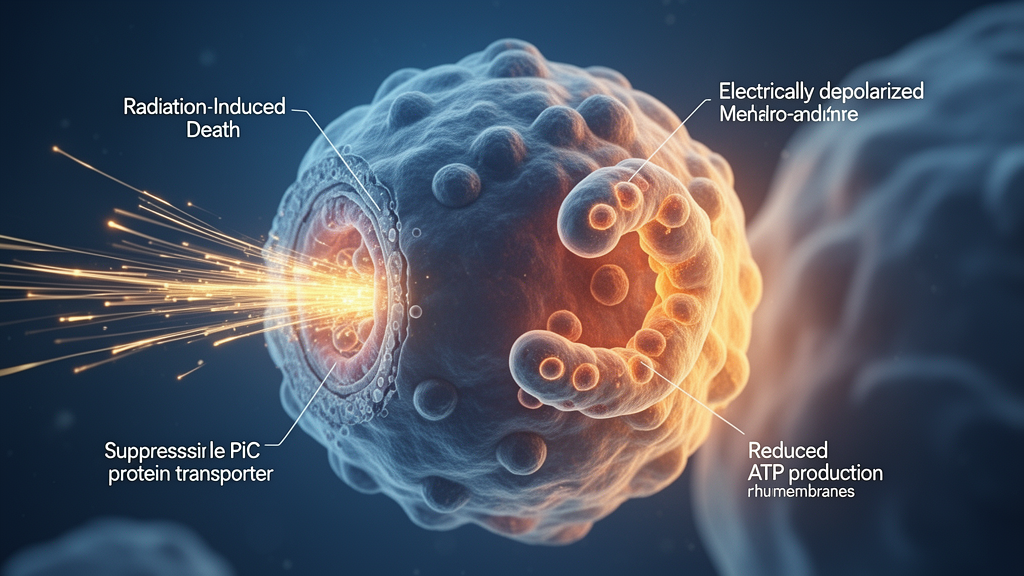
Radiation suppressed the expression of the mitochondrial phosphate carrier, known as PiC, in glioma cells, triggering mitochondrial energy-metabolism failure, collapse of membrane potential, dysregulation of mitochondrial DNA replication, and sustained opening of the mitochondrial permeability transition pore (MPTP), according to a mechanistic study in cells and mouse tumor models. The findings link the radiation-induced loss of PiC to a mitochondrial apoptotic pathway involving Bax/Bcl-2, cytochrome c, and caspase-3, and identify a possible molecular axis for improving glioma radiosensitivity. The study focused on the clinical challenge of radioresistance in glioma, for which the role of PiC during radiotherapy and the mechanisms connecting it to cell death were unclear.
PiC was described as a key protein in maintaining mitochondrial homeostasis, and earlier work had suggested that it may help regulate MPTP opening. The researchers reported that irradiation specifically reduced PiC expression in glioma cells. This suppression was followed by failure of mitochondrial energy metabolism and loss of mitochondrial membrane potential, providing evidence that radiation disrupts several linked features of mitochondrial function.
Experiments examining the underlying sequence placed mitochondrial DNA replication and MPTP activity at the center of the response. Radiation-induced PiC suppression was associated with dysregulation of mtDNA replication and significantly increased, sustained MPTP opening. Taken together, the reported results support a cascade in which radiation suppresses PiC, promotes persistent pore opening and mitochondrial dysfunction, and engages the mitochondrial apoptotic pathway that drives glioma cells toward programmed death.
Concordant changes in apoptotic markers were observed in murine tumor models, extending the cell-based findings to an intact biological setting. The in vivo results were consistent with the mechanistic observations made in glioma cells, although the supplied study summary does not provide numerical effect sizes, radiation doses, model details, or statistical estimates. The work therefore supports the relevance of the PiC–MPTP pathway in experimental glioma systems, but it does not by itself establish how much the pathway accounts for treatment response in people.
Beyond the reported findings, the authors proposed that targeting the PiC–MPTP axis could represent a potential strategy for overcoming radioresistance and enhancing radiosensitivity in glioma. That proposal remains a therapeutic hypothesis rather than a demonstrated clinical intervention. The evidence presented comes from glioma cells and murine tumor models, not a human trial, and does not show that manipulating PiC or MPTP would be safe or effective in patients.
Subject of Research: Radiation-induced PiC suppression, mitochondrial permeability transition, and apoptosis in glioma models
Article Title: The role of the mitochondrial phosphate carrier in modulating mitochondrial homeostasis and enhancing radiosensitivity in tumor cells
Article References: Shen, L., Liu, X., Lu, Y., Wang, K., Gu, H., Yuan, S., & Qian, J. (2026). The role of the mitochondrial phosphate carrier in modulating mitochondrial homeostasis and enhancing radiosensitivity in tumor cells. Molecular Biology Reports, 53(1), Article 1767. https://doi.org/10.1007/s11033-026-12779-7
Image Credits: AI Generated
DOI: 10.1007/s11033-026-12779-7
Keywords: glioma, radiotherapy, mitochondrial phosphate carrier, PiC, mitochondrial homeostasis, permeability transition pore, apoptosis, radiosensitivity, mitochondrial DNA, tumor models, role, mitochondrial
News Source: Nathaniel Bowman. (October 21, 2026). Radiation suppresses PiC, triggering mitochondrial dysfunction and glioma cell death. Scienmag.