A routine freshwater-monitoring survey detected one last-instar larva of the minute caddisfly Stactobia eatoniella in Switzerland’s Morge catchment in March 2020, providing a verified Swiss record more than 70 years after the previous official observation. The specimen was found below Cernet Dessous, in the canton of Valais, during sampling commissioned by the canton’s Service de l’environnement. Researchers deposited it at the Museum of Zoology in Lausanne and transmitted the record to the Swiss biodiversity information system, info fauna. The finding establishes that the species was present in Switzerland in 2020, but the single larva does not reveal how widely it is distributed, whether it formed a resident population or how persistent it may be.
Before this rediscovery, Swiss records for S. eatoniella comprised eight observations made between 1888 and 1944: one in Zürich, one in the gorges de l’Orbe and six in the canton of Valais, including sites in Val d’Illiez, Val d’Hérens, Crans and Binntal. The most recent official record came from around Les Haudères in Val d’Hérens on 27 July 1944. The species had been classified as extinct in Switzerland, designated category RE, and was included in the Swiss List of National Priority Species and Habitats with a high degree of priority. The 2020 observation does not itself document a formal revision of that Red List category, but it demonstrates that the historical designation no longer describes the verified observations available to the authors.
S. eatoniella is a hydroptilid, or micro-caddisfly, within the family Hydroptilidae. These insects measure only 1.5 to 6 millimetres, and Stactobia larvae are approximately 2 millimetres long. Hydroptilidae is the most diverse caddisfly family, with more than 2,000 valid species distributed worldwide, although species richness is highest in warm tropical regions. Switzerland’s fauna includes 302 caddisfly species, 33 of them hydroptilids. At national scale, Hydroptilidae is the second-richest caddisfly family after Limnephilidae when genera and species are considered. The genus Stactobia contains 168 species, including 41 in the Western Palearctic, and three reported from Switzerland: S. eatoniella, S. furcata and S. moselyi.
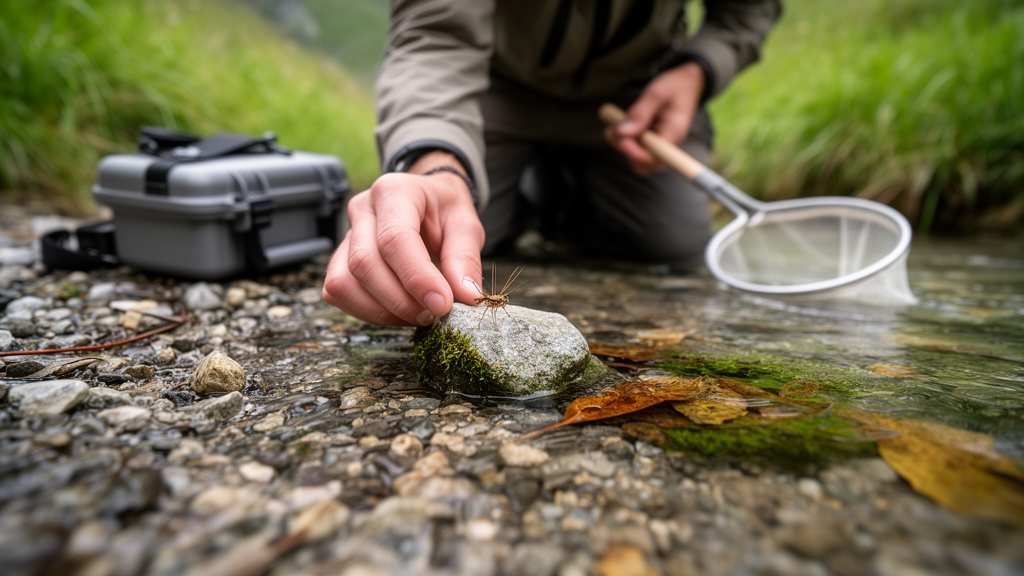
The rediscovery emerged from a surface-water quality-monitoring program in the Morge catchment. Valais’s Service de l’environnement commissioned the consultancy office biol conseils to sample benthic macroinvertebrates using the Swiss biotic index, or IBCH, method. The biological work was combined with physicochemical analyses, flow measurements and studies of diatoms. Five sites were sampled in spring 2020 at elevations ranging from 480 metres above sea level, where the Morge enters the Rhône River, to 1,480 metres. At each site, investigators collected eight samples from different substrates. Material containing benthic macroinvertebrates, mineral material and organic debris was combined into one composite sample per site and fixed in 100% ethanol.
After sieving the preserved samples, workers sorted the benthic macrofauna and identified organisms to family level under a stereomicroscope following the IBCH method. The S. eatoniella specimen emerged from site MOR 10.2, below the locality called Cernet Dessous, on 18 March 2020. The site lies at 46°17′30.924″ north, 7°19′46.046″ east and 1,125 metres above sea level. The record, made under specimen identifier GBIFCH0082987, provided the basis for reporting the species to info fauna. Because identification followed the monitoring protocol’s routine sorting process, the rediscovery arose as a product of broad catchment surveillance rather than a dedicated search designed specifically for Stactobia.
Hydroptilid larvae undergo a distinctive developmental process called hypermetamorphosis. During the first four larval instars, they are minute, lack a case and differ markedly in form from the fifth instar. In the last stage, the abdomen is enlarged, the larva carries a silken case and most of the food reserves needed for the future adult accumulate in the abdomen. The recovered animal was in this final, case-bearing stage. The case lacks the pronounced lateral flattening found in most other hydroptilid genera. Adults of S. eatoniella are black with white markings, and the species has one generation per year. Its documented cycle includes the laying of about 70 red-orange eggs in empty pupal cases, first-instar larvae appearing in mid-June, final-instar larvae occurring in August and pupation taking place in May and June of the following year.
Stactobia larvae live in hygropetric, or petrimadicolous, environments: rocky places covered by a constant, uninterrupted film of flowing water. Examples include stream margins, spring seepage areas and spray zones around waterfalls or rapids. The larvae graze on films of algae and lichens covering the substrate, while adults remain close to these wet surfaces, generally no more than a metre away. They may run, hop or make short circular flights over the substrate during the hottest part of the day. S. eatoniella is reported from France, Italy, Spain, Austria, Germany and Slovenia. Records are also cited from Slovakia and Hungary, although those observations were not mentioned in recent synthesis works.
The physical conditions at Cernet differed from the microhabitat normally associated with S. eatoniella. The Morge occupies a deeply incised section reached by a logging road, where active erosion destabilizes the stream banks. Its bed contains very large boulders and locally stone slabs, with sand and gravel on the banks. The bed gradient in this section is around 12%, and water seeps into the steep sides. Samples were taken from the wetted bottom, where water depth ranged from 15 to 25 centimetres. Measured flow velocities ranged from 75 centimetres per second to less than 5 centimetres per second in nearly stagnant conditions. The sampled material included mobile blocks, organic litter, pebbles, gravel, sand, silt and the upper surface of one block.
Only one larva was recovered during the March sampling, and a second survey at Cernet on 13 October 2020 found no additional specimen. The authors considered that the individual might have been dislocated from a more typical nearby habitat, such as a lateral seep, a water film on slabs or boulders, or an area wetted by spray from a small waterfall, and then carried into the river bed. They said more specific investigation of lateral wetlands and seepages would be needed to locate a possible established population. Such work would require caution to avoid harming a population that could be very small and fragile. The observation therefore documents presence at the time of collection, not local abundance, an expanded known range or long-term occupancy of the sampled bed.
The rediscovery also highlights how difficult small freshwater invertebrates can be to monitor. Of the 302 Swiss caddisfly species assessed for the national Red List, 51% are listed as threatened; within Hydroptilidae, the corresponding proportion is 67%, and 36% of the family’s Swiss species have a high or very high national priority status. The authors associate these assessments partly with incomplete knowledge of distribution and ecology. Minute size makes the insects difficult to notice, larval identification to species level is demanding, and routine monitoring rarely collects adults. Standardized sampling can also miss hygropetric habitats, whose specialized conditions may divide species into small, isolated populations. More than 30% of red-listed Swiss hydroptilids are closely associated with springs, and S. eatoniella is particularly associated with spring brooks.
Swiss spring-fed ecosystems are themselves in decline, which the authors connect to extensive spring capture and drainage. Cantonal inventories of ecologically valuable springs are therefore presented as an important step toward filling gaps in faunistic knowledge, locating specialized habitats and identifying springs that warrant priority protection. The Morge specimen does not resolve the distribution of S. eatoniella in Switzerland, and no abundance estimate or population trend can be inferred from one animal. It does, however, provide a contemporary verified observation of a species previously considered extinct nationally and show how a species associated with hygropetric spring habitats can be recovered through routine sampling. Further evidence would require targeted surveys of suitable seeps and wet films, conducted with enough care to avoid disturbing any fragile population that may be present.
Subject of Research: A 2020 monitoring-based rediscovery of the hydroptilid caddisfly Stactobia eatoniella in Switzerland
Article Title: Rediscovery of Stactobia eatoniella McLachlan, 1880 ( Trichoptera , Hydroptilidae ) in Switzerland after more than seventy years
Article References: Vuataz, L., Stucki, P., Fauquet, L., & Bernard, R. (2021). Rediscovery of Stactobia eatoniella McLachlan, 1880 (Trichoptera, Hydroptilidae) in Switzerland after more than seventy years. Alpine Entomology, 5, 55-60. https://doi.org/10.3897/alpento.5.67985
Image Credits: AI Generated
Keywords: Stactobia eatoniella, caddisflies, Hydroptilidae, Switzerland, Valais, species rediscovery, freshwater monitoring, hygropetric habitats, spring brooks, aquatic biodiversity, Rediscovery, Stactobia
News Source: Margaret Porter. (October 21, 2026). Routine monitoring rediscovers Switzerland’s tiny Stactobia caddisfly. Scienmag.