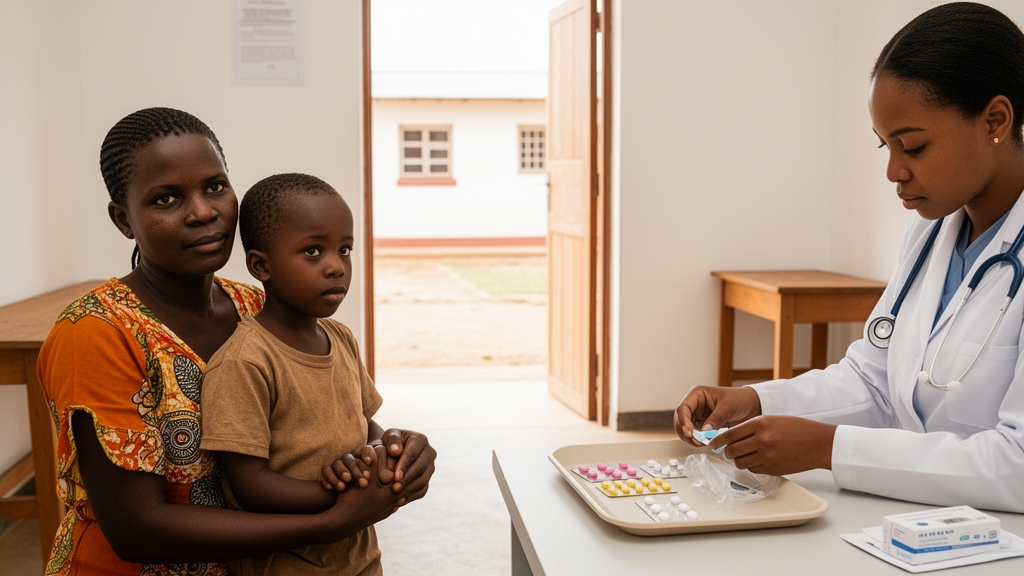
HIV prevalence among children with tuberculosis in Tanzania’s 10 high-burden regions fell from 28.5% in 2018 to 8.9% in 2023, according to a retrospective analysis of national surveillance records. The study included 25,449 children younger than 15 years who were registered with tuberculosis and had a documented HIV status between January 2018 and December 2023. Of these children, 3,667 were HIV-positive, giving an overall prevalence of 14.4% with a 95% confidence interval of 14.0% to 14.8%. Although the annual decline was substantial, the analysis found that co-infection remained more common among older children, children registered with relapse tuberculosis and children in several regions.
Researchers analyzed Tanzania’s national electronic tuberculosis surveillance system, DHIS2-eTL. Eligibility was limited to children below 15 years with documented HIV status, and HIV positivity was confirmed at tuberculosis registration. The investigators used a chi-square test for linear trend to assess annual changes in prevalence. They also used modified Poisson regression with robust variance to estimate adjusted prevalence ratios for factors associated with HIV co-infection. As a result, the estimates describe children encountered through the tuberculosis surveillance system who had an HIV status recorded; they do not represent every child with tuberculosis or every child living with HIV in Tanzania.
HIV positivity declined in each successive year covered by the analysis. It was 28.5% in 2018, with a 95% confidence interval of 26.8% to 30.2%, and 8.9% in 2023, with an interval of 8.1% to 9.8%. The test for linear trend yielded a chi-square statistic of 719.7 with one degree of freedom and a p-value below 0.001. This corresponds to a roughly two-thirds proportional reduction over the six-year observation period. The surveillance analysis documents a marked change in the prevalence of co-infection among notified children, but it does not establish which interventions or changes in health services produced that change.
Prevalence increased across the three pediatric age groups. HIV positivity was 9.0% among children younger than five years, with a 95% confidence interval of 8.5% to 9.5%; 17.7% among those aged 5 to 9 years, with an interval of 16.8% to 18.6%; and 22.6% among those aged 10 to 14 years, with an interval of 21.6% to 23.7%. The chi-square statistic for this pattern was 684.3 with one degree of freedom and a p-value below 0.001. In the adjusted model, registration at ages 10 to 14 was associated with an adjusted prevalence ratio of 2.40, compared with the reference category, with a 95% confidence interval of 2.22 to 2.59. There was no statistically significant difference in prevalence between boys and girls, for which the reported p-value was 0.814.
Regional variation was also pronounced. Prevalence was highest in Njombe, at 29.7%, and lowest in Ruvuma, at 6.7%, with the overall regional difference reported at p below 0.001. After adjustment, registration in Njombe was associated with an adjusted prevalence ratio of 1.46, with a 95% confidence interval of 1.30 to 1.64. The study’s conclusion also identified Njombe, Mbeya and Iringa as places where co-infection remained concentrated. Relapse tuberculosis was associated with an adjusted prevalence ratio of 2.30, with a 95% confidence interval of 1.92 to 2.76. These are adjusted associations rather than evidence that age, region or relapse status directly caused HIV co-infection, and the surveillance records do not identify the mechanisms behind the observed patterns.
The retrospective design provides population-scale program data but carries important limitations. Results depend on the completeness and accuracy of routine records, while excluding children whose HIV status was not documented. The analysis also cannot directly determine the incidence of tuberculosis among children living with HIV or fully measure differences in access to testing, care-seeking and health services. Although the six-year trend and multivariable analysis add information beyond descriptive reporting, the findings should be interpreted as measured prevalence and modeled associations within notified cases. Children living with HIV who develop tuberculosis are described in the study background as having higher case fatality and lower treatment success than their HIV-negative peers; the present surveillance analysis did not directly compare those clinical outcomes. The authors concluded that Tanzania’s National Tuberculosis and Leprosy Programme should prioritize repeat HIV testing for children aged five years and above and for tuberculosis retreatment cases, with geographically intensified attention in Njombe, Mbeya and Iringa.
Subject of Research: HIV prevalence and associated factors among Tanzanian children with tuberculosis
Article Title: Prevalence and factors associated with HIV among children with tuberculosis in ten high-burden regions of Tanzania, 2018–2023: a retrospective analysis of national surveillance data
Article References: Mgeyi, E. N., Kalabamu, F. S., Onduru, O. G., Riziki, K. M., Balama, R. F., Sililo, G. A., Shimba, P., Kwesiga, J. B., Rose, A., Wafula, S. T., Nsubuga, D., & Kimuli, D. (2026). Prevalence and factors associated with HIV among children with tuberculosis in ten high-burden regions of Tanzania, 2018–2023: a retrospective analysis of national surveillance data. BMC Infectious Diseases. https://doi.org/10.1186/s12879-026-14459-0
Image Credits: AI Generated
DOI: 10.1186/s12879-026-14459-0
Keywords: HIV, tuberculosis, pediatric co-infection, Tanzania, surveillance data, prevalence trends, age differences, regional variation, relapse tuberculosis, public health, Prevalence, factors
News Source: Ophelia Keating. (October 21, 2026). HIV prevalence fell among Tanzanian children with tuberculosis, surveillance analysis shows. Scienmag.