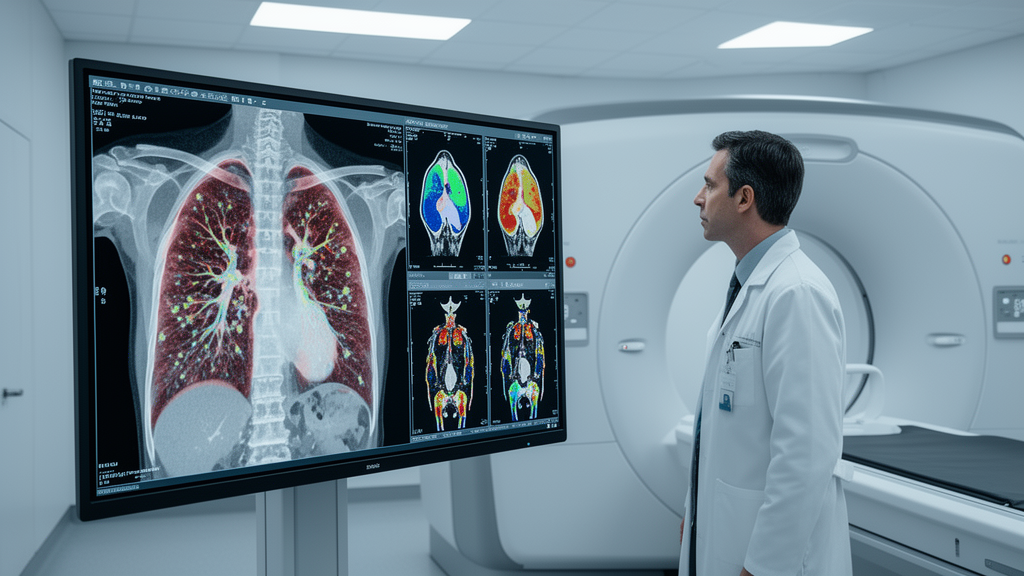
A retrospective quantitative imaging study of 165 patients found that dual-layer spectral computed tomography supplied measurable information that helped distinguish interstitial lung disease associated with antisynthetase syndrome (ASS-ILD) from disease associated with polymyositis or dermatomyositis (PM/DM-ILD). Right-lower-lobe volume performed best among the evaluated spectral CT parameters, producing an area under the receiver operating characteristic curve of 0.727, with 79.2% sensitivity and 58% specificity. The findings indicate potential complementary diagnostic value, although the study does not establish spectral CT as a standalone test.
The cohort comprised 69 patients with ASS-ILD and 96 patients with PM/DM-ILD, all of whom underwent both spectral CT and conventional high-resolution computed tomography (HRCT). Researchers quantified four types of measurements in each lung lobe: lung volume; 70 keV monoenergetic CT number, abbreviated MCTN; effective atomic number, or Zeff; and electron density, expressed as a percentage of water density. The groups were compared overall and within subgroups matched by radiological pattern or imaging feature, including nonspecific interstitial pneumonia and ground-glass opacity.
A Bonferroni correction was used for multiple testing, with an adjusted significance threshold of p < 0.00625. Across the full comparison, the ASS-ILD group had significantly smaller right- and left-lower-lobe volumes and higher MCTN and electron-density values than the PM/DM-ILD group; all adjusted p values were below 0.05. Volume differences were also observed when the analysis was restricted to patients whose HRCT scans showed nonspecific interstitial pneumonia.
In that subgroup, right-lower-lobe volume in ASS-ILD was 374.79 cm³, with an interquartile range of 291.08 to 619.35 cm³, compared with 596.22 ± 193.33 cm³ in PM/DM-ILD. Left-lower-lobe volume was 364.13 cm³, with an interquartile range of 255.83 to 567.04 cm³, in the ASS-ILD group, versus 563.74 ± 189.98 cm³ in the PM/DM-ILD group. Both raw comparisons produced p values below 0.001.
Quantitative differences also appeared when the researchers selected patients with ground-glass opacity. In that subgroup, left-lower-lobe electron density in ASS-ILD was 29.7% of water density, with an interquartile range of 24.1 to 43.8, compared with 25.3% and an interquartile range of 20.05 to 32.78 in PM/DM-ILD. The corresponding left-lower-lobe MCTN was −706.3 Hounsfield units, with an interquartile range of −763.15 to −562.5, in ASS-ILD, versus −749.7 Hounsfield units and an interquartile range of −802.98 to −678.33 in PM/DM-ILD.
Each ground-glass-opacity comparison had a raw p value of 0.003. These subgroup results show that the measured differences were detectable even when conventional HRCT patterns or signs were similar. Right-lower-lobe volume offered the strongest discrimination among the dual-layer spectral CT parameters evaluated, but its sensitivity of 79.2% and specificity of 58% mean that the measurement alone would not classify every patient correctly.
The study therefore characterizes spectral CT as an adjunct rather than a replacement for conventional HRCT, clinical assessment and serological testing. Within the reported population, however, quantitative lower-lobe differences distinguished ASS-ILD from PM/DM-ILD and demonstrate how spectral CT can add information beyond conventional imaging appearances.
Subject of Research: Diagnostic value of quantitative dual-layer spectral CT for distinguishing ASS-ILD from PM/DM-ILD
Article Title: A quantitative study: investigating the diagnostic value of using dual-layer spectral computed tomography in differentiating idiopathic inflammatory myopathy-associated interstitial lung disease
Article References: Xie, S., Wang, S., Zhang, Z., Liang, Y., Yu, J., Qi, R., Tan, C., Liu, H., Zhang, X., Liao, W., Zhao, L., Zhang, T., & Zhang, L. (2026). A quantitative study: investigating the diagnostic value of using dual-layer spectral computed tomography in differentiating idiopathic inflammatory myopathy-associated interstitial lung disease. BMC Medical Imaging. https://doi.org/10.1186/s12880-026-02960-6
Image Credits: AI Generated
DOI: 10.1186/s12880-026-02960-6
Keywords: spectral CT, antisynthetase syndrome, interstitial lung disease, polymyositis, dermatomyositis, quantitative imaging, lung volume, high-resolution CT, diagnostic accuracy, quantitative, investigating, diagnostic
News Source: Ophelia Keating. (October 21, 2026). Spectral CT signals distinguish antisynthetase-related lung disease in retrospective study. Scienmag.