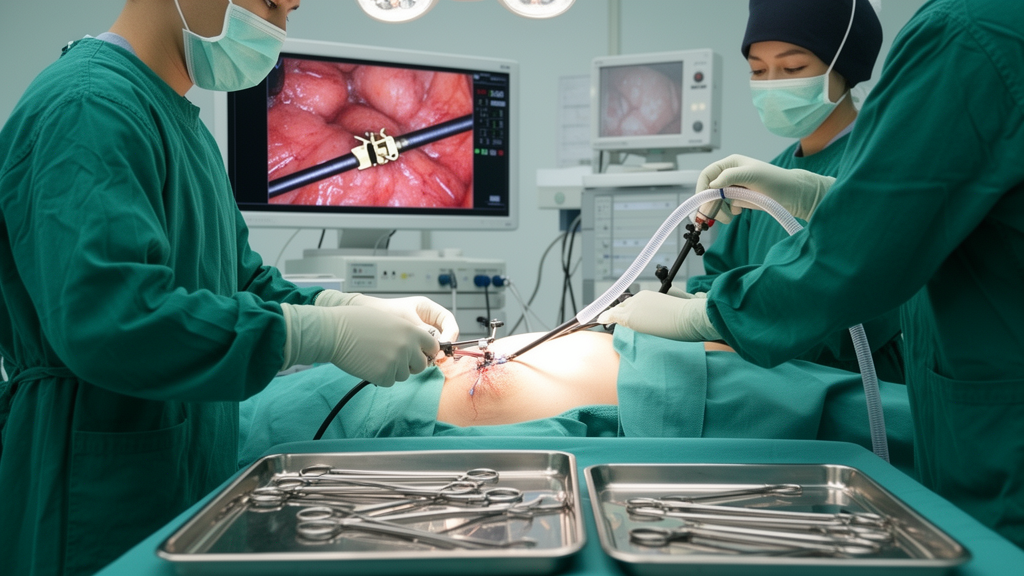
A single-patient case report describes the management of an early gastric leak after laparoscopic sleeve gastrectomy with an over-the-scope clip (OTSC) and staged laparoscopic drainage. A 45-year-old man was admitted two weeks after surgery with left-sided chest pain, fever up to 39.8 °C and tachypnea. Contrast-enhanced CT identified a proximal staple-line leak, a 60-mm left subphrenic collection, an intra-abdominal hematoma and a left pleural effusion.
The patient had a body mass index of 52.9 kg/m² and weighed 164 kg at a height of 176 cm. His sleeve gastrectomy had been performed in another country, and no operative documentation was available. In particular, the report states that there were no data on the stapling device, bougie width or staple-line reinforcement. He had been discharged from the original hospital on postoperative day 2.
At admission, he had mild diffuse abdominal pain without generalized peritonitis, nausea or vomiting. Laboratory findings included leukocytosis, elevated C-reactive protein and low hemoglobin, while renal and liver function were not impaired. Chest radiography showed a left-sided pleural effusion. Peroral and intravenous contrast CT showed extraluminal air and a liquid collection adjacent to the staple line in the left subphrenic region, with peroral contrast entering the collection. The findings supported a proximal staple-line leak with an associated collection, hematoma and pleural effusion.
The first laparoscopic revision was performed on the day of admission. Surgeons found hemoperitoneum and postoperative adhesions but no source of active bleeding. They cleared the peritoneal cavity and placed peritoneal drainage. The left subphrenic collection was not drained during this operation because of extensive adhesions in that space and the operative team’s relatively limited experience, according to the case report.
On postoperative day 3, the patient underwent endoscopy under general anesthesia in the supine position. The endoscopists identified a subcardial staple-line gastric fistula measuring 9–10 mm. An OTSC was deployed with a manually operated wheel, producing good approximation of the tissue and closing the staple-line defect. The endoscopists confirmed proper clip placement macroscopically at the end of the procedure.
The next day, an experienced surgical team performed another laparoscopic revision. After debriding the left subphrenic space, the surgeons drained the perigastric collection. Contrast introduced through a nasogastric tube during the operation showed no visible leak. Microbiological analysis of the specimen identified Enterococcus faecalis, and antibiotics were added to treatment. A drain was left in the left subphrenic space, and no further endoscopic intervention was performed.
A subsequent peroral Gastrografin esophagogastroduodenoscopy study showed normal passage of contrast through the gastric sleeve and duodenum without leakage. The nasogastric tube was removed, feeds were started, and the patient was discharged on postoperative day 7. During follow-up, the source reports no signs of infection, normal feeding and normal gastrointestinal tract function. At two months, the patient remained asymptomatic and had experienced progressive weight loss after the bariatric procedure.
The report places the case within a step-up framework for postoperative gastric leak. The cited literature gives an incidence of 1–8%, although it also reports more recent data of approximately 0.5%. According to Rosenthal’s classification, leaks are acute when they occur in the first seven days, early from one to six weeks, late after six weeks and chronic after more than 12 weeks. The patient’s presentation at two weeks therefore met the classification’s definition of an early leak.
For hemodynamically stable patients, the discussion describes conservative stabilization with gastric decompression, broad-spectrum intravenous antibiotics, nutritional support and drainage of accessible collections. The cited approach calls for reassessment after 48–72 hours, with escalation if the patient does not improve. Endoscopic options include OTSC for selected small-to-medium defects and covered stents for larger defects or high intraluminal pressure. Reported OTSC success rates in the cited studies range from 31% to 87%, depending on timing, defect size and fibrosis. Surgical management can include laparoscopic drainage, revision, bypass, fistulojejunostomy or gastrectomy in refractory cases.
This report is limited by its single-case design and cannot establish comparative effectiveness, causation or a general treatment standard. The absence of original operative documentation also prevented assessment of details such as the stapling device, bougie width and staple-line reinforcement. The successful outcome therefore documents one selected sequence of intervention in this patient rather than the broader clinical effectiveness of OTSC closure combined with laparoscopic drainage.
Subject of Research: Case report of combined endoscopic clip closure and laparoscopic drainage for gastric leak after sleeve gastrectomy
Article Title: A case of successful management of gastric leak after sleeve gastrectomy using an endoscopic clip and laparoscopic drainage
Article References: Marinov, V. M., Kostov, K. I., Kobakova, Y. A., Kirkova-Bogdanova, A. G., Vakrilova Becheva, M. S., Semerdzhieva, N. E., Ivanova, S. A., Chaneva, M. S., Atanasova, V. P., Yonchev, Y. T., Todorov, R. F., Bashev, N. Z., Bashov, I. E., Teneva, D. N., Danov, K. V., Moneva-Sakelarieva, M. G., Atliev, K. T., Kyosev, V. S., Pavlova, S. M., … Atanasov, P. Y. (2026). A case of successful management of gastric leak after sleeve gastrectomy using an endoscopic clip and laparoscopic drainage. Pharmacia, 73, Article e206962. https://doi.org/10.3897/pharmacia.73.e206962
Image Credits: AI Generated
DOI: 10.3897/pharmacia.73.e206962
Keywords: Sleeve gastrectomy, Gastric leak, Over-the-scope clip, Laparoscopic drainage, Bariatric surgery, Case report, Postoperative complication, Endoscopic therapy, case, successful, management, gastric
News Source: Ophelia Keating. (October 20, 2026). Over-the-Scope Clip and Laparoscopic Drainage Managed Postoperative Gastric Leak in a Single Sleeve Gastrectomy Case. Scienmag.