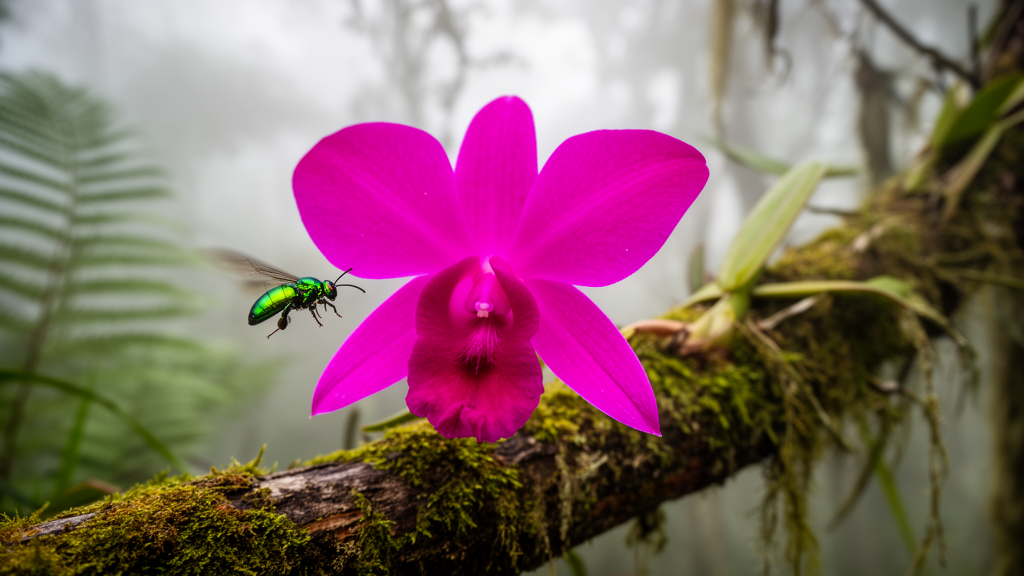
A literature review of orchid pollination in Guatemala found documented pollinators for 98 of the 1,231 orchid species reported in the country, leaving most of its orchid flora uncharacterized in this respect. The synthesis included about 150 scientific publications covering 71 genera and highlighted substantial gaps in knowledge of the animals that transfer pollinia between orchids.
The authors used the orchid checklist published by Archila and colleagues in 2018, which listed more than 1,200 taxa, as the basis for their search. They searched academic databases including PubMed, Web of Science and Scopus, together with relevant botanical databases, using combinations of terms such as “orchids,” “pollination” and “Guatemala.”
Studies were eligible when they addressed pollination of orchid species known to occur in Guatemala and covered subjects such as floral morphology, pollinator behaviour or ecological interactions. The researchers excluded publications that did not provide solid data, including reports of pollinia transfer. Titles and abstracts were screened first, after which the full texts of selected studies were assessed.
Information was extracted from the included papers about the orchid species studied, identified pollinators, relevant floral traits and ecological settings. These data were organized for analysis. The resulting review showed that most of the available information was sparse or incomplete, and only a small number of the cited studies had been conducted in Guatemala itself.
At least one effective pollinator was documented for every species in 22 genera, but each of those genera was represented in Guatemala by only one or two species. For 150 genera, the review found no documented effective pollinator. Known pollinator groups included bees, wasps, flies, butterflies, moths and hummingbirds, with observations of pollinia transfer forming an important criterion for inclusion.
The pattern differed considerably among the larger genera. Known pollinators were reported for 27% of the 30 Guatemalan Stanhopea species, 25% of the four Phragmipedium species and 20% each for the five Acropera and Myrmecophila species. Coverage was lower for several other genera, including Sobralia, with known pollinators for three of 47 species, Encyclia, with two of 32, Epidendrum, with one of 113, and Stelis, with one of 36.
The review describes several limitations in studying pollination among tropical orchids. Their diversity complicates species identification and the construction of comprehensive datasets, while cryptic habits can make orchids difficult to locate. Specialized floral structures and strategies such as mimicry, deceit and rewards also require detailed study of both the plants and their pollinator communities. Some pollinators may be difficult to observe, and nighttime or otherwise elusive interactions can require specialized equipment and considerable logistical effort.
Environmental pressures add another constraint because habitat loss and climate fluctuations may affect both orchids and their pollinators. The review also notes an imbalance in the wider literature: tropical regions, including Latin America, are less represented than temperate and subtropical areas, where more active pollination research is concentrated. It cites an analysis in which only half of species records with reproductive data were epiphytic even though about 72% of orchid species exhibit epiphytic growth, indicating an underrepresentation of that ecological form in the available research.
Overall, the authors conclude that the pollination biology of Guatemala’s orchids remains largely unexplored. They argue that future investigations should combine expertise from ecology, botany and entomology to address the difficulty of studying tropical orchid–pollinator relationships. They also state that filling these gaps is important for understanding the role of orchids in tropical ecosystems and for developing effective conservation strategies for these threatened plants.
Subject of Research: A systematic literature review of pollination biology in Guatemalan orchid species
Article Title: Pollination of Guatemalan orchids – state of knowledge
Article References: Lipińska, M. M., & Barabasz, C. (2024). Pollination of Guatemalan orchids – state of knowledge. Neotropical Biology and Conservation, 19(2), 199-221. https://doi.org/10.3897/neotropical.19.e119499
Image Credits: AI Generated
DOI: 10.3897/neotropical.19.e119499
Keywords: orchid pollination, Guatemala, pollinators, orchid diversity, systematic review, tropical ecosystems, pollinia transfer, research gaps, biodiversity conservation, Pollination, Guatemalan, orchids
News Source: Julie Wynn. (October 20, 2026). Review finds pollination data for 98 of 1,231 orchid taxa in Guatemala. Scienmag.