A regional reference dataset presents 51 cytochrome c oxidase subunit I (COI) mitochondrial DNA sequences from fish collected at markets in Oman and Saudi Arabia. The specimens represent 47 species at eight coastal localities and add first records in the Barcode of Life Data System (BOLD) for Plectropomus marisrubri, Scarus zufar and Scorpaenopsis lactomaculata.
The dataset forms part of the genetic component of the PRISTINE project, which integrates the study of archaeological fish remains, ancient proteins and molecular identification to investigate long-term patterns of fish biodiversity and exploitation in the Indo-Pacific region. Because ancient DNA is often poorly preserved in tropical contexts, PRISTINE uses collagen-based taxonomic identification as an alternative molecular approach. Fresh reference fish supply skeletons for ichthyoarchaeological analysis, scales for a Reference Collagen Database and fin tissue for COI sequencing.
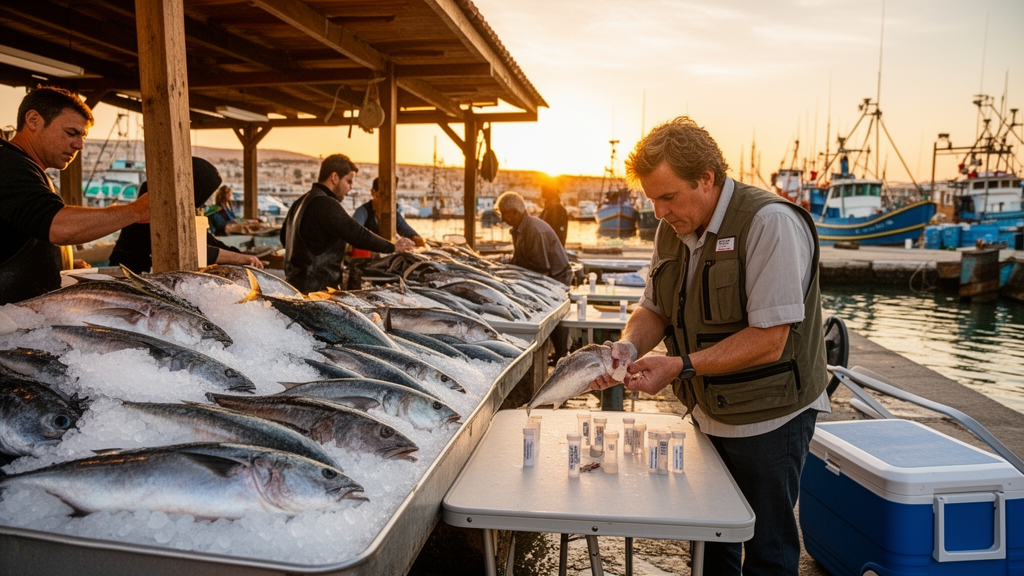
The study material comprised 40 specimens representing 37 species from Oman and 11 specimens representing 11 species from Saudi Arabia. Fish were obtained at eight coastal localities on the Arabian Peninsula. At major markets, including those in Jeddah and Muscat, researchers either approached fishermen as they landed their catch or selected very fresh fish whose origins sellers had carefully verified. The sampling procedure was intended to obtain specimens from small-scale fisheries near those markets, although the dataset remains limited to market-sourced material from two countries.
Each fish was photographed, measured, weighed and fin-clipped. Fin clips were placed immediately in 96% ethanol to limit DNA degradation and stored at −20 °C until extraction. DNA was recovered with the cetyl trimethyl ammonium bromide method, using overnight incubation at 60 °C with CTAB buffer and Proteinase K. DNA was separated with chloroform-isoamyl alcohol, precipitated with isopropanol at −20 °C for at least six hours, washed with cold 76% ethanol, air-dried and resuspended in TE buffer.
COI data were generated with both Sanger sequencing and next-generation sequencing on an Illumina platform. Barcoding amplification used several primer combinations, while selected specimens underwent long-range amplification intended to recover mitochondrial genomes. PCR products were checked on 2% agarose gels for short products and 0.8% gels for long products. The Illumina library used double multiplexing and combined teleost, elasmobranch, foraminifer, crustacean, insect, fern and mammal samples. Only the COI gene was included for specimens from which complete mitochondrial genomes were not recovered.
Raw Sanger sequences were imported into Geneious Prime 2024.0.5, screened for quality and manually inspected where reads were low quality or contained ambiguous bases. Forward and reverse reads were aligned, and overlapping regions were trimmed to create a consensus sequence for each specimen. Reads were mapped to GenBank references, while consensus sequences underwent quality control and annotation with MitoAnnotator. The specimen table reports sequence lengths ranging from 634 to 1,557 base pairs.
Initial identifications were based on morphological examination of meristic and morphometric characteristics, colouration patterns and other diagnostic features. The researchers consulted specialized taxonomic literature and, when necessary, compared specimens with verified museum specimens and authoritative descriptions. Consensus sequences were then compared with records in BOLD and NCBI GenBank using BLAST to check and refine the preliminary species assignments.
Where molecular and morphological identifications disagreed or remained uncertain, specimens were re-evaluated using published species distributions, regional occurrence records and sample provenance. Only assignments considered robust after this integrative review were retained. Cleaned COI sequences and associated species and locality metadata were exported in FASTA format and submitted to BOLD. The accession identifiers provide access to supporting information such as specimen photographs, primers and electropherograms, while skeletal voucher specimens are held in the Muséum National d’Histoire Naturelle except for two Sphyrna lewini specimens that were not collected because of their large size.
An assessment of BOLD species representation at the time of submission found no previous records for P. marisrubri, S. lactomaculata and S. zufar, making the new sequences their only representation in that comparison. Several other taxa remained sparsely represented, with fewer than 10 records: Bolbometopon muricatum, Cetoscarus bicolor, Hipposcarus harid, Scarus fuscopurpureus, Scarus ghobban, Trachurus indicus and Velifer hypselopterus. The study increased the available records for Dermatolepis striolata from one to two. These additions expand taxonomic and geographic coverage for a region whose fish genetic data were described as uneven and comparatively limited, but the 51-specimen dataset does not represent the full diversity or distribution of fishes across the Red Sea, Arabian Sea or wider Arabian Peninsula.
Subject of Research: Regional reference dataset of fish mitochondrial COI sequences from Arabian Peninsula markets
Article Title: Fish mtDNA COI sequences from local fish markets in the Red Sea and Arabian Sea: A reference dataset
Article References: Jiménez Cano, N. G., Dettaï, A., Mansoor Al-Nabhani, H., Abu El-Regal, M., Al-Jabri, A., & Béarez, P. (2026). Fish mtDNA COI sequences from local fish markets in the Red Sea and Arabian Sea: A reference dataset. ZooKeys, 1291, 195-204. https://doi.org/10.3897/zookeys.1291.181633
Image Credits: AI Generated
DOI: 10.3897/zookeys.1291.181633
Keywords: fish genetics, mitochondrial COI, DNA barcoding, Red Sea, Arabian Sea, Oman, Saudi Arabia, BOLD database, marine biodiversity, Fish, mtDNA, sequences
News Source: Juliet Wilcox. (October 20, 2026). Fish mtDNA COI sequences from local fish markets in the Red Sea and Arabian Sea: A reference dataset. Scienmag.