An integrative taxonomic study combining detailed fungal morphology with DNA sequence analysis has identified two new species in Cortinarius section Telamonia: Cortinarius linzhiensis and Cortinarius pallidomarginatus. The investigation was based on four specimens collected in July and August 2025 from forests in the Xizang Autonomous Region and Yunnan Province, China, and was not a comprehensive survey of Cortinarius diversity in either region.
The specimens were gathered during macrofungal fieldwork in the Yarlung Zangbo Grand Canyon National Nature Reserve in Xizang and border counties of Yunnan. Researchers examined macroscopic and microscopic features, including the cap, gills, stem, basidiospores, basidia, marginal elements and pileipellis. Dried material was mounted in 5% potassium hydroxide for microscopy, with Congo red used to facilitate observation, while scanning electron microscopy was used to examine spore ornamentation. The specimens were deposited in the Herbarium of Cryptogams of the Kunming Institute of Botany, Chinese Academy of Sciences.
DNA was extracted from the fruiting bodies, and the nuclear ribosomal internal transcribed spacer region, ITS, and nuclear ribosomal large subunit region, nrLSU, were amplified and sequenced. The dataset contained 64 sequences representing 22 species: eight newly generated sequences and 56 sequences downloaded from other sources. It included 54 ITS and 10 nrLSU sequences and produced a combined alignment of 1,555 characters, including gaps.
Maximum-likelihood and Bayesian phylogenetic analyses yielded similar tree topologies, and both new species clustered within section Telamonia. Section Tragani was selected as the outgroup. The authors considered the placements consistent with several diagnostic section-level traits, including weakly hygrophanous caps with dense fibrillose squamules, fibrous-scaly stems, white to dirty-white veils that can form a ring, moderately verrucose ellipsoid to amygdaliform spores, and a duplex pileipellis. Some placements had relatively low bootstrap support.
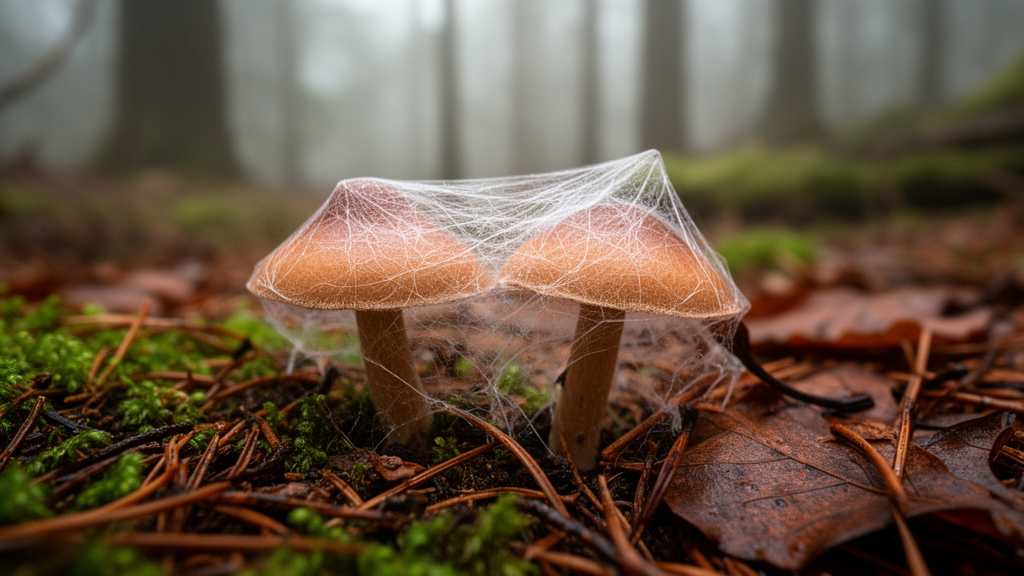
Cortinarius linzhiensis was represented by a holotype collected at 3,420 meters in a mixed forest of Quercus aquifolioides and Picea likiangensis var. linzhiensis in Lulang Town, Linzhi City, and by an additional specimen from Picea-dominated forest at 3,815 meters. Its medium-sized fruiting bodies have caps 40–90 millimeters wide that are light brown to dark brown, wrinkled, weakly hygrophanous and densely covered with fibrillose squamules. The cap margin can crack halfway up the cap and bears grayish-white, spiderweb-like veil remnants.
The C. linzhiensis stem is dirty white, sometimes with a pale purple tint at the apex, and bears brown fibrillose squamules and a pale yellow ring. Its basidiospores measured (8–)8.5–10(–11) × 5.5–7(–7.5) micrometers, with a mean length-to-width ratio of 1.47 ± 0.08. The pileipellis has a weakly developed epicutis 15–45 micrometers thick. Phylogenetic analysis placed the species as sister to C. lijiangensis, although with moderate bootstrap support. By comparison, C. lijiangensis has a maroon cap and stem, an evanescent arachnoid annulus and a thicker epicutis of 140–230 micrometers.
The two C. linzhiensis collections differed by two nucleotide substitutions and insertion–deletion sites in their ITS sequences, as well as in cap color and pigmentation of the stem apex. The authors interpreted these differences as intraspecific variation associated with differences in altitude and host-forest environment rather than as diagnostic characters, and therefore treated the collections as conspecific.
Cortinarius pallidomarginatus was collected at 1,770 meters in a broad-leaved forest dominated by Castanopsis, Lithocarpus and Cyclobalanopsis in Houqiao Town, Tengchong City, Yunnan. Its 40–60-millimeter cap is weakly hygrophanous and reddish brown, with a white margin, reddish-brown spiderweb-like veil remnants and dense fibrillose squamules. Its gills are reddish brown, and its stem is light reddish brown. Basidiospores measured (8–)8.5–10 × (5.5–)6–7 micrometers, with a mean length-to-width ratio of 1.43 ± 0.06, and were brown in potassium hydroxide with moderately verrucose ornamentation.
Phylogenetic analysis placed C. pallidomarginatus in a sister clade to a misidentified C. torvus-like lineage, with low bootstrap support, and showed it as closely related to C. subionophyllus and C. ultimiionophyllus. Morphologically, its reddish-brown cap with a white margin distinguishes it from those two species, which have grayish-purplish-brown to ochraceous-brown caps without white margins. The analysis also exposed unresolved taxonomy within Telamonia: some sequences labeled C. torvus formed separate clades, including one clustering with C. tigrinipes, indicating possible misidentification or misapplication of the name.
Because many published reference species of section Telamonia lack publicly available sequences for the protein-coding loci RPB1, RPB2 and TEF1-α, the researchers selected ITS plus nrLSU for the primary reconstruction to maximize taxon coverage. Newly obtained sequences for the three protein-coding loci provided supplementary evidence for the independent evolutionary status of the new species. The conclusions remain bounded by a sample of only four specimens, relatively low bootstrap support for some placements, and limited availability of high-resolution reference sequences.
Subject of Research: Integrative taxonomy of two new Cortinarius section Telamonia species from southwestern China
Article Title: Integrative taxonomy reveals two new species of Cortinarius section Telamonia ( Cortinariaceae , Agaricales ) from southwestern China
Article References: Li, T.-S., Zhang, Y., Yang, Y.-Y., Guan, H.-B., Wu, F., & Zhao, Q. (2026). Integrative taxonomy reveals two new species of Cortinarius section Telamonia (Cortinariaceae, Agaricales) from southwestern China. MycoKeys, 138, 149-162. https://doi.org/10.3897/mycokeys.138.186765
Image Credits: AI Generated
DOI: 10.3897/mycokeys.138.186765
Keywords: Cortinarius, Telamonia, fungal taxonomy, new species, mushroom morphology, ITS sequencing, nrLSU sequencing, phylogenetics, Xizang, Yunnan, Integrative, taxonomy
News Source: Drew Townsend. (October 20, 2026). Morphology and DNA analysis identify two new Cortinarius section Telamonia species from southwestern China. Scienmag.