Subterranean sampling devices, or SSDs, are vertically buried PVC tubes with side holes and a pitfall trap at the bottom, and they are considered the most suitable method for collecting arthropods living in the superficial subterranean environment known as the Milieu Souterrain Superficiel, or MSS. Yet a nagging doubt has shadowed the method since its adoption: what if surface-active species that bump into the tube from the outside simply follow it downward and eventually fall through a side hole into the trap at depth? Now a team working in the Swiss National Park has checked, for the first time, whether standard SSDs really capture only the invertebrates naturally active at the depths they are supposed to represent.
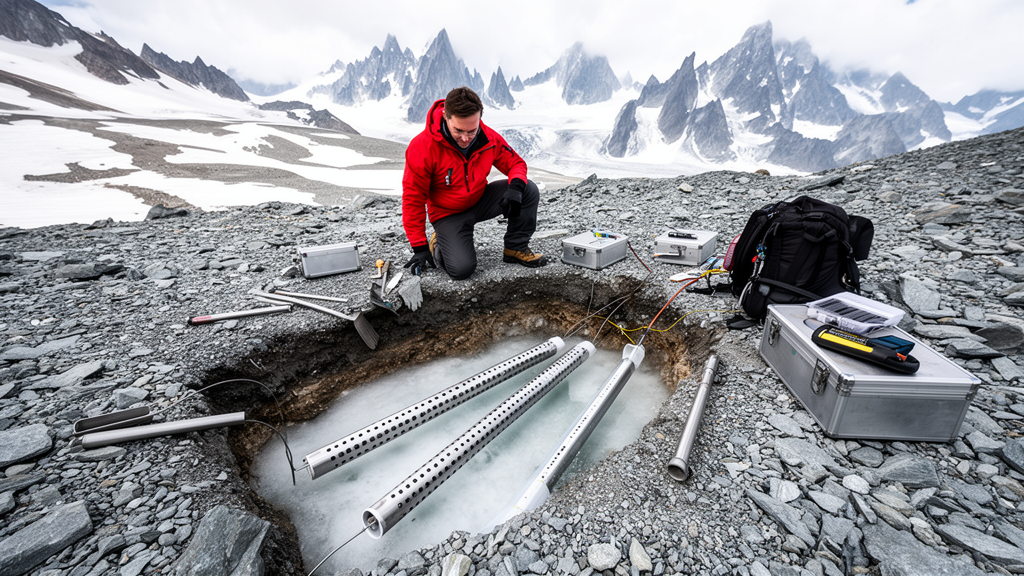
Rock glaciers provide cold and stable habitats for terrestrial invertebrates and are regarded as climate refugia for mountain biodiversity, but their arthropod communities remain severely understudied even as global warming threatens the ice that sustains them. The Valletta rock glacier has a north-facing tongue, is 700 m long and 350 m wide, and spans elevations between 2490 and 2660 m above sea level with an average slope of 22 percent. Standard SSDs consist of a 1 m long, 11 cm diameter PVC tube buried vertically with its opening sealed at ground level.
Between 40 and 90 cm depth, the tube wall is pierced with numerous 8 mm holes through which invertebrates can enter, and a plastic cup holding propylene glycol as a preservative sits at the bottom as a pitfall trap. The researchers reasoned that if these standard tubes are depth-specific, their catches should resemble those of short sections of the same tubing buried so that they only capture arthropods within a narrow depth band, and should differ from catches in the uppermost layer of the scree. To test this, the team buried one standard SSD and a set of three short SSDs at each of three sites on the dolomite scree of the Valletta rock glacier, at 2533, 2590 and 2645 m above sea level, with 290 m between neighboring sites.
Each short SSD was a 45 cm long section of standard tubing, equipped with holes over a distance of only 20 cm, so that the top 15 cm and bottom 10 cm of the tube had no openings. Buried at three different depths, the short SSDs collected invertebrates in defined ranges of 15 to 35 cm, 40 to 60 cm and 70 to 90 cm. Within each site, the standard tube and the three short sections were placed just 3 to 9 m apart, and a nylon cord attached to each short SSD allowed the buried devices to be found again.
All traps operated for 341 days, from 16 July 2021 to 22 June 2022, spanning a full year of seasonal activity in the scree. When the traps were emptied, sorted and identified by experts across seven taxonomic groups, the haul revealed individuals of 11 arthropod species and one gastropod species. Three species dominated the catches while all others were represented by only one to three individuals.
The most abundant was the millipede Pterygophorosoma alticolum, accounting for 68.6 percent of all individuals, followed by the ground beetle Oreonebria bremii at 24.2 percent and the pseudoscorpion Neobisium jugorum at 3.5 percent. In total, standard SSDs yielded 281 individuals, while the short SSDs at 15 to 35 cm, 40 to 60 cm and 70 to 90 cm produced 52, 57 and 43 individuals respectively. The statistical verdict came from two complementary analyses.
Analysis of similarity, a nonparametric permutation method that compares Bray-Curtis dissimilarities between and within groups, returned an R statistic of 0.34 with a p value of 0.039, indicating that the species composition of the standard SSDs and the deep short SSDs differed significantly from that of the shallow short SSDs at 15 to 35 cm. Permutational multivariate analysis of variance, based on 999 permutations of the untransformed raw data, confirmed that species composition varied with the depth range at which the devices operated, with an F statistic of 2.923 and a p value of 0.024. Pairwise comparisons with corrections for multiple testing showed that only the shallow short SSDs differed from the standard tubes, at p = 0.045.
Translated into plain terms, the catches of the standard SSDs faithfully represent the invertebrate species active at depths of 40 to 90 cm in the scree layer. Seven of the 11 arthropod species, including the three most abundant, were caught with the short SSDs between 40 and 90 cm, and five of these were also recorded with the standard SSDs. This proves that individuals of these species are naturally active in scree layers at depths of up to 90 cm, either permanently or during seasonal vertical migrations.
Crucially, surface-active species do not appear to follow the tube downward to enter the traps at deeper levels, so standard SSDs neither attract nor facilitate the capture of invertebrates from the surface or from the upper scree. The three dominant species are high mountain specialists of cold rocky environments. Pterygophorosoma alticolum is an alpine-nival millipede endemic to the Central Alps that does not occur below 2000 m above sea level, and its lower elevational limit is shifting upward in the study area, shrinking its total distribution and threatening its long-term survival.
Oreonebria bremii is the alpine ground beetle with the strongest preference for cold environments, endemic to the Central and Eastern Alps, with previously known westernmost populations recently reassigned to a different species. Neobisium jugorum is a pseudoscorpion endemic to the Alps, distributed from Austria to France at elevations of 1700 to 3520 m. The assumption that invertebrates captured with SSDs are naturally active at the investigated depth, rather than displaced from upper layers or the surface, has now been validated in the scree of a rock glacier.
Because the demonstrated depth specificity was confirmed at three different sites, the authors suggest it may also apply to SSDs in other types of superficial subterranean habitat, such as scree fields of volcanic or alluvial debris, giving the finding potential general validity.
Subject of Research: A first-ever field test in the Swiss National Park confirms that vertically buried subterranean sampling devices capture only the invertebrates naturally active deep in alpine rock glacier scree.
Article Title: Checking the depth specificity of a subterranean sampling device in alpine rock debris
Article References: Gilgado, J. D., Rusterholz, H.-P., & Baur, B. (2025). Checking the depth specificity of a subterranean sampling device in alpine rock debris. Subterranean Biology, 52, 135-142. https://doi.org/10.3897/subtbiol.52.158440
Image Credits: AI Generated
DOI: 10.3897/subtbiol.52.158440
Keywords: subterranean biology, rock glaciers, alpine biodiversity, sampling methods, Swiss National Park, arthropods, MSS, Checking, depth, specificity, subterranean, sampling
News Source: Margaret Porter. (October 20, 2026). Research report: Checking the depth specificity of a subterranean sampling device in alpine rock debris. Scienmag.