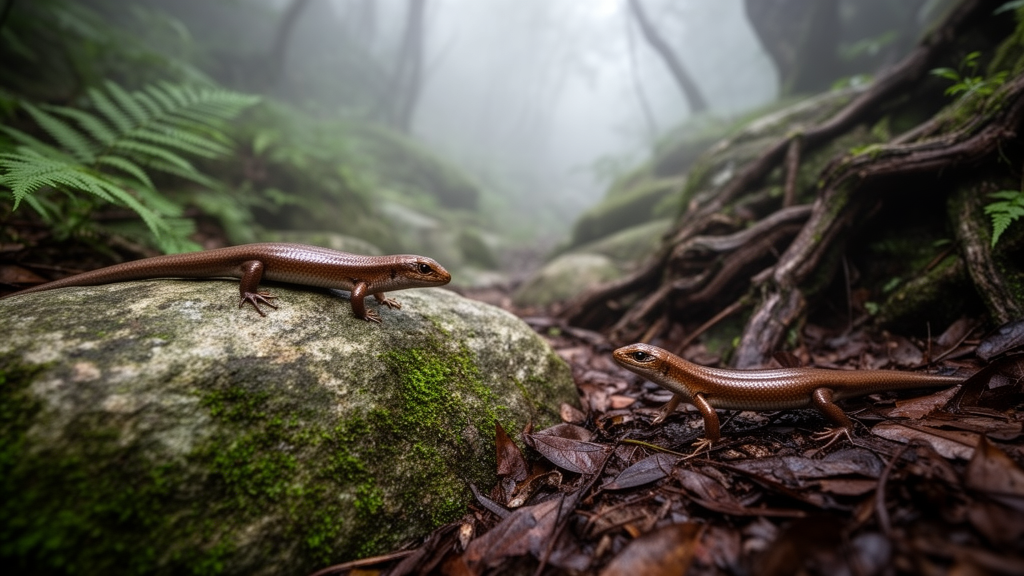
A zoological study combining morphological examination with molecular genetic analysis identified two previously undescribed species of the lizard genus Scincella in western Sichuan, China. The researchers described Scincella jinchuanensis and Scincella maerkangensis from specimens collected in Jinchuan County and Maerkang City, respectively, bringing the authors’ totals to 53 recognized species of Scincella worldwide, including 19 recorded in China.
The new species were identified from a collection of 10 specimens, six from Jinchuan County and four from Maerkang City in Sichuan’s Aba Tibetan and Qiang Autonomous Prefecture. Both localities lie in the northern Hengduan Mountains, a region on the eastern Qinghai–Xizang Plateau with pronounced elevational gradients and high biodiversity. Before the descriptions, 16 species of Scincella were recognized in China, including 10 documented in Sichuan Province.
Following the extraction of liver tissue, the specimens were fixed in 10% formaldehyde for three days and transferred to 80% ethanol for long-term preservation. Liver samples were stored in 85% ethanol at −80 °C, and all specimens and samples were deposited at Yibin University. Morphological examinations measured body dimensions with a digital caliper to the nearest 0.1 mm and recorded scale counts and other meristic characters. The senior author collected all measurements to avoid inter-observer bias, while comparison data for other Scincella species came from published studies.
The molecular analysis used three mitochondrial DNA fragments: 16S ribosomal RNA, 12S ribosomal RNA and cytochrome c oxidase subunit I, or COI. The final alignments contained 520 base pairs for 16S, 353 for 12S and 619 for COI. Maximum-likelihood and Bayesian analyses placed all sampled Scincella, including the unidentified specimens, within a strongly supported monophyletic group, with 100% bootstrap support and a Bayesian posterior probability of 0.95. The two proposed species formed a broader clade with S. heishuiensis, S. wangyuezhaoi and other recently described species.
Scincella jinchuanensis was most closely associated with S. heishuiensis, which together formed a strongly supported sister lineage, with 100% bootstrap support and a posterior probability of 1.00. Its diagnosis includes six dorsal scale rows between the dorsolateral stripes, 28 midbody scale rows, 17–18 enlarged undivided lamellae beneath the fourth toe and 23–25 gular scales. The adult male holotype had a snout–vent length of 40.01 mm and a tail length of 73.59 mm. In life, it had a bronze dorsum with black spots, a continuous lateral stripe and a silver-gray to silver-white underside.
Scincella maerkangensis was distinguished by four dorsal scale rows between the dorsolateral stripes, 24 midbody scale rows, 14–15 enlarged undivided lamellae beneath the fourth toe and 24 gular scales. Its adult female holotype measured 50.18 mm in snout–vent length and 71.90 mm in tail length, giving a tail-length-to-snout–vent-length ratio of 1.43. In life, the holotype had a copper-colored dorsum with three longitudinal bands of black spotting, pale gray flanks and a silver-gray venter. It also differed from S. wangyuezhaoi in coloration, midbody scale-row count, dorsal scale rows between the dorsolateral stripes and the number of scale rows covered by the dorsolateral stripes.
The genetic results were consistent with recognition of two separate species. The uncorrected 16S distance between S. jinchuanensis and S. maerkangensis was 6.74%. Based on 16S sequences, the Jinchuan lineage differed from S. wangyuezhaoi by 5.12% and from S. heishuiensis by 3.82%; the Maerkang lineage differed from those species by 6.38% and 6.17%, respectively. Corresponding COI distances were 17.1% and 13.7% for the Jinchuan lineage and 14.8% and 14.6% for the Maerkang lineage. Morphological traits, including midbody scale rows, dorsal scale rows between the dorsolateral stripes, subdigital lamellae and coloration, further separated both lineages from named congeners.
The study was constrained by a small type series and by its reliance on three mitochondrial fragments for the phylogenetic analysis. Both new species were known only from their respective type localities when the work was completed, so the available specimens do not establish their full geographic distributions, population sizes or habitat requirements across the Hengduan Mountains. The authors also noted that higher-level classification within Scincella remains unresolved and that the taxonomic status of several recognized species requires further systematic investigation. They called for expanded specimen sampling, additional genetic markers and genomic-scale data to investigate diversification in the region.
The authors concluded that the morphological and molecular evidence supported separate identities for Scincella jinchuanensis and Scincella maerkangensis. They proposed the common names “Jinchuan ground skink” and “Maerkang ground skink,” respectively, and the Chinese names “金川滑蜥” and “马尔康滑蜥.” The specimens were reported from rocky areas near small shrublands, where the animals were observed using large rocks as shelter and basking on sunlit exposed surfaces.
Subject of Research: Description of two new Scincella lizard species from western Sichuan using morphology and mitochondrial DNA
Article Title: Two new species of the genus Scincella Mittleman, 1950 ( Squamata , Scincidae ) from southwestern China
Article References: Liu, F., Pu, H., Tan, S., Chen, J., Cai, B., Lyu, B., Shu, G., Wu, Y., & Guo, P. (2026). Two new species of the genus Scincella Mittleman, 1950 (Squamata, Scincidae) from southwestern China. Zoosystematics and Evolution, 102(2), 575-588. https://doi.org/10.3897/zse.102.184613
Image Credits: AI Generated
Keywords: Scincella, new species, taxonomy, western Sichuan, Hengduan Mountains, mitochondrial DNA, morphology, lizard diversity, species, genus, Mittleman, Squamata
News Source: Margaret Porter. (October 20, 2026). Morphological and mitochondrial DNA study identifies two new Scincella species in western Sichuan. Scienmag.